Muzzle for Dogs to Stop Chewing: When It Helps, When It Doesn’t, and What to Use Instead
A muzzle can help manage access to dangerous objects, but it is not automatically the right solution for destructive chewing. Learn the difference between chewing, scavenging, and swallowing—and choose the right approach for your dog.
Muzzle for Dogs to Stop Chewing: Table of Contents
Jump directly to the section that matches your dog's chewing, scavenging, training, or muzzle-selection problem.
Tip: The most important sections are the difference between destructive chewing and scavenging, muzzle limitations, and the muzzle features that matter for your dog's specific behavior.
Why Do Dogs Chew Things They Shouldn't?
Chewing is a normal part of canine behavior, but the reason behind inappropriate chewing can vary. Understanding the cause helps you decide whether you need better management, more appropriate outlets, training, or a different solution altogether.
Chewing itself is normal. Chewing the wrong things is the problem.
Puppies and adult dogs naturally use their mouths to explore, play, investigate objects, and satisfy their need to chew. The challenge is teaching the dog which objects are appropriate while reducing access to things that can be damaged or swallowed.
Teething
Puppies often chew more intensely while their adult teeth are developing. Mouth discomfort and curiosity can make furniture, shoes, clothing, and other objects especially tempting.
Boredom or Too Little Stimulation
A dog without enough physical activity, mental stimulation, or appropriate things to do may create its own entertainment. Chewing can become an easy way to occupy time.
Stress, Anxiety, or Frustration
Some dogs become destructive when they are experiencing stress, frustration, fear, or anxiety. The pattern can be especially noticeable during particular situations, such as confinement or being left alone.
Exploration and Curiosity
Dogs investigate the world with their mouths. Smell, texture, movement, taste, and novelty can all make an object interesting, especially when the dog has easy access to it.
Attention or Learned Reinforcement
Some dogs discover that grabbing or chewing a forbidden object reliably produces a response from their owner. Repeated interactions can unintentionally strengthen the behavior.
Food-Seeking Behavior
Some dogs direct destructive behavior toward objects that smell like food or may be associated with food. A pattern that seems unusual or persistent deserves a closer look.
When does your dog chew?
The timing and location of the behavior can provide useful clues about what may be contributing to it.
Consider whether separation-related stress or anxiety could be involved.
Increase appropriate physical and mental enrichment.
Teething and exploration may be important contributors.
The behavior may be moving from destructive chewing toward scavenging or object grabbing.
Ask what happens after your dog grabs the object.
The dog destroys or mouths the object but does not attempt to swallow it.
The behavior is becoming more closely related to scavenging and access management.
The safety concern increases because the object can become a gastrointestinal foreign body.
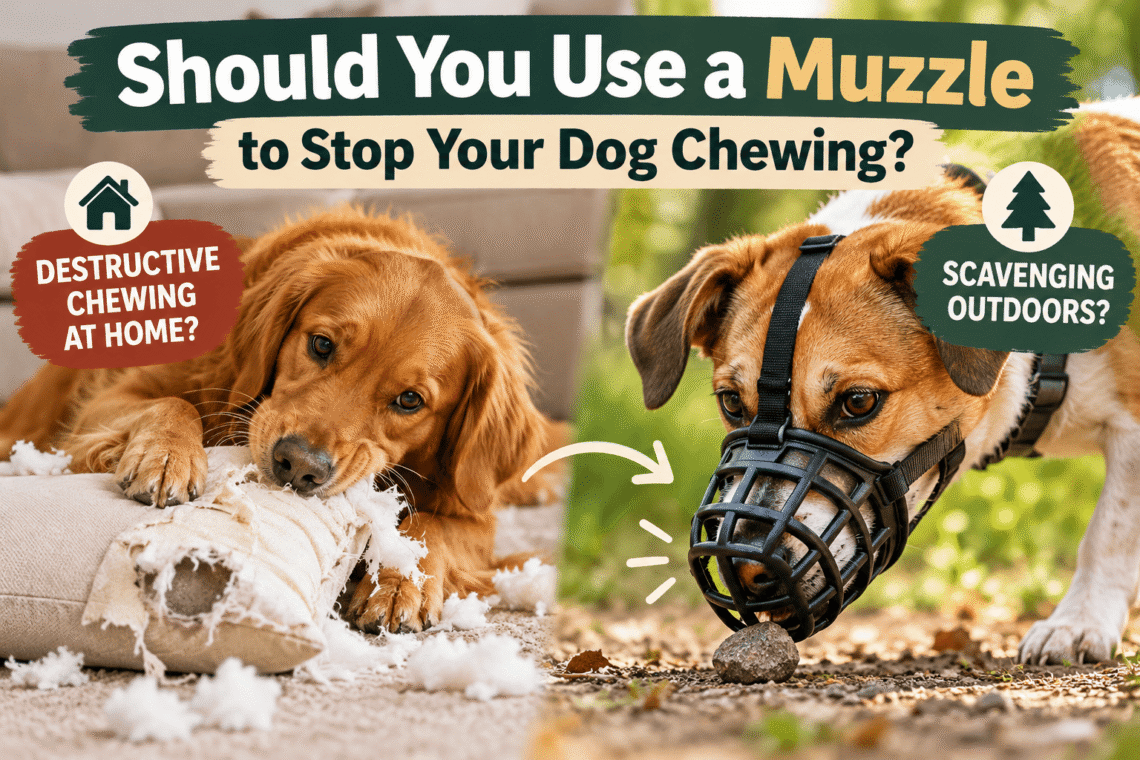
A muzzle should not be used simply because a dog chews furniture.
For ordinary destructive chewing, environmental management, appropriate chew outlets, enrichment, supervision, and training are central. A muzzle becomes a different conversation when the dog is using its mouth to repeatedly grab or swallow potentially dangerous objects.
Can a Muzzle Actually Stop Chewing? →Before buying a muzzle, let's look at what a muzzle can—and cannot— actually prevent.
Can a Muzzle Actually Stop a Dog From Chewing?
Not in the way many owners expect. A muzzle can physically limit access to objects, but it does not teach a dog what to chew, remove boredom or anxiety, or fix destructive behavior by itself.
A muzzle manages access. It does not “cure” chewing.
Veterinary behavior guidance specifically distinguishes ongoing destructive chewing from situations where a dog scavenges or swallows inappropriate objects outdoors. A properly fitted basket muzzle may help with the latter, while destructive chewing usually needs behavior and environmental management.
Limit access
Reduce a dog's ability to pick up certain objects from the ground.
Help manage outdoor scavenging when training alone isn't enough.
Add another layer of prevention for dogs that repeatedly ingest unsafe objects.
Reduce opportunities to rehearse inappropriate object-grabbing behavior.
Fix the underlying cause
Teach a dog which household objects are appropriate to chew.
Solve boredom or inadequate enrichment.
Treat anxiety or separation-related behavior.
Replace supervision, environmental management, or training.
What happens after your dog gets the object?
This distinction can help determine whether you are dealing mainly with destructive chewing or with a scavenging and ingestion problem.
Your dog grabs an object but does not try to swallow it.
Your dog destroys or mouths furniture, shoes, toys, or similar objects.
Your dog consumes rocks, plastic, garbage, sticks, fabric, or other non-food items.
When can a muzzle actually be useful?
The situation is different when the dog is using its mouth to repeatedly grab or swallow dangerous objects outdoors.
A dog repeatedly picking up or swallowing rocks may benefit from additional access management.
Outdoor scavenging can make it difficult to prevent access to discarded food and other objects.
Some dogs repeatedly pick up objects during walks despite active supervision and training.
Veterinary guidance may include basket muzzle training as part of a broader prevention strategy for some dogs.
The muzzle works best as part of a larger plan
Remove or block access to inappropriate objects where practical.
Watch for the behavior and intervene before an unsafe object is swallowed.
Teach useful cues such as “leave it” and reinforce appropriate alternatives.
Add appropriate access management when the situation calls for another layer of prevention.
A basket muzzle is different from a muzzle that simply holds the mouth closed.
Cornell describes basket muzzles as suitable for situations where a dog needs longer access management because a properly fitted basket allows panting, drinking, and treats. Soft or sleeve-style muzzles restrict mouth opening and are intended for more temporary situations.
Compare Basket vs. Soft Muzzles →“Am I trying to stop chewing—or prevent access to something dangerous?”
If the answer is destructive chewing, concentrate on the cause, appropriate chewing outlets, supervision, and behavior modification. If the answer is repeated outdoor scavenging or object ingestion, a properly fitted basket muzzle may be one part of the management plan.
The next section compares destructive chewing with scavenging so you can determine which type of problem your dog is actually showing.
Destructive Chewing vs. Scavenging: What's the Difference?
“My dog won't stop chewing” can describe two very different problems. A dog that destroys furniture at home needs a different solution from a dog that grabs rocks, trash, sticks, or other objects during walks. Understanding the difference helps you decide whether a muzzle belongs in the plan at all.
The key distinction: destructive chewing is usually about the dog interacting with an object by chewing it, while scavenging becomes much more concerning when the dog repeatedly picks up and potentially swallows inappropriate objects. A muzzle may help manage access to dangerous outdoor objects, but it is not a treatment for the underlying behavior.
Destructive Chewing
This usually means the dog is chewing household or otherwise inappropriate items, such as furniture, shoes, bedding, doors, or other belongings.
- Often happens indoors or in familiar environments
- Can be associated with teething, boredom, exploration, frustration, or anxiety
- Management and access control are important
- Appropriate chew outlets and behavior training are part of the solution
- A muzzle should not be treated as the primary fix for ongoing destructive chewing
Outdoor Scavenging
Scavenging is more about seeking out, picking up, and sometimes swallowing objects or substances found in the environment.
- Commonly occurs on walks, in yards, parks, or other outdoor areas
- The target may be rocks, garbage, sticks, discarded food, or other objects
- The safety issue can be access to something harmful rather than chewing itself
- Supervision and training remain important
- A properly fitted basket muzzle can sometimes provide an additional layer of management
Ask What Happens After Your Dog Finds the Object
Picks It Up
Your dog notices an object and immediately puts it in the mouth.
Chews It
The dog then gnaws, tears, or plays with the item without necessarily trying to swallow it.
Swallows It
The behavior becomes more urgent when inappropriate objects are repeatedly ingested or the dog attempts to gulp them down.
Why this matters for muzzle selection: a dog that destroys a couch is not automatically a candidate for a muzzle. By contrast, a dog that repeatedly tries to ingest dangerous objects outdoors may benefit from basket-muzzle management alongside supervision and training. Veterinary guidance specifically discusses basket muzzles for dogs that ingest inappropriate objects because properly fitted basket designs can allow panting, drinking, and treats.
- ASPCA — Destructive Chewing: ASPCA.org
- American Kennel Club — When, Why, and How to Correctly Use Dog Muzzles: AKC.org
- Cornell University College of Veterinary Medicine — Muzzle Choices: Cornell Veterinary Medicine
- Cornell University College of Veterinary Medicine — Gastrointestinal Foreign Body Obstruction: Cornell Veterinary Medicine
When Can a Muzzle Help With Chewing?
A muzzle can be useful when “chewing” is really part of a bigger access problem—especially when your dog repeatedly grabs or ingests unsafe objects outside. In that situation, the muzzle is a management tool that helps prevent access while training and supervision address the behavior itself.
The most useful way to think about it: don't use a muzzle simply because a dog likes to chew. Consider one when preventing access to a specific dangerous object is part of the safety plan, and choose a design that allows normal panting and drinking when it needs to be worn.
Repeatedly Picking Up Rocks or Stones
Some dogs repeatedly seek out rocks and other hard objects outdoors. When a dog is difficult to redirect and there is a realistic risk of ingestion, a properly fitted basket muzzle can provide an additional barrier to those objects.
Garbage, Food Scraps, or Litter
A dog that races toward discarded food or trash may ingest something dangerous before a handler can intervene. In these situations, muzzle management can help reduce access while “leave it,” recall, and environmental management are being reinforced.
Sticks and Other Outdoor Objects
For dogs that habitually grab sticks or other inappropriate objects on walks, the goal is not to stop the dog from chewing altogether. The goal is to reduce access to objects that may create a safety problem.
Dogs That Repeatedly Swallow Objects
Repeated ingestion of non-food objects deserves particular attention because swallowed material can cause serious gastrointestinal problems. A basket muzzle may be considered as one layer of prevention when other management measures are not enough.
Example: Two Dogs, Two Different Solutions
A Muzzle Makes More Sense When…
Important: a muzzle should not become a substitute for supervision, training, or solving the underlying cause of destructive behavior. Veterinary and canine-behavior guidance generally treats muzzles as management tools, not as a way to correct ongoing behavioral problems such as destructive chewing.
- Cornell University College of Veterinary Medicine — Muzzle Choices: Cornell Veterinary Medicine
- Cornell University College of Veterinary Medicine — Basket Muzzle Training: Cornell Veterinary Medicine
- Cornell University College of Veterinary Medicine — Gastrointestinal Foreign Body Obstruction: Cornell Veterinary Medicine
- American Kennel Club — When, Why, and How to Correctly Use Dog Muzzles: AKC.org
- ASPCA — Destructive Chewing: ASPCA.org
When Shouldn't You Use a Muzzle for Chewing?
A muzzle can prevent a dog from accessing certain objects, but that does not make it a general-purpose solution for chewing. For many dogs, putting on a muzzle simply changes what the dog can reach without addressing why the chewing is happening.
The clearest rule: don't use a muzzle as a substitute for solving ordinary destructive chewing. If the dog is chewing furniture, shoes, bedding, doors, or similar household items, the underlying cause needs attention rather than simply blocking the mouth.
Your Dog Chews Furniture at Home
Furniture chewing is usually better addressed through management, appropriate chew outlets, supervision, enrichment, and training. The fact that a muzzle prevents biting an object does not make it a treatment for the reason the dog wants to chew that object.
Your Dog Needs Normal Chewing Outlets
Dogs naturally use their mouths to explore and chew. A dog may need appropriate, size-appropriate chew options and better environmental enrichment rather than having normal oral behavior suppressed.
The Behavior Is Driven by Anxiety or Frustration
When chewing is connected with distress, isolation, frustration, or another behavioral trigger, simply restricting the mouth does not address the trigger. The behavior itself needs to be evaluated and managed appropriately.
You Need an All-Day “Chewing Fix”
A muzzle should not be treated as a way to leave a dog unsupervised for long periods just because the dog chews. Muzzle use needs to match the dog's needs, the muzzle's design, and the situation in which it is being used.
Signs That You May Be Solving the Wrong Problem
Don't Confuse “Stops Access” With “Solves the Behavior”
Important safety point: veterinary and canine-behavior guidance does not recommend using a muzzle simply to stop barking, chewing, or another ongoing behavior problem. A muzzle is a management device, so the fit, design, duration, and reason for use all matter.
- ASPCA — Destructive Chewing: ASPCA.org
- American Kennel Club — When, Why, and How to Correctly Use Dog Muzzles: AKC.org
- Cornell University College of Veterinary Medicine — Muzzle Choices: Cornell Veterinary Medicine
- American Kennel Club — Damaging Chews: AKC.org
Can a Dog Chew Through a Basket Muzzle?
A common concern from owners of persistent chewers is whether a dog can simply bite through the muzzle. The answer depends on the muzzle's construction, fit, and what the dog is actually trying to do. A basket muzzle is designed primarily to restrict access to objects while still allowing important normal behaviors such as panting and drinking when properly fitted.
What matters most: don't choose a muzzle based only on the phrase “anti-chew.” Look at the construction, the amount of room inside the basket, the strength and quality of the material, the security of the straps, and whether the dog can comfortably pant and drink.
Construction
A durable basket structure creates physical space between the dog's mouth and the objects around it.
Fit
An incorrectly fitted muzzle can shift, rub, or allow the dog to work against the edges.
Airflow
Basket-style designs are useful for appropriate longer-duration situations because they can permit normal panting and drinking.
Security
The muzzle needs to stay correctly positioned without becoming excessively tight or restricting normal breathing.
Three Things Often Confused With “Chewing Through” a Muzzle
For a Persistent Chewer, Check These Before Buying
Important: no muzzle should be treated as indestructible or as permission to leave a dog unsupervised with a newly introduced muzzle. A properly fitted basket muzzle is a management tool, and its suitability depends on the individual dog and the situation.
- Cornell University College of Veterinary Medicine — Muzzle Choices: Cornell Veterinary Medicine
- Cornell University College of Veterinary Medicine — Basket Muzzle Training: Cornell Veterinary Medicine
- American Kennel Club — When, Why, and How to Correctly Use Dog Muzzles: AKC.org
Basket Muzzle vs. Soft Muzzle for Chewing
For dogs that chew, bite at, or try to swallow objects, the difference between a basket muzzle and a soft muzzle is more than comfort or appearance. The design determines how much the dog can pant, drink, take treats, and move the mouth while wearing it.
For outdoor scavenging and object-ingestion management, a properly fitted basket muzzle is generally the type to investigate first. Soft or sleeve-style muzzles have a much more restrictive design and are intended for shorter periods rather than situations where a dog needs to pant, drink, or remain active.
Basket Muzzle
Basket muzzles create a physical barrier around the mouth while leaving an open area in front of the snout. When correctly fitted, they can allow normal panting, drinking, and delivery of treats.
- Better suited to outdoor management
- Allows substantially more mouth movement than a closed sleeve design
- Can allow panting and drinking when properly fitted
- Can be useful for dogs that try to ingest inappropriate objects
- Can support reward-based muzzle training
Soft or Sleeve Muzzle
Soft muzzles generally hold the mouth more closed. That makes them unsuitable for situations where a dog needs to pant freely, drink, or remain physically active for an extended period.
- More restrictive around the mouth
- Not the same choice as an open basket design
- Primarily associated with short-term use
- Not the preferred design for prolonged outdoor scavenging management
- Requires particular attention to duration and environmental conditions
Basket vs. Soft Muzzle at a Glance
Which Type Fits the Situation?
One important selection detail: don't assume that every basket muzzle is suitable for every dog or every situation. The opening, basket depth, material, straps, and overall fit all matter. A muzzle should be selected according to the dog's measurements and intended use—not simply because it is labeled “no-chew,” “anti-bite,” or “anti-scavenging.”
- Cornell University College of Veterinary Medicine — Muzzle Choices: Cornell Veterinary Medicine
- Cornell University College of Veterinary Medicine — Basket Muzzle Training: Cornell Veterinary Medicine
- American Kennel Club — When, Why, and How to Correctly Use Dog Muzzles: AKC.org
Why “Anti-Chewing Muzzle” Doesn't Always Mean What You Think
Product listings often use phrases such as “anti-chewing,” “no-chew,” “anti-biting,” or “anti-scavenging.” Those terms can sound interchangeable, but they may describe very different designs and intended uses.
“Anti-chewing” is a product-description term, not a guarantee that the muzzle will solve destructive chewing. Before buying, look past the headline and examine what the product is physically designed to prevent, how it fits, and whether it allows the normal behaviors your dog needs.
“No-Chew”
This phrase may simply mean that the dog has reduced access to an object while wearing the muzzle. It does not mean the dog's desire to chew has disappeared or that the underlying behavior has been corrected.
“Anti-Biting”
This generally describes restricting a dog's ability to bite. That is different from choosing a muzzle specifically for a dog that scavenges and attempts to swallow objects outdoors.
“Anti-Scavenging”
This wording is closer to the problem addressed by a basket muzzle used during walks: reducing access to environmental objects that the dog may attempt to pick up or ingest.
“Basket Muzzle”
This describes the physical design rather than the behavior. A basket muzzle can be used for several purposes, but its suitability still depends on fit, construction, and the individual dog's needs.
What the Label Doesn't Tell You
Use This Checklist Instead of Trusting the Product Name
A useful buying principle: choose the function first and the marketing label second. A dog that destroys household items needs behavior and environmental management. A dog that repeatedly ingests inappropriate outdoor objects may have a legitimate need for additional physical management, such as a properly fitted basket muzzle, alongside training and supervision.
- Cornell University College of Veterinary Medicine — Muzzle Choices: Cornell Veterinary Medicine
- Cornell University College of Veterinary Medicine — Basket Muzzle Training: Cornell Veterinary Medicine
- American Kennel Club — When, Why, and How to Correctly Use Dog Muzzles: AKC.org
- ASPCA — Destructive Chewing: ASPCA.org
What If My Dog Chews and Swallows Everything?
If your dog does more than chew—if they regularly swallow pieces of toys, rocks, fabric, sticks, trash, or other non-food objects—the main concern is no longer simply destructive chewing. Repeated ingestion can create a risk of choking or gastrointestinal obstruction and deserves a more careful management plan.
This is where a muzzle discussion becomes more relevant—but also more serious. Cornell Veterinary Medicine specifically includes basket muzzle training among prevention strategies for dogs that ingest inappropriate objects, particularly when other methods are unsuccessful. The muzzle should be treated as one layer of prevention rather than the entire solution.
Non-Food Objects
Rocks, clothing, pieces of toys, corn cobs, bones, and other non-digestible objects can become lodged in the gastrointestinal tract after being swallowed.
Repeated Ingestion
If your dog repeatedly searches for and swallows inappropriate objects, management should focus on preventing access as well as understanding why the behavior occurs.
Possible Medical Concern
Persistent eating of non-food items can have behavioral explanations, but veterinary guidance recommends considering medical causes when abnormal ingestive behavior is present.
Think of the Problem in Four Steps
Find the Target
Identify the objects your dog repeatedly seeks, chews, or attempts to swallow.
Reduce Access
Remove reachable objects at home and manage the outdoor environment as much as possible.
Train an Alternative
Work on behaviors such as leaving objects alone, releasing items, and responding to the handler.
Add a Safety Layer
When appropriate, a properly fitted basket muzzle can reduce access to dangerous objects during managed outdoor activities.
What the Dog Does Matters
When Swallowing Has Already Happened
If you know or strongly suspect that your dog has swallowed a foreign object, don't assume a muzzle will solve the immediate problem. A muzzle can help prevent the next object from being swallowed, but it cannot remove something that is already inside the digestive tract. Vomiting, loss of appetite, abdominal pain, diarrhea, dehydration, or lethargy can occur with gastrointestinal obstruction and should be taken seriously.
- Cornell University College of Veterinary Medicine — Gastrointestinal Foreign Body Obstruction in Dogs: Cornell Veterinary Medicine
- Cornell University College of Veterinary Medicine — Basket Muzzle Training: Cornell Veterinary Medicine
- Merck Veterinary Manual — Behavior Problems of Dogs: Merck Veterinary Manual
- Merck Veterinary Manual — Disorders of the Stomach and Intestines in Dogs: Merck Veterinary Manual
- ASPCA — Destructive Chewing: ASPCA.org
Is My Dog Chewing or Showing Signs of Pica?
Not every dog that chews an inappropriate object has pica. Chewing can be normal canine behavior that becomes destructive when the wrong object is targeted. Pica is different: it refers to persistent consumption of non-food substances and can warrant veterinary attention.
The important distinction is consumption. A dog that gnaws a stick and drops it is different from a dog that repeatedly seeks out and swallows non-food items. When ingestion is a recurring pattern, don't assume the solution is simply a stronger “anti-chewing” muzzle.
Ordinary or Destructive Chewing
Dogs naturally explore their environment with their mouths. Problematic chewing can be influenced by factors such as puppy teething, boredom, exploration, frustration, or other behavioral triggers.
- Dog chews an object without consistently swallowing it
- Behavior may occur during play or exploration
- Household objects may become targets
- Appropriate chew outlets can redirect the behavior
- Environmental management and training can reduce access to inappropriate items
Pica or Repeated Non-Food Consumption
Pica involves persistent consumption of non-food substances. Repeated ingestion can have medical or behavioral contributors, so the pattern should not be dismissed as simple chewing.
- Dog repeatedly seeks out non-food materials to consume
- The behavior happens across multiple situations or objects
- Swallowing is a consistent part of the behavior
- There may be a risk of gastrointestinal obstruction or other complications
- Veterinary assessment may be appropriate to investigate underlying causes
Patterns Worth Paying Attention To
Questions to Ask Before Buying a Muzzle
When Repeated Ingestion Deserves Veterinary Attention
Don't automatically label persistent object-eating as a training problem. Repeated consumption of non-food substances can have behavioral or medical contributors. A veterinarian can help determine whether further evaluation is appropriate, particularly when the behavior is persistent, escalating, or accompanied by digestive or other health changes.
- Merck Veterinary Manual — Behavior Problems of Dogs: Merck Veterinary Manual
- Merck Veterinary Manual — Pica in Animals: Merck Veterinary Manual
- Cornell University College of Veterinary Medicine — Gastrointestinal Foreign Body Obstruction: Cornell Veterinary Medicine
- ASPCA — Destructive Chewing: ASPCA.org
Muzzle Features That Matter for Dogs That Chew
Once you've established that your dog's problem involves scavenging or inappropriate-object ingestion, the next step is choosing a muzzle based on function. The right design should provide the needed barrier without unnecessarily restricting normal behaviors.
Don't start with the product name. Start with your dog's behavior, the objects you're trying to prevent access to, how long the muzzle will be worn, and whether your dog needs to pant, drink, take treats, and move comfortably.
Open Basket Design
An open basket provides a physical barrier while leaving space around the mouth. This is particularly relevant when the dog needs to pant and drink while wearing the muzzle.
Room to Pant
The muzzle should provide enough space for normal panting. This becomes especially important during walks, exercise, or warm weather.
Access to Water
For appropriate longer wear, choose a design that allows the dog to drink rather than treating water access as an afterthought.
Correct Sizing
Accurate measurements are essential. A muzzle that is too small can be restrictive, while a poor fit can shift or become less effective.
Six Features to Prioritize
Fit Matters as Much as the Material
Don't overvalue “toughest” construction. A highly rigid or restrictive muzzle is not automatically the right choice. The better match is the design that provides the necessary object-access control while still meeting the dog's breathing, drinking, comfort, and fit needs for the intended situation.
- Cornell University College of Veterinary Medicine — Muzzle Choices: Cornell Veterinary Medicine
- Cornell University College of Veterinary Medicine — Basket Muzzle Training: Cornell Veterinary Medicine
- American Kennel Club — When, Why, and How to Correctly Use Dog Muzzles: AKC.org
How to Choose a Muzzle for a Powerful Chewer
A strong dog that constantly works at a muzzle needs more than a product labeled “heavy duty.” The goal is to match the muzzle's construction and fit to the dog's strength and the actual problem you are trying to manage.
Think durable, but don't confuse durable with restrictive. A strong basket can provide a useful physical barrier, but the muzzle still needs enough space for normal panting, appropriate drinking, and comfortable movement. Fit remains just as important as material.
Look at Construction
Powerful dogs can place more force against straps, buckles, and the basket itself. Examine the complete construction rather than focusing on one material claim.
- Inspect the basket structure and connection points
- Look at how the basket attaches to the head straps
- Consider whether the material suits the dog's size and activity level
- Check whether adjustment hardware appears secure and robust
- Read the manufacturer's intended-use information
Prioritize Correct Fit
A durable muzzle can still perform poorly when the size is wrong. The dog should not be able to easily work the muzzle out of position, and the basket should provide sufficient breathing room.
- Measure before selecting a size
- Allow appropriate room in front of the nose
- Check that the dog can pant normally
- Make sure straps hold the muzzle securely
- Recheck the fit after the dog moves and walks normally
Powerful-Chewer Selection Checklist
Common Mistakes With Powerful Chewers
Remember what the muzzle is protecting against. If your powerful chewer is destroying furniture, the right answer is not simply finding the strongest muzzle. If the dog is repeatedly trying to eat dangerous objects outdoors, a durable and properly fitted basket muzzle may be one part of a broader safety and training strategy.
- Cornell University College of Veterinary Medicine — Muzzle Choices: Cornell Veterinary Medicine
- Cornell University College of Veterinary Medicine — Basket Muzzle Training: Cornell Veterinary Medicine
- American Kennel Club — When, Why, and How to Correctly Use Dog Muzzles: AKC.org
- American Kennel Club — Damaging Chews: AKC.org
How to Measure Your Dog for a Muzzle
Correct sizing is one of the most important parts of choosing a muzzle for a chewing or scavenging dog. A muzzle that is too small can restrict normal mouth movement, while one that is poorly fitted may shift and become less effective.
Don't guess from breed or weight alone. Muzzle sizing varies between manufacturers and between individual dogs. Use the measurements requested by the specific manufacturer, then compare them with the product's own sizing chart before ordering.
Muzzle Length
Many muzzle sizing systems ask for the distance from the area around the base of the nose to the front of the snout. Follow the manufacturer's exact measuring points because different brands can define the measurement differently.
Muzzle Circumference
Circumference measures around the dog's snout. This is particularly important for determining how much space the basket provides around the mouth and nose.
Snout Height
Some manufacturers also request the vertical height of the snout. This can help determine whether the basket has enough room for the dog's mouth to open for panting.
Head or Neck Measurements
Some designs use additional head or neck measurements to determine strap sizing and stability. Check the manufacturer's instructions rather than assuming one universal measurement system.
How to Get More Reliable Measurements
From Measurement to Correct Size
Measure
Record every measurement requested by the manufacturer.
Compare
Match your dog's numbers against that specific product's size chart.
Check the Design
Confirm the selected size still provides the panting and drinking space needed for the intended use.
Test the Fit
Once fitted, observe the muzzle during calm movement before relying on it outdoors.
Why the manufacturer's chart matters: there is no single universal muzzle-sizing formula. A “medium” from one manufacturer may not match a “medium” from another. Always follow the measurement points and sizing instructions supplied for the exact muzzle you are considering.
- Cornell University College of Veterinary Medicine — Muzzle Choices: Cornell Veterinary Medicine
- Cornell University College of Veterinary Medicine — Basket Muzzle Training: Cornell Veterinary Medicine
- American Kennel Club — When, Why, and How to Correctly Use Dog Muzzles: AKC.org
How Should a Muzzle Fit a Dog That Chews?
A muzzle should be secure enough to stay in the correct position without being so tight that it restricts normal breathing or causes unnecessary pressure. For a dog that chews or scavenges outdoors, fit also determines whether the muzzle continues to provide the intended barrier while the dog moves, pants, and drinks.
The goal is not the tightest possible fit. A good basket-muzzle fit provides enough room around the snout for normal panting while keeping the muzzle stable and preventing unnecessary rubbing, shifting, or escape from the equipment.
Room Around the Nose
The dog's nose should not be forced against the front of the basket. There should be appropriate space for the individual dog's snout according to the manufacturer's fitting guidance.
Enough Space to Pant
A basket muzzle intended for appropriate active use needs sufficient room for the mouth to open and the dog to pant normally.
Secure Without Excessive Tightness
The straps should hold the muzzle in place without relying on excessive pressure around the face or neck.
Stable During Movement
Walk your dog normally and observe whether the muzzle shifts significantly when the head turns, the dog sniffs, or the dog moves at a normal pace.
Drinking Remains Possible
A basket design selected for appropriate longer wear should allow the dog to reach water when necessary.
Minimal Unnecessary Rubbing
Check the areas around the nose and face for pressure or rubbing, especially after the dog has worn the muzzle while moving.
Quick Fit Check Before a Walk
How to Recognize a Potentially Poor Fit
Watch the Dog, Not Just the Muzzle
One more important point: fit is not necessarily permanent. Puppies grow, adult dogs can change in body condition, and different muzzle models have different dimensions. Recheck the fit whenever you change products or notice that the muzzle sits differently than it did previously.
- Cornell University College of Veterinary Medicine — Muzzle Choices: Cornell Veterinary Medicine
- Cornell University College of Veterinary Medicine — Basket Muzzle Training: Cornell Veterinary Medicine
- American Kennel Club — When, Why, and How to Correctly Use Dog Muzzles: AKC.org
How to Muzzle-Train a Dog That Hates Muzzles
A dog does not automatically understand that a muzzle is safe or comfortable. If your dog paws at it, backs away, freezes, or repeatedly tries to remove it, rushing straight to a long walk can make the equipment harder to accept. A gradual, reward-based introduction gives the dog time to build a positive association.
The basic principle: let the muzzle become familiar before asking your dog to wear it for longer periods. Keep early sessions easy, reward calm interaction, and progress only while the dog remains comfortable.
Show the Muzzle
Place the muzzle nearby and allow your dog to investigate it voluntarily without immediately putting it on.
Create a Positive Association
Use treats, praise, or another reward your dog values when the muzzle appears and when the dog calmly approaches it.
Introduce the Snout
Encourage the dog to place the nose toward or into the basket voluntarily. Do not force the muzzle onto the face.
Increase Time Slowly
Once the dog is comfortable, gradually increase wearing time before progressing to normal movement or outdoor activities.
A Simple Progression
Make the Muzzle Predict Good Things
What Not to Do During Muzzle Training
Basket muzzles are especially useful for reward-based training because a suitable basket design can allow treats to be delivered through the muzzle. This makes it easier to pair the equipment with positive reinforcement while gradually building duration and confidence.
- Cornell University College of Veterinary Medicine — Basket Muzzle Training: Cornell Veterinary Medicine
- Cornell University College of Veterinary Medicine — Muzzle Choices: Cornell Veterinary Medicine
- American Kennel Club — When, Why, and How to Correctly Use Dog Muzzles: AKC.org
What to Use Instead of a Muzzle for Destructive Chewing
When the real problem is destructive chewing at home, there are usually better ways to manage the behavior than trying to keep the dog's mouth occupied or restricted with a muzzle. The most useful approach combines access control, appropriate chewing outlets, enrichment, supervision, and training.
Start with the environment. If your dog can repeatedly rehearse chewing furniture, shoes, bedding, or other belongings, simply correcting the dog after the damage occurs is unlikely to be enough. Prevent access to tempting objects while teaching the dog what is appropriate to chew instead.
Dog-Proof the Environment
Move shoes, clothing, cables, trash, and other tempting objects out of reach. Use gates, closed doors, or other management tools where appropriate.
Provide Appropriate Chews
Give your dog suitable chew options selected for their size, age, and chewing style, and supervise use when an item can break into pieces.
Add Mental Enrichment
Puzzle activities, training sessions, food-based enrichment, play, and other appropriate activities can give a bored dog more productive ways to use time and attention.
Teach an Alternative Behavior
Reward the behaviors you want—such as settling, playing with an appropriate toy, or moving away from an inappropriate object.
Match the Solution to the Chewing Trigger
Build a Chewing-Friendly Daily Routine
A Practical “Chewing Prevention” System
Prevent Access
Remove or block access to items that repeatedly become chewing targets.
Offer an Outlet
Provide an appropriate chewing option that fits the dog's individual needs.
Reinforce Choices
Reward the dog when they choose the appropriate object or disengage from the wrong one.
Investigate the Cause
Look for patterns involving boredom, teething, frustration, anxiety, or repeated object-seeking.
One important distinction: alternatives to a muzzle are especially relevant for destructive chewing inside the home. They do not mean a muzzle is never useful. A dog that repeatedly swallows unsafe objects outdoors may still need a properly fitted basket muzzle as an additional management layer while training and environmental control continue.
- ASPCA — Destructive Chewing: ASPCA.org
- American Kennel Club — Damaging Chews: AKC.org
- American Kennel Club — When, Why, and How to Correctly Use Dog Muzzles: AKC.org
- Cornell University College of Veterinary Medicine — Basket Muzzle Training: Cornell Veterinary Medicine
Chewing Caused by Boredom, Teething, or Anxiety
Destructive chewing is easier to manage when you identify the pattern behind it. A puppy chewing during teething is not the same situation as an adult dog destroying objects after being left alone. The behavior may look similar, but the management strategy can be very different.
Look for the “when,” not just the “what.” Note what your dog chews, where it happens, when it happens, what occurs immediately beforehand, and what your dog does after chewing. Those details can reveal whether the behavior is linked to normal development, under-stimulation, frustration, anxiety, or simple access to tempting objects.
Teething
Young puppies naturally explore and chew with their mouths. Appropriate chew outlets and management of household objects can help guide this behavior toward suitable items.
Boredom
A dog with too little appropriate activity or enrichment may create its own entertainment by chewing objects that are easy to reach.
Anxiety or Stress
Some chewing patterns occur in situations involving stress, frustration, or being separated from the owner. The timing and surrounding behavior matter.
Exploration
Dogs investigate their environment with their mouths. Young or curious dogs may grab unfamiliar objects simply because they are accessible and interesting.
What the Pattern Can Tell You
Watch What Happens Immediately Before the Chewing
What to Change First
When the pattern changes suddenly, becomes extreme, or involves persistent non-food ingestion, involve a veterinarian. A new or unusual chewing pattern can sometimes warrant investigation rather than being assumed to be simple boredom or bad habits.
- ASPCA — Destructive Chewing: ASPCA.org
- Merck Veterinary Manual — Behavior Problems of Dogs: Merck Veterinary Manual
- American Kennel Club — Damaging Chews: AKC.org
- American Kennel Club — Puppy Chewing: AKC.org
When Chewing Becomes a Veterinary Concern
Many dogs chew as part of normal exploration, play, or development. The situation changes when chewing is accompanied by repeated swallowing of non-food objects, signs of illness, oral pain, or other unusual changes. At that point, choosing a muzzle should not be the only focus.
The biggest warning sign is ingestion. A dog that repeatedly swallows rocks, clothing, pieces of toys, bones, plastic, or other non-digestible material may be at risk of a gastrointestinal foreign body obstruction. Cornell Veterinary Medicine describes these obstructions as emergencies that often require prompt veterinary intervention.
Repeated Non-Food Eating
Persistent consumption of non-food materials should be evaluated rather than treated as ordinary chewing alone.
Vomiting or Appetite Loss
These can occur with gastrointestinal problems, including foreign-body obstruction, and deserve veterinary attention when associated with object ingestion.
Lethargy or Weakness
A dog that becomes unusually tired or unwell after swallowing an object should not be managed solely with a muzzle.
Abdominal Discomfort
Signs of abdominal pain or discomfort together with possible foreign-object ingestion can indicate a problem requiring prompt evaluation.
Contact a Veterinarian Promptly When You Notice…
Persistent Chewing Can Have Different Explanations
If Your Dog May Have Swallowed Something
Identify the Object
Note what you think was swallowed, approximately how much, and when it may have happened.
Watch for Symptoms
Pay attention to vomiting, appetite changes, diarrhea, lethargy, abdominal discomfort, or other unusual signs.
Contact Your Vet
Give your veterinarian the relevant details so they can advise you on the appropriate next step.
Don't Rely on the Muzzle
A muzzle can help prevent another object from being picked up; it cannot remove a foreign object that has already been swallowed.
Emergency situations need immediate veterinary attention. If a dog is having difficulty breathing, choking, collapsing, or showing severe distress, contact an emergency veterinary service rather than trying to solve the problem with a muzzle at home.
- Cornell University College of Veterinary Medicine — Gastrointestinal Foreign Body Obstruction in Dogs: Cornell Veterinary Medicine
- Cornell University College of Veterinary Medicine — Basket Muzzle Training: Cornell Veterinary Medicine
- Merck Veterinary Manual — Behavior Problems of Dogs: Merck Veterinary Manual
- American Kennel Club — Intestinal Blockage in Dogs: AKC.org
- American Kennel Club — Pica in Dogs: AKC.org
Best Muzzles for Dogs With Chewing or Scavenging Problems
There isn't one muzzle that is right for every dog that chews. The better choice depends on whether you're managing destructive chewing, outdoor scavenging, repeated object ingestion, a broad or short snout, or a dog that needs a more secure muzzle design.
For outdoor chewing and scavenging, focus on a properly fitted basket muzzle. The models below are organized by the situation they may suit rather than by a simple “number one” ranking. Always verify the manufacturer's sizing information before buying.
Baskerville ULTRA Muzzle
The Baskerville ULTRA is an open basket muzzle made from thermoplastic rubber. The manufacturer describes it as suitable for active use and says the basket can be reshaped in hot water for a more tailored fit.
- Basket-style design allows panting and drinking
- Can be reshaped with hot water for fitting
- Head strap provides additional stability
- Suitable for reward-based muzzle training
- Designed for active dogs and everyday walking situations
Baskerville CLASSIC Muzzle
The current Baskerville CLASSIC uses thermoplastic rubber and includes a removable guard insert intended to help prevent scavenging. It is specifically useful to investigate when picking up food, wildlife, rocks, or other objects is the main concern.
- Open basket design permits panting and drinking
- Includes an additional guard insert for scavenging management
- Improved TPR material can be reshaped
- Padded nose area for additional comfort
- Available in a broad range of sizes
Baskerville WIDE FIT Muzzle
A muzzle can fail even when the material is strong simply because the shape does not suit the dog's face. The Baskerville WIDE FIT is specifically designed around broad and shorter nose shapes.
- Designed for broad and short-nosed dogs
- Basket construction supports panting and drinking
- TPR material can be reshaped
- Padded construction for comfort
- Head strap adds additional security
JAFCO Dog Muzzle
JAFCO makes plastic muzzles in polyethylene and clear vinyl, with reinforced straps and multiple size options. The manufacturer specifically lists preventing dogs from eating rocks, garbage, poison, and similar objects among its uses.
- Polyethylene and clear-vinyl options
- Reinforced neoprene and nylon straps
- Optional third strap on applicable sizes
- Designed to allow panting and drinking
- Available in multiple size and face-shape configurations
Match the Muzzle to the Actual Problem
Important: these products are management tools, not cures for destructive chewing. For dogs that repeatedly ingest non-food objects, a muzzle should be one part of a broader safety and training plan. A dog that has swallowed a potentially dangerous object may need veterinary evaluation; buying a muzzle does not address an object that has already been swallowed.
- Company of Animals — Baskerville Muzzle FAQ: Company of Animals
- Company of Animals — Baskerville Classic Muzzle: Company of Animals
- Company of Animals — Baskerville Muzzle Range: Company of Animals
- JAFCO Muzzles — Dog Muzzles: JAFCO Muzzles
- JAFCO Muzzles — Products: JAFCO Muzzles
- JAFCO Muzzles — Sizing: JAFCO Muzzles
- Cornell University College of Veterinary Medicine — Basket Muzzle Training: Cornell Veterinary Medicine
Muzzle for Dogs to Stop Chewing FAQs
These questions address the most common confusion around using a muzzle for chewing, scavenging, and inappropriate-object ingestion.
Not as a solution to the underlying behavior. A muzzle may prevent access to some objects while it is being worn, but destructive furniture chewing should be addressed through environmental management, appropriate chew outlets, enrichment, supervision, and behavior training.
A properly fitted basket muzzle is generally the design to investigate for managed outdoor use because it can provide a barrier while allowing panting, drinking, and treat delivery when correctly fitted. The exact model still needs to match the dog's measurements and the objects being targeted.
A basket muzzle does not necessarily eliminate every mouth movement. Its purpose is to manage access to objects. Different basket shapes and openings allow different levels of interaction, so the actual design matters.
Not automatically. Soft muzzles are more restrictive around the mouth and are generally intended for shorter-term situations. They are not the same choice as an open basket design for active outdoor management where normal panting and drinking are important.
Many properly fitted basket muzzles are designed to allow drinking. Always check the specific model and fit rather than assuming every basket has identical dimensions or water access.
A restrictive muzzle that prevents normal panting is not appropriate for situations where the dog needs to pant. Basket muzzles are designed specifically to provide more room for mouth opening and panting when correctly fitted.
First check the fit and design. Then use gradual, reward-based muzzle training so the dog learns to comfortably wear it. Persistent pawing, rubbing, or attempts to remove the muzzle may mean the dog is uncomfortable or that the training progression is too fast.
A muzzle should not be treated as a simple substitute for supervision or as an all-purpose solution for destructive chewing. The design, fit, situation, and intended duration all matter. For ongoing chewing problems, address the cause and environment rather than relying on the muzzle alone.
No. A muzzle can be one management layer that reduces access to inappropriate objects, but persistent non-food ingestion can have behavioral or medical contributors. Veterinary evaluation may be appropriate when the pattern is recurring.
A muzzle cannot remove an object that has already been swallowed. Contact your veterinarian for guidance, especially when the object could cause an obstruction or when symptoms such as vomiting, appetite loss, lethargy, abdominal discomfort, choking, or breathing difficulty occur.
It should be secure enough to remain properly positioned without excessive tightness. The dog needs appropriate room inside the basket for normal panting, and the straps should keep the muzzle stable without unnecessary pressure.
Usually the more useful starting point is appropriate enrichment, activity, supervision, environmental management, and chew outlets. A muzzle may prevent access to some objects, but it does not provide the dog with a better alternative to boredom-driven chewing.
The Muzzle Decision in One View
The biggest takeaway: a muzzle can be very useful for preventing access to dangerous outdoor objects, but “muzzle for dogs to stop chewing” is not one single problem. The correct approach depends on whether your dog is destructively chewing, scavenging, or repeatedly swallowing inappropriate objects.
- Cornell University College of Veterinary Medicine — Muzzle Choices: Cornell Veterinary Medicine
- Cornell University College of Veterinary Medicine — Basket Muzzle Training: Cornell Veterinary Medicine
- Cornell University College of Veterinary Medicine — Gastrointestinal Foreign Body Obstruction: Cornell Veterinary Medicine
- American Kennel Club — When, Why, and How to Correctly Use Dog Muzzles: AKC.org
- ASPCA — Destructive Chewing: ASPCA.org
- Merck Veterinary Manual — Pica in Animals: Merck Veterinary Manual
So, Should You Use a Muzzle to Stop Your Dog Chewing?
The answer depends on what “chewing” actually means in your dog's case. A muzzle can be a useful management tool, but it is not a universal treatment for chewing behavior.
Use the muzzle to manage access—not to hide the behavior. For a dog that destroys furniture, shoes, bedding, or other household items, the better starting point is usually environmental management, appropriate chew outlets, enrichment, supervision, and behavior training. For a dog that repeatedly picks up and swallows dangerous objects outdoors, a properly fitted basket muzzle may provide an additional layer of protection while training and supervision continue.
Mostly Household Chewing?
Focus first on why the dog is chewing, what objects are available, and which appropriate activities can replace the unwanted behavior. A muzzle should not be the main solution for destructive chewing.
Mostly Outdoor Scavenging?
When the real issue is grabbing rocks, trash, discarded food, sticks, or other unsafe objects, a basket muzzle can be considered as one part of an outdoor safety plan.
Repeatedly Swallowing Objects?
Treat ingestion as a separate safety issue. Prevention, supervision, training, and veterinary guidance may all be important, especially when non-food items are repeatedly swallowed.
The Simplest Rule to Remember
Before You Buy a Muzzle, Check These Six Things
One Last Safety Reminder
A muzzle cannot undo an ingestion that has already happened. When a dog may have swallowed a potentially dangerous foreign object—or develops concerning symptoms such as vomiting, appetite loss, marked lethargy, abdominal discomfort, choking, or breathing difficulty—contact a veterinarian or emergency veterinary service promptly.
- American Kennel Club — When, Why, and How to Correctly Use Dog Muzzles: AKC.org
- Cornell University College of Veterinary Medicine — Muzzle Choices: Cornell Veterinary Medicine
- Cornell University College of Veterinary Medicine — Basket Muzzle Training: Cornell Veterinary Medicine
- Cornell University College of Veterinary Medicine — Gastrointestinal Foreign Body Obstruction: Cornell Veterinary Medicine
- ASPCA — Destructive Chewing: ASPCA.org