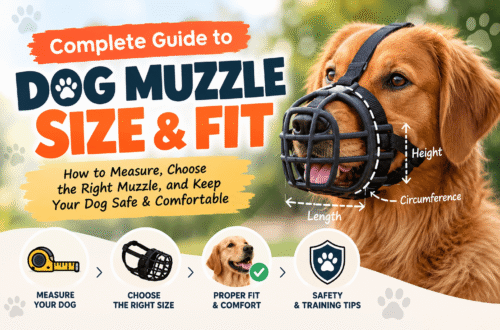
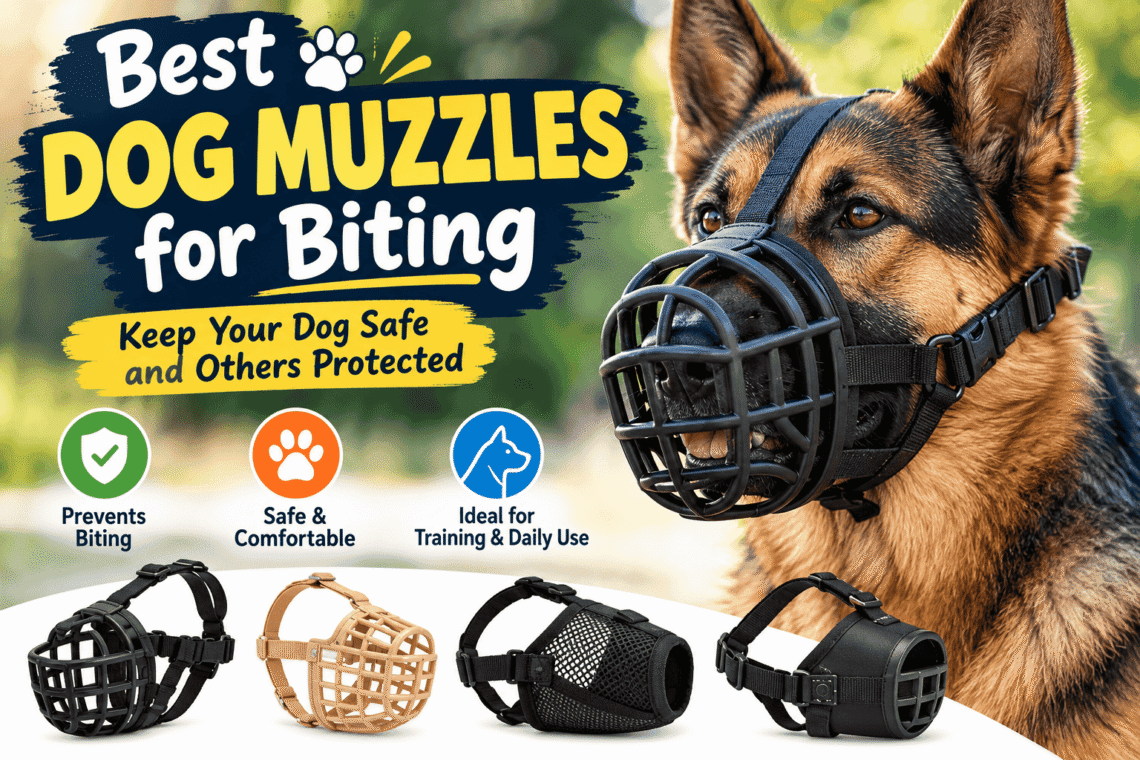
Best Dog Muzzles for Biting: 10 Secure & Comfortable Options Reviewed
Looking for a dog muzzle for biting or searching for an “anti-bite muzzle”? The right choice is about more than strength. You need the right barrier, secure retention, correct dimensions, functional panting room, and a design that matches your dog’s face and intended use.
We compare each option using the same practical criteria: security, fit, breathing function, comfort, retention, intended use, and known limitations.
In this guide, we use the standard term dog muzzle and distinguish basket, soft, vinyl, metal, and specialized designs rather than treating them as interchangeable products.
What are you trying to manage?
Start with the primary situation.
What matters most in the design?
How would you describe your dog’s face shape?
How difficult is your dog to keep safely equipped?
How long will the muzzle typically be used?
Start with the actual use case.
A secure muzzle should be matched to your dog’s bite-risk situation, face shape, retention needs, panting requirements, and intended duration.
Best Dog Muzzles for Biting
Follow the guide from terminology and safety to fit, product comparisons, training, troubleshooting, and the final buying checklist.
Dog Muzzle for Biting: Does It Actually Work?
A properly fitted dog muzzle can help prevent a dog from making a bite by physically limiting access to the target. But the important part is the entire setup—muzzle design, fit, retention, panting room, the dog's face shape, and the situation in which it will be used.
REAL
ANSWER
Yes—a muzzle can be an important physical bite-prevention tool.
It should not, however, be treated as an absolute guarantee that a dog can never bite. A muzzle that slips, allows contact through its openings, is poorly fitted, or is unsuitable for the dog's intended use may not provide the protection the owner expects.
Effective bite management is more than putting a muzzle on the dog.
Think of the muzzle as one part of a safety system rather than a standalone solution.
The physical structure should meaningfully reduce access to the person's skin or the target involved.
The muzzle needs to stay correctly positioned on the dog's actual face, not merely match a breed label.
Appropriate designs should preserve necessary breathing, panting, movement, and other intended functions.
Muzzle conditioning and behavior work help the dog participate calmly rather than treating the equipment as a complete behavioral solution.
What are you actually trying to manage?
Pick the closest situation. This is a starting point—not a product recommendation.
Begin with the actual risk.
The correct muzzle should be selected around the dog's actual situation, dimensions, and required function—not simply around the product label.
“Bite-proof” should be treated as a product claim to investigate, not a promise to accept without checking the details.
Materials, openings, retention systems, sizing, and intended use vary substantially between muzzle designs. Even when a manufacturer uses strong bite-prevention language, examine the complete product specifications and limitations before relying on it.
Before calling a muzzle “secure,” ask this.
Actual bite history, reactivity, handling, or another access problem?
The person's skin, a specific object, or another physical target?
Have the manufacturer's required dimensions been followed?
Does the design permit appropriate panting, movement, and intended use?
Can the dog be conditioned to wear the muzzle calmly?
Start with the dog's measurements, not the product name.
Different muzzle models use different sizing systems. Our detailed guide covers snout length, circumference, width, height, neck/head measurements, and the final real-world fit check.
First, understand what a biting-dog muzzle actually is and what the terminology means.
Sources & Resources +
These resources are used for general guidance on muzzle selection, fitting, conditioning, panting, and safe use. Product-specific specifications should always be checked against the manufacturer's current documentation.
A muzzle for biting is a physical management tool—not a behavioral cure.
When shoppers search for a dog muzzle for biting, anti-bite muzzle, or even a “mouth guard for dogs,” they are usually looking for equipment that limits a dog's ability to make direct mouth contact. The standard product category for that purpose is a dog muzzle.
RIGHT
TERM
What a muzzle actually does
A properly fitted muzzle creates a physical barrier around the dog's mouth. Depending on the design, it can reduce the dog's ability to bite, grab objects, or make unrestricted mouth contact. The exact level of protection depends on the muzzle's construction, openings, retention, dimensions, and the situation in which it is used.
These terms overlap, but they are not interchangeable.
Understanding the label helps you compare the actual construction instead of shopping by a phrase alone.
Dog Muzzle
The broad product category covering basket, soft, vinyl, metal, custom, and other muzzle designs.
Anti-Bite Muzzle
A product description usually emphasizing bite prevention or reduced mouth contact. The exact construction still needs to be checked.
Bite-Proof Dog Muzzle
A high-intent shopping phrase, but “proof” should never be accepted as a universal guarantee without examining the product's actual limitations.
Mouth Guard for Dogs
An informal search term often used when the shopper wants something that prevents biting. In product shopping, the closer standard category is generally a muzzle.
What did you search for?
Select the phrase closest to what brought you here.
Choose by construction—not just the phrase.
“Dog muzzle for biting” is the clearest product category. From there, compare security, fit, retention, breathing room, and intended use.
A biting-dog muzzle can take several forms.
Basket Muzzle
Open structure with space for normal mouth movement, panting, and often drinking depending on the model.
Compare basket designs →Soft Muzzle
Flexible construction that can restrict mouth opening. Use and duration need to follow the manufacturer's instructions.
Compare soft designs →Rigid / High-Security
More substantial construction intended for situations where security and structural resistance are especially important.
Review security features →Custom / Specialized
Designs built around difficult facial shapes, unusual fit requirements, or specialized management needs.
Explore difficult-fit options →Search phrase tells you the problem. Product construction tells you whether it is suitable.
This distinction matters because two products can both be marketed as “anti-bite” while having very different materials, opening sizes, retention systems, dimensions, and intended uses.
Know your dog's muzzle measurements first.
Breed names are not enough to determine a correct muzzle size. Start with the actual dimensions, then compare products using their individual sizing instructions.
“Mouth guard” and “muzzle” are often used differently by shoppers. Here is how to understand the terminology before buying.
Sources & Resources +
General muzzle terminology and function should be evaluated alongside veterinary guidance and the manufacturer's instructions for the specific model.
“Mouth Guard” vs Dog Muzzle: Are They Actually the Same Thing?
If you searched for a mouth guard for dogs biting, you are probably looking for something that limits a dog's ability to bite. In normal pet-product shopping, the product category you are usually looking for is a dog muzzle.
TERM
→ PRODUCT
For bite-prevention shopping, “dog muzzle” is the standard product category.
“Mouth guard” is commonly used as an informal search phrase. Instead of shopping by that phrase alone, compare the actual muzzle construction: basket, soft, vinyl, rigid, metal, or custom/specialized designs.
What the phrase usually means
Search wording can tell you the problem. Product design tells you what you are actually buying.
Look for a dog muzzle—not a literal canine mouth guard.
Start with the standard muzzle category, then compare the construction, fit, retention, breathing room, and intended use.
The search phrase and the product specification are two different things.
Describes the shopper's desired outcome.
May be used by people unfamiliar with muzzle terminology.
Does not tell you the material, dimensions, or retention method.
Should not be used as the only buying criterion.
Defines the actual product category used for mouth management.
Can describe basket, soft, rigid, vinyl, metal, or custom designs.
Lets you compare construction and fit between products.
Allows more precise matching to the dog's situation.
Once you reach the muzzle category, forget the search phrase for a moment.
Compare the physical and functional characteristics that determine whether a particular model is suitable for your dog and intended use.
What physical structure sits between the dog's mouth and the target?
Does the strap system keep the muzzle correctly positioned?
Does the model actually match the dog's snout and facial proportions?
Does the design preserve appropriate mouth-opening and panting room?
Is it intended for walking, handling, training, or higher-risk management?
What does the manufacturer say the design is not intended to do?
Which phrase deserves the most scrutiny?
“Anti-bite” describes the intended purpose.
It still does not tell you whether the specific model has the right construction, retention, sizing, or functional characteristics for your dog.
Use this sequence instead of shopping by keyword alone.
Now that the terminology is clear, compare the muzzle types themselves.
Basket, soft, vinyl, metal, and specialized designs can behave very differently. The next section breaks down those differences before we move into the 10 product reviews.
Once you know which type of muzzle you need, use your dog's actual measurements to narrow the available models.
How we evaluate all 10 dog muzzles using the same review criteria.
Sources & Resources +
Terminology varies across shopping pages, but the standard product category for canine mouth management is a muzzle. Always review the manufacturer's specific sizing, intended-use instructions, and limitations for the exact model.
How We Review the 10 Dog Muzzles: A Consistent Framework for Every Product
A useful dog muzzle for biting review should do more than repeat product descriptions. We compare each model against the same practical criteria so you can see where a muzzle may fit your needs—and where its limitations may matter.
RULES
FOR ALL
Product labels do not determine the review outcome.
Terms such as “anti-bite,” “heavy duty,” “secure,” or “bite-proof” can describe a product's intended purpose, but they do not replace checking the actual construction, sizing, retention, functionality, and stated limitations.
Every muzzle is examined through the same lens.
This makes the comparison easier to understand and prevents one product from being judged by a completely different standard from another.
CRITERIA
Bite-Prevention Design
How substantial is the physical barrier, and how appropriate is the construction for the stated use?
We look at structure, material, openings, and intended purpose.Dimensional Compatibility
Does the product provide a realistic path to a secure, correctly positioned fit?
Snout length, circumference, width, height, and facial shape matter.Panting & Mouth Space
Is the design compatible with the level of mouth movement and panting required for the intended use?
Function becomes especially important during active or longer use.Security on the Head
Does the retention architecture help keep the muzzle positioned when the dog moves, shakes, turns, or lowers its head?
Strap configuration can matter as much as the front structure.Contact & Wearability
How does the design address contact points, weight, padding, and practical wearability?
Comfort is evaluated alongside secure positioning—not instead of it.Conditioning Compatibility
Does the design support a realistic process for introducing and rewarding calm muzzle use?
A difficult-to-condition muzzle can create practical problems even when the physical design looks strong.Who Should Not Choose It?
The most useful review is honest about what a product may not be suited to do.
Face shape, high bite risk, duration, escape behavior, or specific handling needs can change the answer.Which criterion matters most in your situation?
Select one to see what deserves the closest attention when comparing products.
Security should be examined first.
Look beyond the word “bite-proof” and examine the physical structure, material, opening design, and whether the product is actually intended for the level of risk you are managing.
We keep product claims and editorial observations separate.
This distinction matters because a manufacturer can describe a product's intended purpose, while the buyer still needs to decide whether its dimensions, construction, and limitations suit a particular dog.
What the company says
Materials, available sizes, intended uses, compatibility, adjustment instructions, and other specifications published by the manufacturer.
What those specifications mean
Our comparison interprets the published characteristics through the same buying criteria used across the article.
Where we would hesitate
Every product review includes a practical “watch out” section so the reader can see when a different design may make more sense.
What you will see inside each muzzle review.
The use case the design is most naturally suited to.
Basket, soft, vinyl, metal, rigid, custom, or specialized construction.
What the physical barrier and retention system are designed to do.
Panting, drinking, reward delivery, and movement considerations.
How complicated the fit process may be for the individual dog.
The limitation that could change your buying decision.
A muzzle can be excellent for one dog and unsuitable for another.
A broad-faced dog, an escape artist, a dog needing longer active walks, and a dog needing short controlled handling can have very different requirements. A single numerical score can hide those differences.
Before comparing products, make sure you know your dog's measurements.
Muzzle size is not determined reliably by breed name alone. Use the complete measurement guide before narrowing your product choices.
What actually makes a dog muzzle secure enough for bite prevention?
Sources & Resources +
Review methodology is designed to combine primary product information with veterinary and behavior guidance. Manufacturer specifications are not treated as independent proof of suitability for every dog.
What Makes a Dog Muzzle Secure Enough for Bite Prevention?
A secure dog muzzle for biting is a system of physical structure, correct dimensions, and reliable retention. The goal is not to make the straps as tight as possible—it is to keep the muzzle correctly positioned while preserving the functions the dog needs during its intended use.
FIT
HOLD
Security comes from the interaction between barrier, fit, and retention.
A rigid muzzle can still fail if it is the wrong size. A perfectly sized basket can still shift if its retention system is inadequate for the dog. And a very tight muzzle can create unnecessary pressure without solving the underlying design problem.
Think of these as layers—not isolated features.
The more important the bite-prevention requirement, the more carefully each layer should be examined.
Physical Structure
The front and side structure create the actual physical barrier between the dog's mouth and the bite target.
Correct Dimensions
Length, circumference, width, height, and facial proportions determine whether the muzzle sits where it was designed to sit.
Head Stability
Straps, buckles, head pieces, and collar attachments can help prevent movement or escape when the dog turns, shakes, or pulls.
Panting & Movement
Security should not be created by restricting the mouth beyond what is appropriate for the intended activity.
Real-World Stability
Standing still is only one position. The muzzle also needs to be evaluated while walking, turning, lowering the head, and sniffing.
Intended Use
A product designed for grooming or short handling should not automatically be treated as the right tool for every higher-risk situation.
A muzzle can have a strong front barrier and still be poorly secured.
When comparing products, inspect the complete route by which the muzzle connects to the dog's head. The front basket or shell is only one part of that system.
How secure is the setup you are considering?
Check each feature only when you can verify it for the actual product.
A secure-looking muzzle should still be evaluated feature by feature.
“Tighter” is not the same as “more secure.”
Tighten the straps until the muzzle stops moving.
This can confuse a sizing or retention problem with a strap-tension problem. Excessive tightening can create pressure without correcting the underlying fit.
Check the model, dimensions, retention, and positioning.
The right solution may be a different size, shape, retention system, or product—not simply a tighter strap.
Different materials solve different parts of the problem.
Basket
Open structure can provide useful space for panting and drinking, while the exact security depends on design, fit, and retention.
CHECKRigid / Poly
A substantial shell or rigid construction can provide a different level of structural resistance from softer materials.
CHECKWire Metal
Metal basket construction can offer open structure and durability, but fit, padding, weight, and movement still need evaluation.
CHECKCustom
Custom construction can address difficult facial proportions or specialized requirements, but “custom” does not automatically mean appropriate for every bite-risk situation.
CHECKUse security criteria—not marketing labels—to compare the 10 reviewed muzzles.
The next product section applies the same review framework to each model, including security, fit, function, retention, comfort, and limitations.
Security starts with correct measurements.
Before buying, review snout length, circumference, width, height, and the manufacturer's individual sizing method.
Basket vs soft vs vinyl vs metal: which muzzle type makes sense for biting?
Sources & Resources +
Security should be assessed using the exact product's construction, measurements, manufacturer's instructions, intended use, and limitations. Veterinary guidance is especially important when managing meaningful bite risk.
Basket vs Soft vs Vinyl vs Metal: Which Muzzle Type Makes Sense for Biting?
The material and structure of a dog muzzle for biting affect more than appearance. They can influence mouth movement, panting, drinking, retention, durability, comfort, and how much physical separation exists between the dog's mouth and another target.
BEFORE
MODEL
For ongoing bite-risk management, a properly fitted basket-style design is usually the starting point—not a snug sleeve muzzle.
Cornell distinguishes basket muzzles from soft or sleeve designs: basket muzzles are designed to allow panting and drinking, while soft muzzles restrict the mouth and are intended for temporary use. The exact model still needs to match the individual dog's face, risk level, retention requirements, and intended activity.
What will the muzzle actually be used for?
Select the closest use case to see which construction features deserve the most attention.
Start by comparing basket-style designs.
For ongoing bite-risk management, examine basket construction, secure retention, complete fit, and functional panting room.
The right type depends on the job the muzzle needs to perform.
Do not choose a material first and force the dog into it. Start with the required function, then compare the designs capable of providing it.
Basket Muzzle
An open basket forms a cage-like barrier around the snout. Properly fitted basket designs can provide room for panting and drinking and are commonly used for longer periods than restrictive sleeve designs.
Soft / Sleeve Muzzle
A soft muzzle fits closely around the snout and may limit the dog's ability to open its mouth. That makes it fundamentally different from an open basket design.
Rigid / Vinyl Designs
Rigid or semi-rigid materials can create a more substantial front barrier. The exact performance depends on the material, shape, strap architecture, dimensions, and manufacturer specifications.
Metal / Wire Basket
Wire baskets provide an open structure with a different material profile from plastic, TPR, or vinyl designs. Weight, padding, durability, fit, and secure retention remain important.
Compare the construction before comparing brands.
| Feature | Basket | Soft / Sleeve | Rigid / Vinyl | Metal / Wire |
|---|---|---|---|---|
| Open structure | ✓ | Limited | Model dependent | ✓ |
| Functional panting | ✓ | Restricted | Model dependent | ✓ |
| Drinking access | Usually | Restricted | Model dependent | Usually |
| Longer-use potential | Strong | Limited | Use dependent | Use dependent |
| Bite-risk suitability | Design dependent | Limited | Design dependent | Design dependent |
| Reward compatibility | Often | Limited | Model dependent | Model dependent |
Important: “Usually,” “often,” and “model dependent” refer to the construction category, not a guarantee for every product. Always verify the exact model's specifications and fitting instructions.
Which construction should receive the closest attention?
If the dog needs to pant freely, the construction becomes a safety issue.
A soft sleeve that holds the mouth more closed is fundamentally different from an open basket. Cornell identifies soft or sleeve muzzles as temporary tools because they restrict panting and drinking, while properly fitted basket muzzles allow dogs to pant and drink.
A stronger material does not automatically mean a better muzzle.
Structural strength is only one part of the selection. A muzzle still needs the right size, retention, facial shape, function, and intended-use profile.
But only when the entire product remains appropriately fitted and secured.
But wider openings may affect the access problem you are trying to solve.
But tightening is not a substitute for correct sizing or suitable retention.
But custom construction does not automatically guarantee absolute bite prevention.
Now we can compare the 10 muzzles using the same security and fit criteria.
The next section introduces the complete product comparison before we examine each muzzle individually.
Do not choose the type before checking your dog's dimensions.
Length, circumference, width, height, and facial proportions can eliminate otherwise attractive options.
Bite prevention vs “bite-proof”: what does that claim really mean?
Sources & Resources +
The construction guidance in this section draws primarily from veterinary muzzle guidance and manufacturer documentation. Product-specific claims should always be checked against the current model specifications.
“Bite Prevention” vs “Bite-Proof”: What Does It Really Mean?
A dog muzzle can create a physical barrier that helps prevent a dog from making a bite, but “bite-proof” should not be interpreted as an absolute guarantee. The real question is how the muzzle performs as a complete system: barrier, fit, retention, mouth space, material, and intended use.
BEYOND
THE LABEL
“Bite prevention” describes a safety function; “bite-proof” sounds like an absolute performance promise.
Cornell describes a properly fitted basket muzzle as a tool for preventing dog bites and notes that basket designs can allow normal panting and drinking. That does not mean every basket, every size, or every material has identical protection. Even manufacturers may explicitly state that a particular muzzle does not provide 100% protection against a bite.
Select a phrase you see on a product page.
Use the wording as a starting point—not as proof that the product matches your dog's bite-risk situation.
Look at the actual physical barrier.
Ask whether the muzzle physically prevents the dog's mouth from reaching the intended target, then examine fit and retention.
A marketing phrase becomes useful only after you translate it into measurable features.
Instead of asking “Is this muzzle bite-proof?”, break the statement into smaller questions that can actually be checked.
Bite prevention
The product is intended to reduce the dog's ability to make a bite.
Where is the barrier?
Identify the physical structure that separates the mouth from another person or animal.
Can the dog shift or defeat it?
Examine muzzle movement, strap placement, openings, and head stability.
What does the manufacturer exclude?
Serious bite risk, extreme force, unusual facial shapes, or particular activities may require a different design or professional assessment.
Bite prevention is not one feature. It is a chain.
A strong front barrier is useful only when the dog cannot easily remove or reposition the muzzle and the construction remains suitable for the dog's face and intended activity.
SYSTEM
Why a “secure” muzzle can still fail to provide the protection expected.
Wrong length
The muzzle can sit too far forward, too far back, or place the front barrier in the wrong position relative to the mouth.
CHECK → SNOUT LENGTHWrong circumference
A muzzle that is too loose may shift or become removable, while excessive tightness can compromise comfort and function.
CHECK → SNOUT CIRCUMFERENCEPoor retention
A substantial basket is not useful if the dog can back out of it, paw it off, or move it dramatically during activity.
CHECK → STRAP ARCHITECTUREInsufficient mouth space
A design that limits normal mouth opening can create a different safety problem during active use, especially when panting is required.
CHECK → PANTING ROOMOpenings do not match the job
A basket can have adequate airflow while still allowing access to something you intended the muzzle to block.
CHECK → OPENING GEOMETRYIntended-use mismatch
A muzzle designed for brief handling should not automatically be treated as a general-purpose long-duration bite-management solution.
CHECK → MANUFACTURER LIMITSTreat absolute protection language with extra care.
Even BUMAS states that its deformable BioThane muzzle does not provide 100% protection against a dog bite. Its published safety information explains that the design is intended to increase safety and reduce injury risk, while acknowledging that biting cannot be completely ruled out.
Replace broad marketing language with six concrete checks.
Barrier
What physical structure sits between the mouth and the target?
Opening
Could the dog's mouth still reach through the front or sides?
Retention
How is the muzzle prevented from sliding, rotating, or coming off?
Material
Is the construction rigid, flexible, deformable, padded, or mixed?
Function
Does the design provide the panting, drinking, and movement space required?
Limitation
What does the manufacturer explicitly say the product cannot guarantee?
Tap each statement you can verify.
This is a verification tool, not a safety guarantee or product score.
Start with the basics.
Verify the physical barrier and the dog's measurements before treating any bite-related product claim as meaningful.
Add a physical layer of bite-risk management.
A properly selected and fitted muzzle can reduce a dog's ability to make contact with its mouth and can make handling safer in appropriate situations.
Replace training, trigger management, supervision, or professional help.
AKC describes the muzzle as a safety-management tool rather than a solution to the underlying behavioral problem. Dogs with a bite history or significant handling concerns may need structured behavior support.
A good construction still fails if the dimensions are wrong.
Continue to the fit section to see how snout length, circumference, width, height, facial shape, and retention affect a biting dog's muzzle.
Do not order from the “bite-proof” label alone.
Measure first, then compare the manufacturer's sizing requirements against your dog's actual dimensions.
How to fit a muzzle for a biting dog: the measurements that actually matter
Sources & Resources +
This section separates general muzzle guidance from manufacturer-specific claims. Cornell specifically describes basket muzzles as bite-prevention tools while emphasizing correct fitting and functional use. BUMAS explicitly states that its deformable BioThane muzzle does not provide 100% protection against a bite. AKC likewise describes a muzzle as a safety tool rather than a replacement for behavior modification.
How to Fit a Muzzle for a Biting Dog: The Measurements That Actually Matter
A muzzle can only create the intended physical barrier when it stays correctly positioned on the dog's face. For a dog muzzle for biting, measure the dog first, then compare those measurements with the exact manufacturer's sizing information. Breed names alone are not precise enough.
THEN
CHOOSE
For bite-risk management, the muzzle should be long enough, roomy enough for the required mouth function, and secure enough to stay correctly positioned.
Cornell and Preventive Vet both emphasize correct fitting for basket muzzles. Preventive Vet notes that measurements commonly include snout length, circumference with the mouth closed and open, and neck measurements. Company of Animals also uses nose length and circumference when sizing its Baskerville range and advises checking the finished fit for panting, drinking, and nose clearance.
“This size is for my breed” is only a starting point.
Dogs of the same breed can have different snout lengths, widths, head shapes, and proportions. Company of Animals explicitly notes that individual dogs vary even when breed size guides are available.
Five measurements can tell you far more than a breed label.
The exact measurements required vary by manufacturer and muzzle design, but these are the dimensions most useful when assessing a bite-prevention muzzle.
Snout Length
Measure from the tip of the nose to the base of the nose, just below the eyes, according to the muzzle manufacturer's measuring method.
Why it matters → prevents the basket from sitting incorrectly.Closed-Mouth Circumference
Measure around the widest part of the snout according to the manufacturer's instructions. This establishes the dog's basic muzzle circumference.
Why it matters → helps prevent an overly narrow or loose basket.Open-Mouth Circumference
For basket designs intended to permit normal panting, measure as instructed by the manufacturer with enough mouth opening to reflect the dog's panting posture.
Why it matters → a closed-mouth measurement alone may not represent panting space.Snout / Face Width
Width becomes especially important when the dog has a broader muzzle, prominent cheek structure, or proportions that differ from the standard shape of the selected model.
Why it matters → length can fit while width does not.Neck / Head Retention
Some designs require additional head or neck measurements. These help determine whether the strap system can be adjusted appropriately without excessive looseness or pressure.
Why it matters → the barrier is useless if the dog can remove it.Which measurement are you checking right now?
Select a measurement to see what a mismatch can tell you.
Snout length determines where the muzzle sits.
Measure from the nose tip to the base of the nose just below the eyes, then compare that measurement with the exact sizing guide for the model you are considering.
FIT TIP → The nose should not be pressed against the front of the basket.Does the dog have enough room to pant?
A basket muzzle intended for longer use needs adequate internal space for the dog's mouth to open and pant. Cornell states that properly fitted basket muzzles allow panting and drinking. Preventive Vet similarly recommends enough basket space for comfortable mouth opening, panting, and drinking.
Do not judge this by looking at the muzzle while the dog is standing quietly. The relevant question is whether the dog has the needed functional space when walking, exercising, becoming excited, or otherwise panting.
The front of the muzzle should not become a pressure point.
Company of Animals recommends checking for a gap between the dog's nose and the end of the basket and gives approximately 1 cm as an ideal reference for its fitting guidance. Treat that as model-specific guidance—not a universal measurement for every muzzle design.
Tap each condition that is true on your fitted muzzle.
Use this as a visual checklist. It does not replace the manufacturer's fitting instructions or professional assessment for a serious bite-risk dog.
Too tight and too loose create different problems.
Security becomes meaningless if function is compromised.
Excessive pressure can create rubbing, pressure points, discomfort, or insufficient mouth space. A muzzle should not simply be tightened until it feels immovable.
A good barrier cannot help if the dog can defeat the retention.
Excessive movement can let the basket rotate, shift forward, interfere with the dog's eyes, or potentially become removable. Retention must be evaluated together with dimensions.
A standing fit is not the whole test.
Observe the muzzle when the dog moves naturally. The dog may lower its head, turn, sniff, walk, become excited, or attempt to rub the muzzle. The goal is to confirm that the basket remains appropriately positioned without creating unsafe pressure or losing the intended barrier.
Short, broad, or unusual faces may need a different fitting strategy.
Preventive Vet notes that brachycephalic and otherwise difficult-to-fit dogs often need specialty or custom-made options. A standard long-snout basket may have insufficient bridge or facial contact area to remain stable on a short-nosed dog.
For these dogs, do not solve a shape problem by simply tightening the straps. Look for a design intended for the facial structure or seek professional guidance on a suitable custom option.
The right muzzle sits in the middle—not at either extreme.
Excessive tightness can undermine comfort and normal function.
+
FUNCTIONAL
Excessive movement can undermine stability and the intended barrier.
Have your dog's measurements ready before comparing the 10 models.
The upcoming product review section uses fit, retention, function, construction, and limitations together—rather than treating a product name as proof of suitability.
Want to organize the measurements before shopping?
Use the muzzle size calculator as a measurement aid, then verify the final size against the individual manufacturer's sizing chart.
Panting, drinking, and muzzle safety: what should a biting dog still be able to do?
Sources & Resources +
Fit guidance in this section is based on veterinary guidance and manufacturer fitting instructions. Exact dimensions, strap positions, and clearance requirements vary by muzzle model, so the current manufacturer's instructions should control the final fitting decision.
Panting, Drinking & Muzzle Safety: What Should a Biting Dog Still Be Able to Do?
For a dog wearing a muzzle during activity, physical bite prevention is only part of the job. The design also needs to provide the mouth movement, panting room, water access, comfort, and stability required for the situation in which it is used.
IS PART
OF FIT
A properly fitted basket muzzle should allow the dog to pant and drink when those functions are required.
Cornell identifies basket muzzles as suitable for extended use because dogs can pant, drink water, and accept treats through an appropriately designed basket. Cornell also distinguishes soft or sleeve muzzles, which restrict panting and drinking and are intended for temporary use. The exact model and fit still determine whether those functions are actually available on the individual dog.
Before focusing on bite resistance, check these five everyday functions.
A muzzle should be evaluated as equipment the dog will actually wear, not just as a barrier shown in a product photograph.
Panting
The dog needs sufficient mouth-opening space for normal panting when exercise, excitement, stress, or warm conditions make cooling important.
CORE CHECK → MOUTH OPENINGDrinking
For activities where water access is required, confirm that the dog can actually drink with the fitted muzzle rather than assuming an open basket automatically guarantees it.
CORE CHECK → WATER ACCESSContact Points
The nose, bridge, cheeks, and straps should be checked for excessive pressure, rubbing, or repeated friction while the dog is moving.
CORE CHECK → SKIN & PRESSURENatural Movement
The dog should be able to move its head normally enough for the intended activity without the muzzle shifting dramatically.
CORE CHECK → STABILITYTreat Delivery
A basket that allows treats can make gradual muzzle conditioning easier and can support positive training during appropriate use.
CORE CHECK → CONDITIONINGA muzzle that looks roomy while the dog is calm can still be too restrictive when the dog begins to pant.
Preventive Vet recommends selecting a basket with enough room for the dog's mouth to open comfortably for panting and drinking. This is one reason basket construction is fundamentally different from a sleeve muzzle that holds the mouth more closed.
Select the situation in which your dog will wear the muzzle.
The required functional space changes with activity and environment.
Confirm normal panting and drinking function.
Even during an ordinary walk, the basket should provide enough internal space for the dog's normal panting and water access.
SAFETY NOTE → Monitor the dog continuously.REACH WATER?
“It is a basket” is not enough. Confirm drinking on the actual dog.
Cornell states that a properly fitted basket muzzle can allow a dog to drink water. Preventive Vet likewise emphasizes choosing a basket with sufficient space for drinking. However, bowls differ in depth and shape, and individual muzzle geometry varies.
The more the dog pants, the more important muzzle function becomes.
A dog that is calm in the house can have very different breathing requirements outside. Heat, exercise, excitement, stress, and the dog's individual condition can all increase panting.
A muzzle that prevents the mouth from opening also affects panting.
Cornell classifies soft or sleeve muzzles as temporary-use equipment because they limit panting and drinking. Preventive Vet similarly recommends against routine use of soft muzzles because they restrict mouth opening and can interfere with cooling and hydration.
A secure muzzle is not a set-and-forget device.
Company of Animals recommends supervising dogs while they wear its muzzle products, including during early conditioning. This allows the handler to notice rubbing, attempted removal, shifting, chewing, discomfort, or another problem before it becomes significant.
Persistent struggle is information—not something to simply tighten away.
Dogs need gradual conditioning to wear a muzzle comfortably. Repeated pawing, rubbing, attempts to remove it, or a dog refusing to move normally can indicate that the dog needs a better fit, a different design, slower conditioning, or professional help.
Repeatedly trying to remove the muzzle.
Repeatedly scraping the muzzle against surfaces.
Refusing normal movement after fitting.
Visible rubbing or pressure at contact areas.
Insufficient panting room or abnormal breathing demands immediate reassessment.
Check the muzzle against the dog—not the product photo.
Mark the functions you have actually observed with the dog wearing the fitted muzzle.
More restrictive does not automatically mean more suitable.
Barrier + natural mouth function
Open basket geometry can allow panting, drinking, and treat delivery when correctly fitted, while creating a physical barrier around the mouth.
Mouth restriction + temporary handling
Sleeve-style designs limit mouth opening. That can serve a brief, controlled handling purpose but also restrict panting and drinking.
Panting room is only useful when the muzzle stays where it belongs.
Next, we look at escape-resistant features, strap systems, head stability, and the situations in which a biting dog may try to remove its muzzle.
Can your dog pant and drink comfortably in the current fit?
Use the measurement guide as a starting point, then verify actual function on the fitted dog and compare against the manufacturer's instructions.
Escape-proof muzzle features: how to keep a biting dog's muzzle secure
Sources & Resources +
This section follows veterinary and manufacturer guidance that distinguishes open basket muzzles from restrictive sleeve designs and emphasizes proper fit, panting, drinking, conditioning, and supervision. Exact use limits remain model-specific.
Escape-Proof Muzzle Features: How to Keep a Biting Dog's Muzzle Secure
For a dog with meaningful bite risk, muzzle security depends on more than a strong basket. The muzzle must remain correctly positioned when the dog walks, turns its head, lowers its nose, shakes, paws, or tries to remove it. Fit and retention therefore work together.
THE
BARRIER
The most important escape-resistant features are correct sizing, stable head retention, appropriate strap placement, and a construction the dog cannot easily defeat.
Cornell explains that basket muzzles use straps behind the dog's head to hold the basket in position. AKC notes that a muzzle that is too loose may be removable, while excessive tightness can interfere with breathing, panting, and drinking. Company of Animals recommends additional security features such as the collar loop and headstrap during early acclimation of its Baskerville Ultra.
Think of retention as five layers working together.
No single strap or buckle makes a muzzle “escape-proof.” The goal is to create a stable system that matches the dog's facial structure, behavior, and intended use.
Correct Size
Start with the exact snout and head dimensions required by the selected model. Retention cannot compensate for a fundamentally incorrect size.
SECURITY BASEHead Strap
A properly positioned head strap helps prevent the muzzle from sliding forward, rotating, or being pulled away from the face.
POSITION CONTROLCollar / Safety Loop
Some models provide a connection point to the dog's collar for additional stability. Whether one is useful depends on the exact product and the dog's escape behavior.
SECONDARY RETENTIONBasket Integrity
The front structure must maintain the intended physical separation and resist the type of manipulation expected during use.
PHYSICAL BARRIERMovement Check
A muzzle that looks secure while standing still should still be checked during normal movement and after the dog attempts to remove it.
REAL-WORLD TESTThe head strap keeps the barrier aligned with the mouth.
The exact strap architecture differs between models. What matters is whether the finished system keeps the muzzle stable without placing excessive pressure on the throat, nose, eyes, or other sensitive areas.
How does the dog usually try to remove equipment?
Choose the closest behavior to see which retention feature deserves extra attention.
Stabilize the muzzle and check the head strap.
Examine how the head strap and basket interact when the dog paws at the face. Check that the muzzle stays away from the eyes and does not rotate significantly.
CHECK → Head strap + fit + supervisionMore hardware is not automatically better.
The useful question is whether the feature addresses the specific way the dog tries to defeat the muzzle.
“Make it tighter” is not an escape-proof strategy.
AKC notes that a muzzle that is too loose can be removed, but making it excessively tight can interfere with breathing, panting, or drinking and can cause chafing. Security therefore means correct positioning and retention, not maximum strap pressure.
Check stability in the same sequence every time.
The following sequence helps you observe obvious movement problems. It is an observation checklist—not a laboratory test and not a guarantee that the muzzle cannot be removed.
How many security conditions have you actually checked?
Mark only what you have observed on the fitted dog.
Some designs add a secondary connection for extra stability.
Company of Animals recommends using the collar loop and headstrap on the Baskerville Ultra during early acclimation when a dog is trying to remove the muzzle. The current Ultra design also includes a clip connection on its neck strap and an optional lock.
This is a model-specific example. It should not be treated as proof that every muzzle needs the same hardware.
Match the retention architecture to the dog's behavior.
Standard secure fit
Prioritize correct dimensions, comfortable adjustment, and stable positioning during normal activity.
Reinforced retention attention
Examine head straps, secondary attachment points where provided, and how the muzzle behaves when the dog shakes or paws.
Professional-level selection
Product-page labels are not enough. Consider professional guidance from a qualified trainer or veterinary behavior professional when the consequences of muzzle failure are significant.
“Escape-proof” should describe a design goal—not an absolute guarantee.
Dogs differ in anatomy, behavior, strength, persistence, and how they interact with equipment. A muzzle that stays stable on one dog can behave differently on another. For that reason, this article uses “escape-resistant” and “secure” when discussing features rather than promising that any product is impossible for every dog to remove.
What changes when the dog has a short, broad, or flat facial shape?
The next section covers the dogs for whom standard long-snout muzzle sizing can become especially difficult.
Start with the dimensions before choosing an escape-resistant design.
Use the size calculator as a planning aid, then confirm the finished fit using the exact product instructions.
Short-snouted dog muzzles: why flat-faced and broad-faced dogs need extra care
Sources & Resources +
Retention guidance below is based on veterinary and manufacturer guidance. Exact strap placement, adjustment, secondary attachment points, and use limits vary by model. Always follow the current instructions for the muzzle being fitted.
Short-Snouted Dog Muzzles: Why Flat-Faced & Broad-Faced Dogs Need Extra Care
A muzzle designed around a conventional long snout may not sit correctly on a short, broad, or flat-faced dog. For these dogs, facial structure, airway considerations, mouth-opening space, retention, and specialist sizing deserve attention before bite-prevention performance is even considered.
BEFORE
SIZE
Short-snouted and broad-faced dogs often need a muzzle designed specifically for their facial proportions rather than a smaller version of a long-snout model.
Preventive Vet notes that brachycephalic dogs such as French Bulldogs, Bulldogs, Pugs, and Boxers often need specialty or custom-made muzzles because a conventional basket may have less bridge area available to remain stable. The same source emphasizes the importance of easy breathing, particularly when a dog is stressed or exposed to warm conditions. Cornell also recommends selecting a properly fitted basket muzzle that permits panting and drinking.
Shorter does not mean “just choose a shorter muzzle.”
A conventional muzzle can have the right circumference while still fitting poorly around the nose bridge, cheeks, eyes, jaw, or retention points.
Limited bridge space
Short facial proportions can leave less room for conventional nose-to-head retention systems to stabilize the basket.
FIT QUESTION → WHERE DOES THE RETENTION ANCHOR?Panting deserves extra attention
A short muzzle should not be treated as permission to accept a tighter or more restrictive fit. Functional mouth opening remains important.
SAFETY QUESTION → CAN THE DOG PANT?Width can dominate length
Broad cheeks and short noses can make a muzzle pinch even when the measured snout length appears close to the manufacturer's range.
FIT QUESTION → IS THE BASKET BROAD ENOUGH?Eye clearance matters
A muzzle that migrates upward or backward can interfere with the sensitive area around the eyes and indicates a fit that needs review.
FIT QUESTION → DOES IT STAY AWAY FROM THE EYES?Which facial profile is closest to your dog?
Choose the closest description to identify the fitting issue that deserves the most attention.
Facial clearance and breathing function come first.
For a very short or flat face, do not assume a standard basket can be made secure by tightening the straps. Look for a design developed for the facial shape or consider specialist/custom fitting.
START → Measure the actual dog before shopping.There are two different ways to solve a difficult facial shape.
A specialty muzzle may be manufactured around a broader or shorter facial profile. A custom muzzle instead uses measurements specific to the individual dog. Neither label automatically guarantees perfect fit or absolute bite prevention.
Designed around a face category
A wider or differently shaped basket may accommodate dogs that do not fit the proportions of conventional models.
VERIFY → MODEL DIMENSIONSDesigned around the individual dog
Custom construction can be useful when standard dimensions cannot provide the required combination of stability, clearance, and function.
VERIFY → CUSTOM MEASUREMENT PROCESSThe Baskerville Wide Fit illustrates why facial shape deserves its own product category.
Company of Animals currently describes the Baskerville Wide Fit as specifically designed for large broad-nosed dogs, including examples such as Staffies, Boxers, Rottweilers, Mastiffs, and bully breeds. The manufacturer says the TPR construction can be reshaped with hot water for a tailored fit and that the basket allows panting and drinking.
This is a product-specific example, not a recommendation that the model will fit every short-faced dog. The actual dog's dimensions still need to be compared with the current sizing guidance.
For short-faced dogs, “enough room” is a functional question.
Preventive Vet specifically cautions that brachycephalic dogs can have greater breathing difficulty when stressed or when the weather is warm. A muzzle should therefore not be selected by circumference alone. The dog must have appropriate space to pant and breathe.
Cornell likewise states that a properly fitted basket muzzle permits panting and drinking. That makes an open, appropriately sized design fundamentally different from a restrictive sleeve muzzle.
SPACE
Verify these seven conditions before extended outdoor use.
Mark only conditions you have actually observed on the individual dog.
Four shortcuts can turn a difficult fit into a risky one.
Do not rely on breed alone.
Two dogs of the same breed can have different facial proportions. Measure the actual dog.
Do not force a long-snout design to work.
An unsuitable bridge or basket profile may remain unstable even after strap adjustments.
Do not sacrifice panting room for tightness.
Increasing strap pressure is not a substitute for suitable design and correct dimensions.
Do not assume custom means absolute protection.
Custom construction can improve compatibility, but it still needs appropriate materials, retention, function, supervision, and use.
A difficult-to-fit dog with a meaningful bite history deserves more than a product-page decision.
Cornell and Preventive Vet both emphasize appropriate muzzle conditioning, and Cornell specifically advises seeking qualified positive-reinforcement training or veterinary behavior support for dogs with a history of biting or handling sensitivities. For a short-faced dog where fit or breathing is difficult to assess, professional input can help identify a safer equipment and conditioning plan.
Use facial shape to narrow the design family.
The upcoming product section will not treat all dogs as the same shape.
Each muzzle will be examined through the same framework—security, fit, function, retention, comfort, training compatibility, and limitations—with facial shape included where relevant.
Now compare actual models using the same bite-prevention framework.
We will look at each product individually rather than assigning one generic “best” muzzle to every dog.
Still unsure which dimensions matter for your dog's face?
Use the measurement resource as a starting point, then compare every measurement with the exact manufacturer's sizing instructions.
Best Dog Muzzles for Biting: 10 Secure & Comfortable Options Reviewed
Sources & Resources +
Short-faced and broad-faced fitting guidance below is based on veterinary guidance and current manufacturer information. Product-specific fit claims remain dependent on the individual dog's measurements and the current model sizing instructions.
Best Dog Muzzles for Biting: 10 Secure & Comfortable Options Reviewed
The products below are not being treated as interchangeable. Each review considers the same core questions: barrier structure, fit, retention, panting/drinking function, comfort, intended use, and limitations. Product specifications can change, so the manufacturer's current information should be checked before purchase.
MODELS
7 CRITERIA
There is no single muzzle that is appropriate for every biting dog.
Our shortlist spans conventional basket designs, rigid plastic/poly construction, clear vinyl, wire basket designs, broad-face options, security-focused vinyl models, and custom-made BioThane. The aim is to show how construction changes the fit, function, retention, and intended-use picture rather than assigning an artificial universal score.
Find the model family that matches your dog's actual requirements.
Start with your dog's measurements and facial shape. Then use the review framework to compare models that can realistically satisfy the intended use.
What we examine in each individual review.
What physical structure creates the barrier?
We examine the actual basket or front structure rather than relying on terms such as “anti-bite” or “bite-proof.”
Ten different paths to the same practical question: which design fits the dog?
Select a model family below to jump directly to its detailed review.
Baskerville Ultra Muzzle
High-strength TPR basket with a redesigned retention system and model-specific sizing. Company of Animals describes the Ultra as a broad-use basket allowing panting, drinking and treating.
Read Ultra Review →JAFCO White Poly Muzzle
High-density polyethylene construction with reinforced straps. JAFCO offers multiple sizing and strap configurations, including a third-strap option on applicable sizes.
Read JAFCO Poly Review →JAFCO Clear Vinyl Muzzle
Flexible clear vinyl construction with reinforced neoprene straps. JAFCO provides two-strap and applicable third-strap configurations across its size range.
Read Clear Vinyl Review →Baskerville Classic Muzzle
The current Classic uses improved TPR, can be reshaped in hot water, and includes an additional guard insert for food and wildlife scavenging and other access-control uses.
Read Classic Review →Baskerville Wide Fit Muzzle
Designed specifically for large broad-nosed dogs. The current Wide Fit uses TPR, padding and a reshaping process intended to help create a more tailored fit.
Read Wide Fit Review →Dean & Tyler DT Muzzle
Wire basket construction with a product design aimed at ventilation, panting, drinking, walking and running. Dean & Tyler emphasizes measuring carefully before selecting the size.
Read DT Muzzle Review →Dean & Tyler DT Freedom
The DT Freedom is a free-pant wire basket design. Dean & Tyler highlights the importance of correct sizing and specifically warns against leaving a dog unattended while wearing a muzzle.
Read DT Freedom Review →Mia’s Muzzles Guardian
Mia’s Muzzles describes the Guardian as its most secure model, using thicker 3 mm vinyl and offering an optional Bite Guard for larger sizes. The maker says it is intended for moderate-to-high bite-risk situations.
Read Guardian Review →Mia’s Muzzles Double Trouble
The current Double Trouble is positioned by Mia’s Muzzles for dogs that combine bite risk with scavenging. It uses 3 mm vinyl and offers Solid Front or Scavenger Guard configurations.
Read Double Trouble Review →BUMAS BioThane Custom Muzzle
BUMAS makes custom BioThane muzzles around individual measurements and offers configurations for different muzzle shapes and uses. BUMAS also explicitly cautions that its muzzle should not be treated as providing 100% bite protection.
Read BUMAS Review →The shortlist covers four different construction strategies.
That variety is intentional. A dog requiring bite-risk management may need a very different geometry from a dog that mainly needs a comfortable everyday basket or a custom solution for unusual proportions.
Before opening each review, see what makes the model different.
| Model | Core construction | Distinctive design direction | First question to ask |
|---|---|---|---|
| Baskerville Ultra | TPR basket | Broad-use basket + reshaping | Does the Ultra size give enough room and retention? |
| JAFCO White Poly | High-density polyethylene | Structured multi-strap option | Which size and strap configuration fits? |
| JAFCO Clear Vinyl | Flexible clear vinyl | Visibility + structured barrier | Does the individual fit provide adequate function? |
| Baskerville Classic | TPR basket | Guard insert + long-snout direction | Does the guard or basket configuration match the use? |
| Baskerville Wide Fit | TPR basket | Broad / short-nose geometry | Is the dog's facial width compatible? |
| Dean & Tyler DT | Wire basket | Ventilated open design | Does the wire basket fit without excessive movement? |
| Dean & Tyler DT Freedom | Wire basket | Free-pant construction | Does the exact size meet the dog's measurements? |
| Mia’s Guardian | 3 mm vinyl | Maximum-protection positioning | Does the added structure suit the dog's bite-risk situation? |
| Mia’s Double Trouble | 3 mm vinyl | Biting + scavenging | Which front configuration solves the access problem? |
| BUMAS Custom | BioThane | Individual made-to-measure construction | Does custom geometry solve the dog's fitting problem? |
Manufacturer claim, editorial interpretation, and limitation are kept separate.
A manufacturer's description tells us what the company says the product is designed to do. Our review then interprets those features against the same criteria used throughout this article.
Current construction, sizing, features, intended use, and safety information published by the maker.
What those features mean for fit, security, function, retention, and the particular use case.
No artificial “100% bite-proof” guarantee, no claim that one product fits every dog, and no implication of hands-on testing where none occurred.
A muzzle that works beautifully for one dog can be the wrong geometry for another.
A long-nosed dog, broad-faced dog, serious escape artist, scavenger, or dog needing custom dimensions can create very different selection requirements. This review therefore avoids a simple 1–10 overall ranking.
Which review should you open first?
Select the problem you are trying to solve.
Begin with the Guardian, JAFCO, and structured basket reviews.
“Best” means “best match for the dog's requirements,” not “highest score.”
The detailed reviews that follow are designed to help you eliminate unsuitable models and investigate the models whose construction, shape, retention, and function match your dog's needs.
Next: Baskerville Ultra Muzzle — construction, fit, security, and limitations.
We now move from the overview into the individual model reviews, keeping the same evaluation framework from product to product.
Have your dog's measurements ready before opening the product reviews.
A product can only be judged meaningfully against the dimensions and facial shape it is actually expected to fit.
Baskerville Ultra Muzzle: a detailed look at security, fit, function, and retention
Manufacturer Sources & Review References +
Product descriptions in this overview are based on current manufacturer information checked for this article. Manufacturer claims are presented as product descriptions and are not treated as independent laboratory performance guarantees.
Baskerville Ultra Muzzle:
Review for Biting Dogs
A closer look at the Baskerville Ultra through the same bite-management framework used across this guide: barrier, fit, retention, panting, drinking, comfort, and practical limitations.
Our take: The Baskerville Ultra is a basket-style muzzle built around a combination of physical mouth coverage, adjustable retention and room for normal muzzle functions such as panting, drinking and receiving treats. That makes it relevant to dogs that need a secure management tool, but the actual level of bite-risk protection still depends heavily on correct sizing, fitting, retention and conditioning.
What the Baskerville Ultra Is Designed to Do
The current Company of Animals description emphasizes safety, comfort, function and a more tailored fit rather than describing the Ultra as an absolute guarantee against every bite scenario.
High-strength TPR basket
Company of Animals states that the current Ultra uses high-strength thermoplastic rubber (TPR), with a basket that can be warmed and moulded for a more tailored fit.
Designed for normal muzzle functions
The manufacturer describes the Ultra as allowing dogs to pant, drink and receive treats while wearing it.
Additional retention
The current design uses an adjustable neck strap with a clip connection and a removable head strap. Company of Animals also describes an optional lock on the neck-strap connection.
Security is more than the basket
For a dog with meaningful bite risk, the basket material is only one part of the system. Correct measurements, enough clearance for panting, reliable retention and calm muzzle conditioning all matter.
How Secure Is the Baskerville Ultra?
Instead of asking whether any muzzle is simply “bite proof,” examine the individual parts that create a secure management setup.
Baskerville Ultra Size Guide
Company of Animals currently lists six Ultra sizes. Breed examples are only starting points; measure your dog before choosing a size.
| Ultra Size | Nose Length | Nose Circumference | Typical Breed Examples |
|---|---|---|---|
| Size 1 | 5 cm | 22 cm | Bichon Frise, Maltese, Toy Poodle, Yorkshire Terrier |
| Size 2 | 6 cm | 26 cm | Border Terrier, Mini Poodle, Mini Schnauzer |
| Size 3 | 7 cm | 28 cm | Beagle, Border Collie, Cocker Spaniel, Corgi, Standard Schnauzer |
| Size 4 | 8 cm | 32 cm | Australian Cattle Dog, Dalmatian, Husky, Springer Spaniel, Staffie |
| Size 5 | 9.5 cm | 36 cm | Boxer, Malamute, Doberman, Golden Retriever, Labrador, Weimaraner |
| Size 6 | 10 cm | 42 cm | German Shepherd, American Bulldog, Rottweiler, St. Bernard, XL Bully, Great Dane |
Important sizing note
Company of Animals recommends measuring both nose length and circumference. Its FAQ says that when the measurements fall into different size brackets, the nose-length measurement should guide the choice because a muzzle that is too short can interfere with comfortable panting and drinking. The Ultra can also be reshaped using hot tap water.
Can a Biting Dog Pant and Drink in the Ultra?
This is one of the biggest differences between a functional basket muzzle and a restrictive sleeve-style design.
Ultra Fit Check: Start With Your Dog, Not the Breed Name
Choose the situation closest to your dog. This quick guide points you toward the issue that deserves the most attention before purchase.
What is your biggest fitting concern?
Select one option to see the most relevant check for the Baskerville Ultra.
Who May Fit the Baskerville Ultra — and Who May Need Another Design?
Potentially suitable when...
- You want a basket-style muzzle rather than a restrictive sleeve.
- Your dog's facial measurements fall within the Ultra size range.
- You need room for panting, drinking and treat-based conditioning.
- Your dog benefits from an additional head-strap retention point.
- You are prepared to introduce the muzzle gradually before higher-risk situations.
- You value a heat-shapeable basket for a more tailored fit.
Reconsider the design when...
- Your dog's face does not sit naturally inside the available geometry.
- Repeated movement causes the muzzle to shift substantially.
- The dog cannot achieve comfortable panting in the selected size.
- You need a highly specialized custom muzzle because standard dimensions do not work.
- Your intended use requires a level of bite-risk management that should be assessed by a qualified professional.
- You are looking for a muzzle to “fix” aggression rather than manage safety while behavior is addressed separately.
A Practical Pre-Use Security Test
Before relying on any muzzle around a bite-risk trigger, check the physical setup rather than the product name.
Side movement
Gently observe whether the basket can rotate excessively from normal head movement. Large unwanted movement indicates a fit or retention issue to investigate.
Nose clearance
The dog's nose should not be forced against the front of the basket. Recheck length before trying to solve a short fit by tightening straps.
Panting clearance
Observe the dog's normal mouth opening and panting behavior in a controlled, comfortable environment.
Strap integrity
Inspect buckles, clips, webbing and adjustment points regularly. Replace worn equipment rather than relying on a damaged retention system.
The Ultra Still Needs Muzzle Conditioning
A mechanically secure muzzle can still fail as a management tool if the dog has not been gradually taught to wear it comfortably.
Build a positive association
Company of Animals recommends positive-association methods because a muzzle placed on the face can initially feel unfamiliar to a dog.
Increase duration gradually
Start with calm, short sessions and increase duration only while the dog remains comfortable. Avoid making the first experience a stressful vet visit or high-trigger encounter.
Our biggest limitation with this review
This is a source-based product review, not a hands-on laboratory or bite-force test. Product construction, sizing and manufacturer features are identified from current Company of Animals information. The practical observations above are editorial interpretation of how those features relate to muzzle selection. We do not label the Ultra “100% bite proof,” because real-world security depends on the individual dog, facial fit, retention, use conditions and supervision.
Checking the Baskerville Ultra for your dog?
Before ordering, compare the available size information with your dog's actual measurements and confirm the current product listing. This link takes you to Amazon's current Baskerville Ultra listings.
Helpful resources before buying the Baskerville Ultra
Company of Animals — Baskerville Ultra Muzzle product page · Baskerville range · Muzzle measuring guide · Company of Animals FAQ · 2026 Company of Animals catalogue
JAFCO Poly Muzzle:
Review for Biting Dogs
The JAFCO White “Poly” Muzzle takes a different approach from a conventional open basket: lightweight high-density polyethylene, reinforced straps and optional third-strap retention. Here we examine how those design choices translate into bite-risk management, ventilation, fit and everyday handling.
Our take: The JAFCO Poly is especially relevant when a buyer is looking for a structured muzzle with strong physical coverage and a retention system that can be configured with an additional third strap. JAFCO also specifies room for panting and drinking. But the same rule applies here as with every muzzle in this guide: material strength does not replace correct fit, retention, conditioning and supervision.
What Makes the JAFCO Poly Different?
JAFCO's current product information describes the Poly as a lightweight, high-density polyethylene muzzle with reinforced neoprene/nylon straps. It is handmade in the USA and has been part of JAFCO's muzzle range for decades.
Rigid polyethylene construction
JAFCO says its White “Poly” muzzle is made from lightweight, high-density polyethylene. The company also describes it as a rigid poly construction rather than a soft sleeve.
Reinforced strap system
The current JAFCO product page describes reinforced neoprene/nylon straps and a zinc die-cast, nickel-plated buckle used across the strap system.
Optional third strap
For eligible sizes, JAFCO offers a third strap that runs from the bridge of the muzzle between the dog's eyes and connects behind the ears with the side straps.
Retention deserves equal attention
For a dog that actively tries to dislodge equipment, the additional strap option may be meaningful because security depends on keeping the muzzle positioned correctly, not merely on the strength of the front material.
JAFCO Poly Security: Look at the Whole System
Instead of treating “strong muzzle” as a complete specification, break the design into barrier, retention, fit and function.
JAFCO Poly Sizing: Measurements Matter More Than the Label
JAFCO currently lists nine size configurations. Its fitting guidance measures from the tip of the nose to the stop and adds 1–2 inches to circumference for pant room.
| JAFCO Size | Nose Length | Listed Circumference | JAFCO Breed Examples |
|---|---|---|---|
| #0 | 2 in | 7½ in | Chihuahua and similar small breeds |
| #1 | 2¾ in | 10¼ in | Jack Russell Terrier, Manchester Terrier |
| #2 | 3¼ in | 11½ in | Beagle, Brittany Spaniel, Cocker Spaniel, Kerry Blue Terrier |
| #3 | 3½ in | 13 in | Belgian Shepherd, Malinois, Dalmatian, Golden Retriever |
| 3X | 4 in | 14 in | Most Pit Bull Terrier breeds, according to JAFCO |
| #4 | 4½ in | 16 in | German Shepherd, Doberman, Giant Schnauzer |
| #5 | 4 in | 18 in | Bull Mastiff, Great Dane, small St. Bernard |
| #3R | 3 in | 14 in | Female Rottweiler and similarly broad-faced dogs |
| #4R | 3 in | 16½ in | Male Rottweiler and similarly broad-faced dogs |
One sizing detail that is easy to miss
JAFCO specifically tells buyers to add 1–2 inches to the snout circumference measurement to account for pant room. That is important for a dog that needs to wear a muzzle while active or stressed. A muzzle should not be selected by breed name alone.
Two-Strap vs Third-Strap JAFCO Poly
JAFCO's current configuration options let some buyers choose between the standard two-strap arrangement and a setup with an additional bridge-to-behind-the-ears retention strap.
Two-strap configuration
The standard arrangement uses the side strap system around the head. JAFCO says sizes 0 and 1 are available only in this configuration due to their smaller size.
Third-strap configuration
For eligible sizes, the third strap connects at the bridge of the muzzle, passes between the dog's eyes and connects behind the ears. JAFCO also uses the third strap as standard on its 3R and 4R designs.
JAFCO Poly Fit Check for Bite-Risk Dogs
Choose the issue that most closely matches your situation. This is a practical screening tool, not a substitute for professional assessment in a high-risk case.
What are you trying to solve?
Select one concern to see which part of the JAFCO Poly setup deserves the closest attention.
Can a JAFCO Poly Muzzle Be Used While the Dog Pants and Drinks?
JAFCO explicitly says its muzzles are designed so dogs can pant and drink while wearing them. That functional space is particularly important when a muzzle is being used for more than a very brief task.
Designed around open-mouth function
JAFCO says its muzzle design should allow panting. Correct sizing is still essential because the available internal space is determined by the dog's actual facial dimensions.
Water access remains possible
The manufacturer states that dogs can drink while wearing the muzzle using a water bowl or bucket.
Treat-hole option
JAFCO currently lists a conditioning option with a treat hole for its muzzle sizes, allowing the wearer to be introduced to the muzzle using food-based training.
Function is not a permission to ignore stress
A muzzle that technically permits panting or drinking still needs to be monitored for fit, heat, rubbing, distress and other signs that the dog is not coping well with the equipment.
Where the JAFCO Poly Design Makes the Most Sense
These are use-case observations based on the product's construction and manufacturer-described functions, not a universal ranking.
| Scenario | Why It May Fit | What to Check |
|---|---|---|
| Bite-risk management | Structured polyethylene barrier with secure strap options | Fit, retention, conditioning and supervision |
| Escape-prone dog | Third-strap configuration is available on many sizes | Whether that configuration is offered for your selected size |
| Longer-duration wear | JAFCO designs its muzzle to allow panting and drinking | Actual clearance and individual tolerance |
| Training sessions | Treat-hole conditioning option is available | Build duration gradually and keep sessions positive |
| Broad facial shape | Dedicated 3R/4R options exist | Actual nose length and circumference |
JAFCO Poly: Strengths and Watch-Outs
A useful review should identify what the construction solves and where the buyer still has to make the right decision.
Structured and deliberately retention-focused
The combination of high-density polyethylene, reinforced straps, multiple size configurations and optional third-strap retention gives the design a distinctly management-oriented architecture.
Wide size selection
The current JAFCO sizing system extends from very small dogs through large breeds and includes 3X, 3R and 4R configurations for facial dimensions that may not fit a simple small/medium/large system.
Rigid does not automatically mean better fit
A rigid muzzle can be a poor match when its dimensions do not follow the dog's facial geometry. Measurement and positioning remain critical.
Don't buy solely for the “strong” label
For bite-risk management, evaluate the complete setup: barrier, retention, clearance, comfort, conditioning and the circumstances in which the dog will wear it.
What this review does — and does not — claim
This is a source-based review of the JAFCO Poly, not a hands-on destructive test, bite-force test or independent certification. JAFCO describes its product as having been used in police-service-dog work and as suitable for managing aggressive or problem dogs. Those are manufacturer claims and historical product positioning; they are not independent proof that one size or configuration will prevent every possible bite in every dog. The practical takeaway is to assess the individual dog's fit and the complete retention setup.
Checking JAFCO Poly options?
Before ordering, compare your dog's actual measurements with the sizing information and confirm the current listing matches the JAFCO Poly model and size you need.
Helpful resources before choosing a JAFCO Poly muzzle
JAFCO Muzzles — Current JAFCO products · JAFCO sizing guide · JAFCO official website
JAFCO Clear Vinyl Muzzle:
Review for Biting Dogs
The JAFCO Clear Vinyl Muzzle uses flexible clear vinyl instead of the rigid polyethylene construction found in JAFCO's Poly model. We look at what that changes for bite-risk management, fit, retention, panting, drinking, conditioning and everyday handling.
Our take: The Clear Vinyl model is worth considering when a structured JAFCO muzzle is desired but a more flexible material is preferred. JAFCO says the design allows panting and drinking and offers a third-strap configuration on eligible sizes. For bite-risk use, however, flexibility should not be confused with a guaranteed level of protection: fit, retention, facial shape and supervision remain central.
What Is the JAFCO Clear Vinyl Muzzle?
JAFCO describes this model as a clear, flexible-vinyl muzzle with reinforced neoprene/nylon straps. It is part of the same long-running JAFCO range as the Poly muzzle, but the body material is different.
Flexible clear-vinyl body
The current JAFCO product page identifies the Clear Vinyl Muzzle as being made from clear flexible vinyl rather than high-density polyethylene.
Built for normal muzzle functions
JAFCO says its muzzle designs are intended to allow breathing, barking and panting and are designed so dogs can drink while wearing the muzzle.
Treat-hole option
JAFCO currently states that a conditioning option with a treat hole is available for all the muzzle sizes it provides.
Clear material changes the feel, not the fundamentals
The flexible body may feel different from a rigid Poly muzzle, but the core selection questions remain the same: accurate measurements, adequate panting room, reliable retention and comfortable conditioning.
JAFCO Clear Vinyl vs JAFCO Poly: What's Different?
Both are JAFCO management tools, but the body material creates an important product distinction.
Uses clear flexible vinyl. JAFCO currently lists six sizes, #0 through #5, with two- or third-strap configurations depending on size. The size #4 clear-vinyl muzzle is listed at 7.3 ounces.
Uses lightweight high-density polyethylene. JAFCO currently offers a broader size/configuration system for the Poly, including its 3X and Rottweiler-oriented options.
Don't turn the material comparison into a simple “stronger is better” rule
Vinyl and polyethylene solve different design problems. For a biting dog, the useful question is whether the complete muzzle system is appropriately fitted and retained for that individual dog and intended situation, rather than choosing a material based on one adjective.
How Secure Is the JAFCO Clear Vinyl Muzzle?
Security comes from several components working together. The clear vinyl body is only one piece of that system.
JAFCO Clear Vinyl Sizing
JAFCO uses the same core measurements across its muzzle range: nose length from the tip to the stop and muzzle circumference. The company advises adding 1–2 inches to the circumference measurement to account for pant room.
| Size | Nose Length | Listed Circumference | JAFCO Breed Examples |
|---|---|---|---|
| #0 | 2 in | 7½ in | Chihuahua and similar breeds |
| #1 | 2¾ in | 10¼ in | Jack Russell Terrier, Manchester Terrier |
| #2 | 3¼ in | 11½ in | Beagle, Brittany Spaniel, Cocker Spaniel, Kerry Blue Terrier |
| #3 | 3½ in | 13 in | Belgian Shepherd, Malinois, Dalmatian, Golden Retriever |
| #4 | 4½ in | 16 in | German Shepherd, Doberman, Giant Schnauzer |
| #5 | 4 in | 18 in | Bull Mastiff, Great Dane, small St. Bernard |
The circumference detail matters
JAFCO specifically tells owners to add 1–2 inches to the snout circumference measurement for pant room. This is especially relevant for dogs that may pant heavily during exercise, anxiety or excitement. Do not select the Clear Vinyl simply because the printed breed example appears to match your dog.
Two Straps or Three? Retention Is Part of the Fit
The current Clear Vinyl range can be configured with either the standard side-strap arrangement or an additional third strap on eligible sizes.
Two-strap setup
Sizes #0 and #1 are limited to the two-strap configuration because of their smaller dimensions. For larger sizes, the correct two-strap fit still needs to pass the manufacturer's movement check.
Third-strap setup
JAFCO offers the third strap for sizes #2–#5. It rises from the bridge of the muzzle, passes between the dog's eyes and connects behind the ears. This adds another retention point to the system.
Panting, Drinking and Everyday Function
JAFCO explicitly designs its muzzle range around breathing and drinking access. The individual fit still determines whether those functions work comfortably on a particular dog.
Clear Vinyl Fit Check
Choose the concern closest to your dog's situation. The result highlights the measurement or retention issue to investigate first.
What's your main concern?
Use this quick guide before relying on the muzzle in a higher-risk situation.
Who May Find the JAFCO Clear Vinyl a Practical Fit?
Potentially suitable when...
- You prefer a flexible vinyl muzzle body rather than rigid polyethylene.
- Your dog's measurements fit one of the six Clear Vinyl sizes.
- You need a design that allows panting and drinking.
- Your dog's size qualifies for the optional third-strap configuration.
- You want a treat-hole option for muzzle conditioning.
- You are willing to verify the fit before higher-risk use.
Look at another design when...
- Your dog's facial dimensions do not fit the standard #0–#5 range.
- The muzzle shifts substantially during normal movement.
- The dog cannot comfortably achieve functional panting in the selected size.
- You require a highly specialized custom fit that standard sizing cannot provide.
- You are choosing based only on the word “vinyl” or “strong” without assessing retention and fit.
- The situation involves significant bite risk that warrants individualized professional guidance.
Before Using the JAFCO Clear Vinyl Around a Bite Trigger
Run through these checks before treating the muzzle as your management barrier.
Noseband placement
JAFCO's fitting guidance places the felt noseband just below the dog's stop. The muzzle should sit where the manufacturer specifies, rather than being pushed far backward.
Nose clearance
Confirm that the chosen muzzle length corresponds to the dog's measured snout rather than trying to compensate for an undersized muzzle with strap tension.
Panting and drinking
Observe the dog's normal mouth movement and confirm that the muzzle provides practical room for panting and drinking.
Movement test
Follow JAFCO's own pull-test instructions and inspect all straps, buckles and adjustment points before use.
The Clear Vinyl Muzzle Still Requires Conditioning
A muzzle is easier to use safely when the dog has learned that wearing it is a normal, predictable experience.
Introduce it before you need it
Use gradual positive training rather than making the first muzzle experience happen during an already stressful event.
Build calm duration
Begin with brief, controlled sessions and increase duration while the dog remains comfortable. The treat-hole option can support food-based conditioning.
Independent-review limitation
This is a source-based review, not a hands-on laboratory test or independent bite-resistance certification. JAFCO describes the product as a muzzle for managing difficult and aggressive dogs and says its designs are used in working-dog contexts. Those statements are manufacturer claims. We therefore do not describe the Clear Vinyl as universally “bite proof” or guarantee that it will prevent every bite in every dog or situation.
Checking JAFCO Clear Vinyl options?
Before ordering, compare your dog's actual nose measurements with JAFCO's sizing information and confirm that the available listing matches the Clear Vinyl model and size you need.
Helpful resources before choosing a JAFCO Clear Vinyl muzzle
JAFCO Muzzles — Current JAFCO products · JAFCO sizing guide · JAFCO official website
Baskerville Classic Muzzle:
Review for Biting Dogs
The Baskerville Classic is a redesigned TPR basket muzzle that combines physical mouth coverage with a removable anti-scavenging guard. We examine how its construction, shape, fit, retention and everyday functions apply when a dog also needs bite-risk management.
Our take: The Classic stands out because it is not built only around bite management. Its current design combines a basket muzzle with an additional removable guard intended to limit scavenging and wound licking. Company of Animals also says the basket allows panting, drinking and play, while the TPR can be reshaped in hot water for a more tailored fit. For a biting dog, those features can be useful, but the product still needs to be correctly fitted, retained and conditioned.
What Is the Baskerville Classic Muzzle?
The current Classic is part of Company of Animals' redesigned Baskerville range. Its defining combination is an improved TPR basket, reshaping capability, padded nose area and a removable guard insert.
Improved TPR construction
Company of Animals says the new Classic uses improved thermoplastic rubber that is lighter than the older classic plastic design and describes it as four times stronger with increased durability. This is a manufacturer-stated comparison.
Hot-water reshaping
The TPR basket can be reshaped in hot water, allowing the owner to tailor the basket more closely to the dog's facial shape.
Removable guard insert
The Classic includes an additional guard intended to prevent food and wildlife scavenging, eating unwanted objects and licking wounds.
One muzzle can solve several management problems
The removable guard makes the Classic particularly flexible for situations where bite-risk management and scavenging prevention are both part of the owner's concern.
The Classic's Main Design Features
These features matter for different reasons. A buyer should evaluate them according to the dog's actual needs rather than treating every feature as equally important.
How Secure Is the Baskerville Classic for Bite Management?
The Classic should be assessed as a complete management system rather than by looking at the TPR material alone.
Baskerville Classic vs Baskerville Ultra
Both belong to the current Baskerville range, but their feature emphasis is different.
The Classic combines an improved TPR basket with a removable anti-scavenging/wound-licking guard. Company of Animals describes it as especially suitable for longer-nosed dogs and highlights the padded nose piece and reshaping capability.
The Ultra uses high-strength TPR and emphasizes quick fitting through its clip-connected neck strap, an optional lock and a redesigned head strap. Its current range is listed as sizes 1–6.
The useful distinction
The Classic's defining extra is the removable guard and its broader size range, while the Ultra places more emphasis on its retention and quick-fitting system. Which feature matters more depends on the dog's face and the actual management problem.
Panting, Drinking and the Anti-Scavenge Guard
The Classic can function differently depending on whether the removable guard is installed.
Maximum open-basket function
Company of Animals states that the basket allows panting and drinking. It also says treats can be given when the anti-scavenging guard is removed.
Added scavenging control
The additional guard is designed to prevent the dog from picking up food waste, rocks and other unwanted objects, and can also help limit wound licking.
The guard has a different job
The anti-scavenging insert should not be treated as a substitute for correct bite-management assessment. It is an additional management feature within the Classic design.
Observe actual function
Even when a manufacturer describes a muzzle as allowing panting and drinking, the individual dog's fit, facial shape, stress level and environment still need to be considered.
Who May Find the Baskerville Classic a Useful Match?
Potentially suitable when...
- Your dog needs a basket-style muzzle with usable panting space.
- You also need to manage scavenging or unwanted object pickup.
- Your dog has a longer facial shape that suits the Classic geometry.
- You want a TPR muzzle that can be reshaped with hot water.
- You want a padded nose area and an adjustable neck strap.
- You want one design that can serve more than one management purpose.
Look at another design when...
- Your dog's facial shape does not sit naturally within the Classic basket.
- The selected size does not provide practical panting clearance.
- Your dog can shift or escape the muzzle despite correct adjustment.
- You need a specialty design for an unusually broad, short or difficult-to-fit face.
- Your primary requirement is a specialized high-security configuration that should be assessed individually.
- You are expecting the muzzle to resolve the underlying behavior problem on its own.
Classic Fit Check: What Should You Investigate First?
Choose the concern closest to your dog's situation to reveal the most relevant fitting question.
What is your main concern?
Use this as a quick screening tool before relying on the muzzle in a demanding situation.
Four Checks Before Using the Classic Around a Bite Trigger
Confirm nose length
Company of Animals advises using the appropriate sizing information and says that if nose length and circumference fall into different size categories, the nose-length measurement should determine the size.
Check panting room
The basket should provide usable room for the dog to pant. A muzzle that restricts functional mouth movement is not made safer by simply tightening the straps.
Look for unwanted movement
Watch the muzzle during ordinary head movement. Excessive rotation, sliding or rubbing suggests that the fit needs attention before use.
Use the removable guard deliberately
Install the anti-scavenging guard when that management feature is needed. Remove it when appropriate for treat-based conditioning and other situations where the open basket is preferable.
The Classic Still Needs Positive Muzzle Training
Company of Animals recommends gradual acclimatization using positive association rather than introducing the muzzle only when the dog is already stressed.
Let the dog investigate the muzzle
Allow the dog to become familiar with the equipment and use rewards to create a positive association before asking for longer wear.
Increase wearing time step by step
Company of Animals suggests beginning with only a few seconds, then gradually increasing duration while rewarding calm acceptance.
Training and management are different jobs
The muzzle can provide a physical management barrier, but it does not by itself change why a dog reacts or attempts to bite. Behavior work should be addressed separately.
Observe the dog while wearing it
Company of Animals recommends full supervision while its muzzles are being worn, particularly during early training and adjustment.
What we can verify — and what we cannot
This is a source-based product review using current Company of Animals information. We have not independently tested the Classic's bite resistance, performed destructive testing or conducted a laboratory comparison against competing muzzle materials. The company's statement that the improved TPR is four times stronger than its classic plastic design is presented here as a manufacturer claim, not as independent test evidence. We also do not describe the Classic as universally “bite proof,” because real-world security depends on fit, retention, the individual dog and the circumstances of use.
Checking the Baskerville Classic for your dog?
Compare the available Classic sizes and confirm the current listing before ordering. Pay particular attention to nose length and the amount of space available for comfortable panting.
Helpful resources before choosing the Baskerville Classic
Company of Animals — Baskerville Classic Basket Muzzle · Baskerville range · Company of Animals FAQ · 2026 Company of Animals catalogue
Baskerville Wide Fit Muzzle:
Review for Broad & Short-Nosed Dogs
The Baskerville Wide Fit was created specifically for large dogs with broader or shorter noses. This review examines its wider basket, TPR construction, heat-shaping capability, retention, panting room and practical fit for dogs that may not suit conventional muzzle shapes.
Our take: The Wide Fit's main advantage is its facial-shape-specific design. Company of Animals positions it for large broad-nosed dogs such as Staffies, Boxers, Rottweilers, Mastiffs and Bully breeds. The wider basket can address a common fitting problem: trying to force a conventional narrow muzzle onto a broad face. But it still must provide enough room for comfortable panting, sit correctly on the face and remain secure during movement.
Why a Wide-Fit Muzzle Matters for Broad Faces
Muzzle sizing is not only about overall dog size. Facial geometry can determine whether a conventional basket sits comfortably and securely.
What the Baskerville Wide Fit Is Designed to Provide
The current Company of Animals product page identifies several features specifically intended to improve fit and everyday muzzle function.
Improved TPR material
Company of Animals says the Wide Fit uses improved thermoplastic rubber that is lighter than traditional plastic designs while offering increased strength and durability.
Heat-shapeable basket
The Wide Fit can be reshaped using hot water so the basket can better accommodate different nose shapes.
Padded nose piece
The current design includes an improved padded nose piece intended to improve comfort where the muzzle contacts the dog.
Adjustable neck strap
Company of Animals describes the neck strap as secure and easy to adjust, allowing the muzzle to be positioned more appropriately.
Open basket function
The manufacturer states that dogs can pant, drink and play while wearing the Wide Fit when appropriately fitted.
The geometry is the main story
The Wide Fit exists because the standard muzzle shape is not an ideal starting point for every face. For broad or short noses, shape compatibility can be more important than simply moving up in size.
How Secure Is the Baskerville Wide Fit for Bite Management?
The Wide Fit should be evaluated through its complete security stack, especially because broad-faced dogs can be difficult to fit with conventional muzzle shapes.
Baskerville Wide Fit Size Guide
Company of Animals currently lists two Wide Fit sizes. Breed examples are reference points only; actual nose length and circumference should be checked before purchase.
| Wide Fit Size | Nose Length | Circumference | Typical Breed Examples |
|---|---|---|---|
| Size 1 | 4 cm | 28 cm | Boxer · Pit Bull · Staffie |
| Size 2 | 4.5 cm | 32 cm | Mastiff · XL Bully · Rottweiler |
Do not size the Wide Fit from breed alone
Company of Animals' current sizing information gives two Wide Fit categories, but the same basic fitting principle applies: measure the individual dog's facial dimensions and use the correct size. A broad face can still have a different nose length and circumference from another dog of the same breed.
Panting, Drinking and Play
These functions are especially important for broad- and short-nosed dogs because a muzzle should not create avoidable breathing restrictions.
Short-Nosed Dogs Need Extra Attention to Airflow
A broad or shortened face changes the fitting problem. The goal is not simply to find a basket that fits around the head; the dog must still have practical room for comfortable breathing and panting.
Check mouth-opening space
Company of Animals' guidance for broad noses emphasizes that dogs must be able to open their mouths to pant. This is particularly important when considering short-nosed facial shapes.
Don't force a narrow muzzle
A muzzle that pinches the sides of a broad face can create a poor fit even when the length appears close. The Wide Fit's broader geometry is intended to address this issue.
Watch the dog, not just the product
During use, observe breathing, panting, comfort and behavior. Product specifications cannot replace an assessment of how an individual dog actually responds to the fitted muzzle.
Warm weather deserves extra caution
Panting is an important part of canine temperature regulation. Avoid treating a muzzle as suitable for extended hot-weather activity simply because the product is described as allowing panting.
Wide Fit Check: Does Your Dog Match the Design?
Select the situation closest to your dog to identify the most important fitting question.
What is your main concern?
This quick guide helps identify where to focus before purchase and use.
Who May Find the Baskerville Wide Fit a Practical Match?
Potentially suitable when...
- Your dog has a large broad or short facial profile.
- A standard narrow muzzle shape does not sit comfortably.
- You need a basket design rather than a restrictive sleeve.
- You need usable room for panting and drinking.
- You want a heat-shapeable TPR basket.
- You want a padded contact area around the nose.
Look at another design when...
- Your dog's dimensions fall outside the two available Wide Fit sizes.
- The muzzle remains loose or unstable after correct adjustment.
- The selected size does not provide comfortable mouth-opening and panting room.
- Your dog needs a highly specialized custom-fit muzzle.
- The dog's facial anatomy makes even broad commercial baskets unsuitable.
- You are relying on the muzzle as a substitute for behavior management and professional guidance.
Wide Fit vs Standard Baskerville Shapes
The important difference is facial geometry rather than a simple “strong vs weak” comparison.
Broad / short facial shape
Company of Animals specifically identifies the Wide Fit for large broad-nosed dogs and lists two sizes. The wider basket is the central design feature.
Most-breed basket design
The Ultra is positioned as a general Baskerville basket muzzle for most breeds, with six sizes and an additional removable head strap.
Longer-nosed geometry
Company of Animals positions the Classic for longer-nosed dogs and lists ten sizes, along with its removable anti-scavenge guard.
Five Checks Before Using the Wide Fit Around a Bite Trigger
Measure the face
Start with actual nose length and circumference rather than choosing a size entirely from the dog's breed.
Check mouth opening
Confirm the dog can open its mouth sufficiently for normal panting within the fitted basket.
Check side clearance
The wide basket should provide appropriate lateral space without sitting so loosely that the muzzle can move excessively.
Check strap adjustment
Confirm the neck strap is correctly adjusted and that the muzzle remains in position during ordinary head movement.
Check comfort over time
Look for rubbing, pressure points, distress or abnormal attempts to remove the equipment. Fit should be reassessed whenever the dog's body or facial dimensions change.
The Wide Fit Still Needs Gradual Conditioning
A well-designed muzzle is easier to use when the dog has been taught to accept it calmly before it is needed in a demanding environment.
Introduce without pressure
Let the dog investigate the muzzle and build a positive association before fastening it for longer periods.
Reward calm acceptance
Use gradual reward-based sessions so wearing the muzzle becomes a predictable and familiar experience.
Increase duration slowly
Build wearing time gradually and observe breathing, comfort and behavior rather than rushing to a long-duration session.
Important review limitation
This is a source-based review, not an independent laboratory test or hands-on bite-resistance trial. Company of Animals describes the Wide Fit as a secure basket muzzle for large broad-nosed dogs and states that it provides panting, drinking and play space. Those are product claims; the actual safety of the setup depends on the individual dog's measurements, facial shape, retention, conditioning and circumstances of use. We therefore do not describe the Wide Fit as universally “bite proof.”
Checking the Baskerville Wide Fit for your dog?
Before ordering, compare your dog's actual nose dimensions with the current Wide Fit sizing information and confirm the listing matches the broad/short-nose model.
Helpful resources before choosing the Baskerville Wide Fit
Company of Animals — Baskerville Wide Fit Muzzle · Dog Muzzles by Nose Shape · Best Dog Muzzles & Fit Guide · Safe Dog Muzzles Guide · 2026 Company of Animals Catalogue
Dean & Tyler DT Muzzle:
Review for Biting Dogs
The Dean & Tyler DT Muzzle is a classic wire basket design with heavy felt nose padding, leather straps and a large sizing range. Here we examine its physical barrier, retention, ventilation, measurements and the situations where its rigid wire construction needs extra consideration.
Our take: The DT Muzzle is built around a chrome-plated steel wire basket and multiple adjustable leather straps, giving it a distinctly structured approach to bite-risk management. Dean & Tyler says it allows dogs to pant and drink and lists it for exercise such as walking, playing and running. Its current sizing system requires four measurements rather than relying on breed alone. The important limitation is that a rigid wire basket can create a harder contact surface, so the manufacturer's supervision and controlled-use warnings should be taken seriously.
What Is the Dean & Tyler DT Muzzle?
The current DT Muzzle is Dean & Tyler's classic wire basket configuration. Its architecture combines a chrome-plated steel basket, leather retention straps and a heavy felt nose pad.
Chrome-plated steel basket
Dean & Tyler identifies the basket material as chrome-plated steel wire and says it is engineered to maintain its integrity for many years.
Heavy felt nose padding
The snout-contact area is padded with natural heavy felt. The company says this padding is intended to help prevent rubbing and improve comfort.
Leather strap system
Dean & Tyler uses leather straps to secure the DT Muzzle, with multiple adjustment points for fitting the basket to the dog's head.
The metal basket changes the contact profile
A steel wire basket provides a very different physical contact profile from soft or flexible muzzle materials. That can be useful in some management situations, but it also makes controlled use, fit and supervision especially important.
DT Muzzle Feature Map
Each feature solves a different part of the muzzle-selection problem.
How Secure Is the DT Muzzle for Bite Management?
The security question is not simply whether the basket is metal. Dean & Tyler's own fitting instructions emphasize correct dimensions and adjustment.
DT Muzzle Sizing: Four Measurements Are Required
Dean & Tyler specifically asks buyers to measure the dog's snout length, circumference, height and width. Breed classifications are described as general reference points rather than a sizing rule.
| Measurement | What You Are Measuring | Why It Matters |
|---|---|---|
| Snout Length | Tip of the nose to the facial stop | Determines front-to-back basket placement |
| Snout Circumference | Measurement around the muzzle | Helps establish usable internal space |
| Snout Height | Vertical facial dimension | Helps prevent the basket from being too shallow |
| Snout Width | Side-to-side facial dimension | Helps avoid an excessively narrow basket |
Don't oversize the DT Muzzle just to imitate a “full pant”
Dean & Tyler specifically warns against taking measurements with a ball or toy in the dog's mouth to simulate a full pant. The company says that such measurements can produce an excessively large muzzle and may compromise security. Its current guidance instead distinguishes between a comfortable free pant and a deliberately oversized “full pant” measurement.
Panting, Drinking and Exercise
The open wire basket is designed around airflow and mouth access, but correct fitting remains necessary for these functions.
An Important Difference: Wire Basket Contact
Dean & Tyler explicitly warns about rigid wire contact
The manufacturer says its wire baskets are intended for supervised, controlled environments. It notes that because the basket is rigid, contact with people or surrounding objects can potentially cause abrasions, bruising or property damage. This is an important practical limitation for a dog that is very energetic, excitable or likely to collide with people or objects while wearing a metal muzzle.
DT Muzzle Fit Check
Select the concern that is most relevant to your dog to identify the first thing to investigate.
What are you most concerned about?
Use this as a quick pre-purchase screening tool.
Who May Find the DT Muzzle a Practical Match?
Potentially suitable when...
- You want a structured wire basket rather than a soft muzzle.
- You need an open design intended for panting and drinking.
- You want a large number of sizing options.
- You can accurately measure length, circumference, height and width.
- You want heavy natural felt padding at the nose-contact area.
- You need a muzzle intended for walking or controlled exercise.
Look at another design when...
- Your environment involves frequent close contact with people and the rigid basket creates a practical concern.
- Your dog repeatedly dislodges the muzzle despite careful fitting and adjustment.
- You cannot establish adequate panting space with the available dimensions.
- Your dog has facial geometry that does not match the standard wire-basket shapes.
- You need softer external contact characteristics.
- You need a specialty design whose fit should be individually assessed by a qualified professional.
Where the DT Muzzle Fits in the Basket-Muzzle Landscape
The DT Muzzle occupies a different design space from flexible TPR baskets such as Baskerville.
Rigid steel wire
Emphasizes a classic metal basket construction, leather retention and heavy felt padding with more than 30 sizing options.
TPR basket
Uses a flexible TPR basket with hot-water reshaping and a different strap architecture.
Roomier wire basket
Dean & Tyler describes the DT Freedom as its more spacious wire basket option, designed to provide additional mouth-opening space.
The DT Muzzle Still Requires Conditioning
A secure physical barrier works best when the dog has been taught to accept it calmly before it is needed.
Introduce before the stressful event
Give the dog time to become comfortable with the equipment before using it for a difficult walk, veterinary visit or other trigger-heavy situation.
Build duration slowly
Increase wearing time in manageable stages while observing comfort, breathing and behavior.
Don't confuse equipment with behavior treatment
A muzzle can create a physical management barrier. It does not by itself change the reason a dog is reacting or attempting to bite.
Important review limitation
This is a source-based review, not an independent bite-resistance test or destructive laboratory test. Dean & Tyler describes the DT Muzzle as a wire basket designed for ventilation and physical bite management, but manufacturer descriptions do not establish that any muzzle prevents every possible bite in every circumstance. We also have not independently tested the listed sizing configurations. The most important practical variables remain the individual dog's measurements, fit, retention, environment and supervision.
Checking the Dean & Tyler DT Muzzle?
Before ordering, measure your dog's snout length, circumference, height and width, then compare those measurements with the current DT Muzzle listing and sizing information.
Helpful resources before choosing the DT Muzzle
Dean & Tyler — DT Muzzle product page · Wire Basket Muzzles · DT Freedom reference
Dean & Tyler DT Freedom:
Review for Biting Dogs
The DT Freedom is Dean & Tyler's roomiest wire-basket design, built to give the dog more space to open its mouth while keeping the structured steel basket and leather retention approach used across the brand's basket range.
Our take: The DT Freedom is most notable for internal space. Dean & Tyler describes it as its most spacious wire basket and says dogs can open their mouths roughly two to three inches while panting and drinking. That makes the design particularly relevant when ordinary basket muzzles feel too restrictive. The important caveat is equally clear: the company says it is intended to allow a free pant, not a full pant, and warns against oversizing the muzzle by using a ball or toy during measurement.
What Is the DT Freedom Muzzle?
Dean & Tyler describes the DT Freedom as its most spacious wire basket muzzle. It uses a chrome-plated steel basket, natural heavy felt padding and a single leather head strap designed to keep the correctly fitted muzzle in place.
Largest internal basket design
Dean & Tyler identifies the DT Freedom as its most spacious wire basket, with a deeper and wider basket intended to let dogs open their mouths more freely.
Chrome-plated steel wire
The basket uses chrome-plated steel wire, giving the product a rigid physical barrier around the dog's mouth.
Natural heavy felt padding
The snout-contact area is padded with natural heavy felt. Dean & Tyler uses the padding to reduce direct contact between the basket and the dog's nose.
The extra space is the main differentiator
The DT Freedom is not simply another wire basket. Its defining feature is additional internal volume, which can matter when panting room is a primary selection criterion.
DT Freedom Feature Map
These features work together, but not every feature has equal importance for every dog.
How Secure Is the DT Freedom for Bite Management?
The unusual part of the DT Freedom is that Dean & Tyler intends the larger basket to remain secure with only one head strap when properly sized and adjusted.
DT Freedom vs Standard DT Muzzle
These two Dean & Tyler models share the wire-basket concept, but the DT Freedom deliberately creates more internal room.
Dean & Tyler describes this as its most spacious wire basket. Dogs can open their mouths more widely for panting and drinking, subject to correct fit.
The standard DT Muzzle uses a more conventional wire-basket shape with multiple adjustment points and an eye-line strap on most sizes.
“Free Pant” Does Not Mean “Maximum Possible Opening”
This is one of the most important details in Dean & Tyler's current fitting guidance.
Do not measure for a full pant using a ball or toy
Dean & Tyler explicitly warns against placing a ball or toy in the dog's mouth during measurement to imitate a full pant. According to the manufacturer, this can result in measurements that are much too large and may compromise muzzle security. The DT Freedom is intended to allow a comfortable free pant rather than being deliberately sized around the widest possible mouth opening.
How to Approach DT Freedom Sizing
Dean & Tyler's sizing guidance emphasizes the dog's actual facial measurements and says breed classifications are generalizations.
| Measurement | What to Measure | Why It Matters |
|---|---|---|
| Snout Length | Tip of nose to facial stop | Controls basket placement from front to back |
| Snout Circumference | Around the dog's muzzle | Helps establish usable internal space |
| Snout Height | Vertical facial measurement | Helps prevent a basket that is too shallow |
| Snout Width | Side-to-side facial measurement | Helps match the basket to facial width |
Panting, Drinking and Exercise
The open basket is designed around airflow and mouth movement, which is especially relevant for dogs wearing a muzzle during active periods.
Important Limitation: It Is Still a Rigid Wire Muzzle
Dean & Tyler recommends supervised, controlled use
The manufacturer warns that wire basket muzzles can transfer force when a dog wearing one is stimulated. It also notes that fused areas of the wire can retain rough points, meaning close contact with a person can potentially result in abrasions or bruising. This matters when deciding whether a rigid metal basket is appropriate for your dog's environment.
DT Freedom Fit Check
Select the concern that most closely matches your dog.
What are you trying to solve?
This quick tool identifies which part of the DT Freedom design deserves the closest attention.
Who May Find the DT Freedom a Practical Match?
Potentially suitable when...
- You need more internal space than a conventional wire basket provides.
- Your dog needs a muzzle that allows a comfortable free pant.
- You need drinking access while the muzzle is worn.
- You can accurately measure the dog's facial dimensions.
- You want a rigid basket with natural felt nose padding.
- Your intended use can be supervised and controlled.
Look at another design when...
- Your dog's facial geometry does not match the available DT Freedom sizes.
- Your environment involves frequent close contact where a rigid wire basket is a concern.
- Your dog repeatedly removes the muzzle despite accurate sizing and adjustment.
- You need softer external contact characteristics.
- You are tempted to oversize the muzzle solely to create a larger mouth opening.
- You need a highly specialized fit that requires individualized assessment.
DT Freedom vs Baskerville Ultra
Both are basket-style muzzles designed around panting and drinking, but their materials and retention architecture are substantially different.
Uses a chrome-plated steel wire basket and is specifically designed around a larger internal volume. Dean & Tyler says it can allow roughly two to three inches of mouth opening.
Uses a high-strength TPR basket that can be heat-shaped and has a different head-and-neck strap system. Company of Animals positions it for panting, drinking and treat delivery.
The DT Freedom Still Needs Muzzle Conditioning
More internal room can improve physical function, but the dog still needs to learn to accept the equipment.
Introduce the muzzle gradually
Give the dog time to investigate and accept the muzzle before using it during a stressful or trigger-heavy event.
Increase wear time in stages
Start with short, calm sessions and increase duration while observing comfort and normal breathing.
Equipment is not behavior treatment
The muzzle provides physical management. It does not itself resolve the cause of reactive or aggressive behavior.
Pre-Use DT Freedom Checklist
Important review limitation
This is a source-based review using current Dean & Tyler product and fitting information. We have not independently tested the DT Freedom's bite resistance, structural durability or every listed size. Claims concerning the basket's spaciousness, ventilation and security are manufacturer statements. We therefore do not describe the DT Freedom as universally “bite proof.” Actual management performance depends on the individual dog's measurements, fit, retention, behavior, environment and supervision.
Checking the Dean & Tyler DT Freedom?
Compare your dog's measurements with the current DT Freedom sizing information and confirm the exact model before ordering. The Amazon link below opens current DT Freedom listings.
Helpful resources before choosing the DT Freedom
Dean & Tyler — DT Freedom product page · Wire Basket Muzzles · Basket Muzzle range
Mia's Muzzles Guardian:
Review for Biting Dogs
The Guardian is Mia's Muzzles' custom-oriented model for serious bite-risk situations. It uses thicker 3mm vinyl, detailed measurement-based fitting and optional Bite Guard reinforcement. This review examines where that design makes sense — and where its additional weight and customization requirements matter.
Our take: The Guardian is differentiated less by a simple “basket vs soft” category and more by its custom-fit construction. Mia's Muzzles currently describes it as intended for serious bite risks and large dogs, using thicker 3mm vinyl with an optional Bite Guard for very large sizes. The company's ordering system also collects multiple facial and head measurements and requires measurement photos. That can make the fitting process more involved, but it also puts much more emphasis on the individual dog's anatomy rather than a generic breed-to-size chart.
What Is Mia's Muzzles Guardian?
The Guardian is a custom-fit muzzle built around thicker vinyl and a security-oriented configuration. Mia's Muzzles currently offers several customization choices, including nose style, buckle style, treat-hole options and additional retention features.
3mm vinyl construction
Mia's Muzzles identifies the Guardian as a thicker 3mm vinyl model intended to provide increased strength and durability compared with its lighter 2mm construction.
Designed for serious bite risks
The current Guardian product page describes the model as intended for large dogs or dogs with a bite history that need additional security.
Optional Bite Guard
Mia's Muzzles offers an optional Bite Guard for the Guardian. The company's current information says the guard reinforces the front of the muzzle and adds rigidity and protection for powerful or high-risk dogs.
The fit process is part of the product
Unlike a simple off-the-shelf size chart, the Guardian ordering process asks for multiple facial measurements and photos. For difficult faces, that measurement-driven approach can be more relevant than choosing a generic size from a breed label.
Guardian Feature Map
The Guardian's customization options let the buyer configure the muzzle around security, facial shape, training and daily management needs.
How the Guardian Builds Its Security System
The Guardian's bite-risk design should be understood as a stack of barrier, thickness, fit and retention features.
Guardian Fit: Why Mia's Measurements Are More Detailed
The current Guardian order form requires significantly more information than a conventional small/medium/large muzzle system.
Measurement accuracy is not optional
Mia's Muzzles explicitly says accurate measurements are crucial to a good fit and requires at least one photo of the dog, while recommending photos of the measurements being taken. The company also states that it is not responsible for incorrect fit caused by inaccurate measurements. That makes careful measuring a central part of the Guardian purchase rather than a minor ordering detail.
Why the Guardian Uses 3mm Vinyl
Mia's Muzzles currently distinguishes between 2mm and 3mm vinyl based on dog size and bite-risk requirements.
Mia's Muzzles describes 2mm as suitable for smaller dogs and for medium or larger dogs without a previous bite history or with lighter nipping concerns.
The company says 3mm provides increased protection for medium and larger dogs with a bite history or higher-risk needs and recommends thicker vinyl for larger dogs because of its additional durability.
Guardian + Bite Guard: When Does the Extra Reinforcement Matter?
Mia's Muzzles treats the Bite Guard as an optional reinforcement rather than a required feature for every Guardian.
Standard Guardian
Uses 3mm vinyl as the primary construction. This is the core Guardian configuration for large dogs and serious bite-risk management.
Guardian + Bite Guard
The optional Bite Guard reinforces the front of the muzzle. Mia's Muzzles currently says it can provide additional stiffness and protection for powerful or very high-risk dogs, especially at larger sizes.
Panting, Breathing and Drinking
The Guardian's custom measurement system includes pant height, making functional mouth movement an explicit part of the fitting process.
Guardian for Broad or Short-Nosed Dogs
Mia's Muzzles currently offers a dedicated brachycephalic configuration for dogs with short facial structures.
Brachycephalic configuration
The Guardian order system currently identifies a brachycephalic nose style as mandatory for certain short-snouted breeds and dogs that fit the same facial description.
Specific face-shape assessment
The custom order asks for nose width, nose length, closed height, pant height and other measurements rather than assuming all short noses have the same proportions.
Custom does not mean automatically perfect
A made-to-measure design reduces one common source of mismatch, but the quality of the result still depends on accurate measurements, photographs, communication and correct use after delivery.
Airflow remains the priority
For a short-snouted dog, the central question is always whether the fitted configuration permits comfortable breathing and panting under the conditions in which it will actually be worn.
Guardian Fit Check
Select the issue closest to your dog to see which Guardian feature deserves the most attention.
What is your biggest concern?
Use this as a quick screening tool before ordering or relying on the muzzle.
Guardian Retention Options
The custom design lets the buyer choose additional retention features when they are appropriate for the dog's head shape and behavior.
Additional upper retention
Mia's Muzzles currently offers a forehead strap as an optional addition to the Guardian. It provides another point of retention across the head.
Additional collar anchor
The collar loop can connect the muzzle's collar strap to the dog's actual collar and may help prevent the strap from slipping up and over the ears on some dogs.
Neither replaces correct adjustment
Additional retention points should supplement correct fit and adjustment rather than compensate for incorrect dimensions.
Collar loop is a breakaway attachment
Mia's Muzzles specifically notes that the collar loop is designed as a breakaway attachment and should not be fully relied upon by itself to keep the muzzle secure.
Who May Find the Guardian a Practical Match?
Potentially suitable when...
- Your dog is medium-to-large or very large and has meaningful bite-risk management needs.
- A previous standard muzzle has failed because the facial geometry was difficult to match.
- You want 3mm vinyl rather than a lighter 2mm construction.
- You need a custom configuration rather than a simple fixed size.
- You need optional front reinforcement through the Bite Guard.
- You need additional retention features such as a forehead strap.
- You are willing to measure carefully and provide the requested photographs.
Look at another design when...
- Your dog is small and the added weight of the Guardian is unnecessary.
- A lighter 2mm construction better matches your dog's size and management needs.
- You are unable to obtain accurate measurements and photographs for a custom order.
- You need a muzzle immediately rather than waiting for a custom production process.
- Your dog's breathing or facial anatomy cannot be comfortably accommodated.
- You are expecting the muzzle to resolve the underlying behavior rather than provide management.
The Custom-Made Trade-Off
A custom muzzle changes the buying process as well as the physical design.
More individualized geometry
Multiple facial and head measurements allow the Guardian to be built around the dog's proportions rather than selecting a single generic product size.
More configurable features
Nose style, buckle style, treat holes, forehead strap, collar loop, Bite Guard and other options can be specified as part of the custom configuration.
More responsibility before purchase
Accurate measuring and clear photographs are essential. A custom muzzle is only as useful as the information supplied for its design.
Custom orders take longer
Mia's Muzzles currently states that custom orders can take approximately 6–8 weeks to complete before shipping, with separate rush-order provisions. Current timing should be checked at purchase.
Before Using a Guardian Around a Bite Trigger
Guardian Conditioning Still Matters
Custom construction does not eliminate the need for gradual muzzle conditioning.
Introduce the muzzle before the stressful event
Let the dog become familiar with the muzzle in calm surroundings rather than making the first session a stressful outing.
Build a positive association
Treat holes can make reward-based conditioning easier, provided the dog remains comfortable and the muzzle is correctly fitted.
Separate safety from behavior treatment
The Guardian can provide a physical management barrier, but equipment does not itself change the underlying reason a dog is reactive or attempts to bite.
Important review limitation
This is a source-based review using Mia's Muzzles' current product, measuring and feature information. We have not independently tested the Guardian's bite resistance, vinyl strength, retention under force or every custom configuration. Mia's Muzzles itself states that while its custom muzzles are designed for safety and protection, it cannot guarantee their effectiveness in every situation or environment. We therefore do not describe the Guardian as universally “bite proof.”
Checking Mia's Muzzles Guardian options?
The Guardian is a custom model, so start with the correct measurements and configuration rather than buying from the product name alone. You can also check Amazon for any current Guardian-related listings or alternatives available through the marketplace.
Helpful resources before choosing the Guardian
Mia's Muzzles — The Guardian · Add-ons & Features · Muzzle Models
Mia’s Muzzles Double Trouble
A purpose-built option for dogs that need bite-risk management and scavenging control at the same time. The current Double Trouble is made from 3mm vinyl and offers a choice between a Solid Front and a Scavenger Guard configuration.
Bite-risk + scavenging management
Current manufacturer configuration includes Solid Front or Scavenger Guard options.
One muzzle built around two management problems
The Double Trouble is different from a basic bite-management muzzle because the front can be configured to address scavenging as well. That matters when a dog needs a muzzle for outdoor management but also tries to pick up food, waste, sticks, or other unwanted objects.
Why the 3mm construction matters
Mia’s Muzzles currently positions 3mm vinyl as the higher-protection thickness for medium and larger dogs with a bite history or higher bite risk. The material is thicker and less flexible than the company's 2mm option.
That does not mean the Double Trouble should be treated as an absolute “bite-proof” device. Product thickness is only one part of the security equation. A poor fit, incorrect strap adjustment, inadequate conditioning, or inappropriate supervision can undermine the practical safety of any muzzle.
Solid Front vs. Scavenger Guard
This choice is one of the most important parts of the Double Trouble. The two configurations target the same broad problem but approach scavenging control differently.
Solid Front
The Solid Front has no holes on the very front of the muzzle and functions as an integrated scavenger guard.
- Useful when preventing front access to unwanted items is a priority.
- The manufacturer notes that treats can still be offered through the top nose holes with practice.
- Its simpler front can help avoid adding unnecessary extra weight, particularly for smaller dogs.
Scavenger Guard
The Scavenger Guard is an additional front component designed to cover the front and/or treat-hole area to stop dogs from pushing unwanted objects through.
- More targeted toward dogs with persistent scavenging habits.
- Designed to be removable for cleaning and configuration changes.
- The manufacturer states it is lightweight and intended to preserve comfortable breathing.
Why this model starts at 3mm
Mia’s Muzzles currently describes 3mm vinyl as the more protective choice for medium and large dogs with bite history or higher-risk needs. Compared with 2mm vinyl, it is thicker and less flexible, with additional stiffness available through compatible reinforcement options on other models.
What the Double Trouble actually changes
Rather than asking whether a single feature makes this muzzle “best,” look at how each feature affects the particular job you need the muzzle to perform.
Double Trouble use-case checker
Choose the situation that most closely resembles your dog's needs. This does not diagnose behaviour or replace professional fitting advice; it simply shows which product configuration deserves closer attention.
How the configuration changes by situation
The strongest fit is usually the one that solves the actual management problem without adding unnecessary complexity.
Bite-risk management first
Focus on correct 3mm construction, accurate dimensions, secure retention, adequate pant room, and proper muzzle conditioning. Scavenging features may be secondary.
Scavenging is the main issue
The Solid Front or Scavenger Guard becomes more relevant because the goal is not merely to restrict a bite—it is also to reduce access to objects the dog should not pick up.
Both problems occur together
This is where the Double Trouble's design makes the most sense: one custom muzzle is configured around both bite-risk management and scavenging prevention.
Nose style deserves special attention
The current Double Trouble order page offers Covered Sniffer, Open Sniffer, and Brachycephalic nose styles. Mia’s Muzzles says the Open Sniffer is not recommended for scavengers, while its Brachycephalic option is mandatory for certain short-snouted dogs.
That makes nose anatomy a functional decision rather than a cosmetic one. A muzzle should provide enough room for normal mouth and breathing mechanics without relying on a generic breed label alone.
Fit and safety still come before features
A custom muzzle is only as useful as the measurements behind the order. The current Double Trouble page asks for nose width, nose length, closed height, nose tip to base of neck, pant height, eye-to-ear, forehead length, and neck circumference. The manufacturer instructs buyers to follow its measurement guide carefully. After fitting, the dog should be gradually conditioned to wear the muzzle and should be monitored for comfort, overheating, rubbing, or attempts to escape.
Looking for the Double Trouble or similar options?
Availability for custom Mia’s Muzzles products can vary by retailer. Checking current marketplace listings can also help you compare alternative muzzle styles before ordering a custom model.
BUMAS Custom BioThane® Muzzle
A made-to-measure muzzle designed around the individual dog's measurements rather than a standard size chart. BUMAS uses BioThane® straps and lets owners configure the muzzle with different options, colors, and security features.
Custom BioThane® construction
Handcrafted in Austria with individual measurements and configurable options.
Where the BUMAS approach is different
Instead of beginning with “Which standard size fits this breed?”, BUMAS builds the custom muzzle around individual measurements. That can be valuable for unusual head shapes, difficult-to-fit dogs, or owners who want specific configuration and retention options.
Custom fit is the main selling point
BUMAS currently says its custom muzzle can be made for different muzzle shapes and individual dimensions. Rather than asking buyers to choose from a conventional size number, the company uses three measurements: snout length, snout circumference, and hackle circumference.
Photos of the dog are also recommended. This approach can be useful when a dog's head does not correspond neatly to standard commercial muzzle proportions.
The practical advantage is precision. The practical downside is that the owner has to measure carefully and provide accurate information before production.
The three measurements BUMAS asks for
The current custom-order process is intentionally simpler than many multi-measurement muzzle systems.
BioThane® brings some practical advantages
The material is one of the reasons BUMAS feels different from rigid plastic or wire basket designs. These advantages are primarily about maintenance, weight, customization, and wearing experience—not a guarantee of maximum bite resistance.
Easy to clean
BioThane® is waterproof and designed to be easy to clean, which is useful for a muzzle that may be worn outdoors in different weather conditions.
Lightweight construction
BUMAS describes its BioThane® construction as lightweight and flexible, which can make the finished product less cumbersome than some rigid muzzle designs.
Highly configurable
The current custom system offers more than 10 options and more than 30 colors, allowing the muzzle to be configured for different dogs and owner preferences.
BUMAS has extra safety options—but know what they solve
For dogs that create unusual retention or damage-risk challenges, BUMAS provides additional protective features. These should be treated as configuration options rather than proof that the muzzle is escape-proof or bite-proof.
Protection Strap
The manufacturer recommends protective options such as the Protection Strap for dogs with a propensity for damaging their muzzle.
Extra Safety
BUMAS identifies Extra Safety as another protective configuration for dogs where additional reinforcement is needed.
Throat strap
An additional throat strap can be configured where greater retention support is appropriate.
Brow strap
A brow strap provides another adjustment and retention point, depending on the dog's head shape and selected configuration.
Does the BUMAS approach fit your use case?
Use this quick comparison to identify whether the BUMAS custom concept deserves a closer look. It is an editorial guide, not a diagnosis or substitute for professional fitting advice.
This is not a 100% bite-proof muzzle
This is one of the most important points in the entire review. BUMAS's own current safety notice says that because BioThane® is deformable, the muzzle does not offer 100% protection against a dog bite. The manufacturer also recommends additional protective options for dogs with a propensity for damage and advises against BioThane® when there is severe destructive intent. That makes the BUMAS a specialized custom-fit option—not an automatic choice for every high-risk biting dog.
What may work well
- Custom-made around individual measurements.
- Lightweight and waterproof BioThane® construction.
- Broad customization with many colors and configuration options.
- Useful for dogs that do not fit generic muzzle proportions well.
- Manufacturer provides a current online muzzle-training resource with the custom purchase.
Where caution is needed
- Deformable material means it should not be presented as 100% bite-proof.
- Severe destructive intent is specifically a situation in which BUMAS advises against BioThane®.
- Custom ordering depends on accurate owner-supplied measurements.
- Higher-security requirements may call for additional protective options.
- A custom fit still requires checking comfort, panting room, retention, and behaviour after the muzzle is fitted.
Best suited to this type of buyer
The BUMAS makes particular sense for an owner who values a made-to-measure fit, lightweight BioThane® construction, extensive customization, and a muzzle that can be tailored to an unusual snout shape.
It can also be appealing when standard basket muzzles repeatedly create fit problems and the dog's management situation does not require a rigid construction specifically designed for severe destructive intent.
Want to compare BUMAS with other muzzle options?
BUMAS custom products are primarily sold through the manufacturer's own store, so Amazon availability may vary. A marketplace search can still be useful for comparing alternative BioThane®, basket, and custom-style muzzle options.
- BUMAS — BioThane® Custom Made-to-Measure Muzzle
- BUMAS — Muzzle FAQ & Safety Information
- BUMAS — BioThane® Muzzle Collection
- MuzzlesShop — What Makes a Muzzle Secure?
- MuzzlesShop — Muzzle Fit for Biting Dogs
- MuzzlesShop — Panting, Drinking & Muzzle Safety
- MuzzlesShop — Muzzle Training for Biting Dogs
Which Muzzle Should You Choose for a Biting Dog?
There is no single muzzle that fits every biting dog. The useful question is whether the design gives your dog enough room to breathe and pant, stays securely fitted, matches the dog's head shape, and provides the level of management the situation actually requires.
Use this order when choosing
Six questions matter more than the product name
When shopping for a dog muzzle for biting, avoid choosing solely from phrases such as “anti-bite,” “aggression muzzle,” or “bite-proof.” Instead, work through the dog's anatomy, activity, comfort and management requirements.
What is the actual risk?
Consider whether the muzzle is being used because of a known bite history, predictable handling risk, reactivity, or another specific situation.
How long will it be worn?
Longer activities place greater importance on panting, drinking, comfort and appropriate internal space.
What is the face shape?
A broad, narrow, long or short snout can change which muzzle shapes fit safely and comfortably.
Can the dog pant freely?
For many real-world situations, this is a critical requirement. A muzzle that closes the mouth is not equivalent to a roomy basket design.
Can the dog escape it?
Retention matters. A comfortable muzzle that can be repeatedly slipped off does not provide dependable management.
Does the dog also scavenge?
Some dogs need a muzzle to address both bite risk and the tendency to pick up food or other objects outdoors.
Build a starting point for your muzzle search
Select the closest description. This tool does not produce a product ranking; it simply connects the situation with the characteristics worth investigating.
Compare the type of muzzle before comparing brands
For bite-management use, a properly fitted basket-style design is often fundamentally different from a soft muzzle because of the amount of mouth movement and panting space it provides.
Different dogs point toward different product paths
These paths are deliberately not ranked. They show where the characteristics of each reviewed model may become relevant.
Baskerville Ultra
A practical starting point for owners looking for a conventional basket muzzle with room for panting, drinking and treat delivery when properly fitted.
JAFCO Poly / Clear Vinyl
Specialist options to investigate when standard basket shapes do not give you the combination of protection, fit or visibility you need.
Dean & Tyler DT / Freedom
Wire basket constructions provide a different structural approach and can offer substantial internal mouth space.
Mia’s Muzzles Guardian
A custom 3mm vinyl model designed around individual measurements, with optional configurations for retention, anatomy and added protection.
Mia’s Muzzles Double Trouble
Specifically configured around dogs where bite-risk management and scavenging prevention need to be handled together.
BUMAS Custom
A made-to-measure option with lightweight BioThane® construction and extensive customization.
Four fit checks should happen before real-world use
A muzzle does not become reliable simply because the size on the package looks correct. The dog should be able to perform the functions required for the activity while the muzzle remains appropriately secure.
A muzzle works best as part of a larger safety plan
For dogs with a known bite history or significant handling concerns, the muzzle should be paired with appropriate behaviour work rather than used as the entire solution.
A qualified positive-reinforcement trainer, veterinarian, or veterinary behaviour professional can help determine the situations that need management and can help condition the dog to wearing the muzzle calmly.
Do not treat “bite-proof” as an absolute guarantee
Product construction varies considerably, and even manufacturers describe important limitations. A muzzle's practical performance depends on fit, retention, the dog's anatomy, the environment, and the specific use case. This is why the review above focuses on measurable characteristics instead of promising that any muzzle is impossible to defeat.
Compare current dog muzzle options
Once you know the required construction and fit characteristics, compare currently available models rather than starting with the product name alone.
- Cornell Veterinary — Muzzle Choices
- Cornell Veterinary — Basket Muzzle Training
- AKC — When, Why & How to Use Dog Muzzles
- MuzzlesShop — What Makes a Muzzle Secure?
- MuzzlesShop — Basket vs Soft vs Hard Muzzles
- MuzzlesShop — Muzzle Fit for Biting Dogs
- MuzzlesShop — Panting & Drinking Safety
- MuzzlesShop — Escape-Proof Muzzle Features
Muzzle Training for Biting Dogs
A secure muzzle is only useful if the dog can wear it calmly and comfortably. For a dog that may bite when frightened, frustrated, handled, or triggered, gradual conditioning is especially important.
Build comfort in stages
The muzzle should become familiar before it becomes necessary
Cornell Veterinary Medicine recommends gradual muzzle conditioning under low-stress conditions. Its current training guidance separates the process into becoming comfortable placing the nose into the muzzle and then becoming comfortable with the strap being fastened.
Why this matters even more for a biting dog
A dog that already finds handling stressful may resist a muzzle if it is pushed onto the face suddenly. That can create a difficult association with the equipment and make future use harder.
The objective is not simply “get the muzzle on.” The objective is to teach the dog to voluntarily participate in the process while remaining as relaxed as reasonably possible.
Build the behaviour one small step at a time
The sequence below follows the core approach described by Cornell and AKC: voluntary participation first, then brief wearing, then fastening, followed by gradually increasing duration.
Make the muzzle interesting
Put a high-value reward near or inside the muzzle and allow the dog to approach it at its own pace. Do not push the muzzle toward the dog's face.
Goal: voluntary approachReward the nose entering
Once the dog comfortably places its nose into the muzzle to reach the reward, praise and let the muzzle move away again. Keep the interaction brief and easy.
Goal: relaxed nose placementRemove the lure gradually
Present the muzzle without always putting the reward inside first. Reward the dog through the muzzle when it voluntarily places its nose inside.
Goal: muzzle becomes a cueIntroduce the strap
Once the dog reliably chooses to put its nose into the muzzle, briefly attach the strap, reward immediately, and remove it again.
Goal: calm fasteningIncrease duration slowly
Begin with very short periods and build duration gradually. If the dog becomes uncomfortable, return to an easier successful step rather than pushing forward.
Goal: comfortable wearingAdd normal movement
Once the dog can calmly wear the muzzle, gradually incorporate ordinary movement and low-distraction activities before expecting reliable real-world use.
Goal: practical confidenceWhat progress should look like
Do not measure success only by how quickly the muzzle can be put on. Look for increasingly calm, voluntary participation in the process.
When training stalls, make the step smaller
Resistance does not automatically mean the dog “needs to get used to it.” Often the current training step is simply too difficult.
Reduce the pressure
Put more distance between the dog and the muzzle and reward calm observation or voluntary approach before asking for nose placement.
The session may be too difficult
Return to an easier step and reassess the environment. Training should occur when the dog is not already highly stressed.
Separate strap training
Go back to comfortable nose placement and then introduce the strap for extremely brief intervals before increasing duration again.
Check the fit
Persistent rubbing or attempts to remove the muzzle can indicate a fit, comfort, or conditioning problem. Recheck the product before simply extending the training session.
Stop and reassess
Do not force the next repetition. A qualified trainer or veterinary behaviour professional can help identify a safer starting point.
Slow the schedule
Short, successful repetitions are generally more useful than long sessions that repeatedly push the dog beyond its comfort level.
Safety checks before increasing real-world use
Cornell recommends fitting the strap so it cannot slip over the dog's head, while allowing about one to two fingers underneath the strap. The muzzle itself also needs enough internal space for the dog to pant comfortably when the activity requires it.
Do not use training progress as a substitute for checking the physical fit. A dog can appear comfortable with the muzzle while the product still needs adjustment. During use, watch for persistent rubbing, excessive distress, overheating, or an inability to perform the behaviours the muzzle should permit.
Extra care for dogs with a bite history
Cornell specifically advises considering help from a qualified positive-reinforcement trainer or board-certified veterinary behaviourist when a dog has a history of handling sensitivity or biting.
That support can be especially useful when the muzzle is needed for veterinary care, grooming, public handling, or situations in which the dog's stress level can rise quickly.
Need a muzzle that is easier to train with?
Basket-style models with treat access can make reward-based conditioning more practical. Compare the current options with panting space, fit, retention and your dog's facial shape in mind.
Common Dog Muzzle Failures & How to Avoid Them
Many muzzle problems are not caused by the muzzle being “bad.” They happen because the design, size, retention, conditioning, or intended use does not match the dog. Knowing the common failure points makes it much easier to catch a problem before relying on the muzzle.
Four areas to inspect first
Most problems fall into eight predictable categories
A properly fitted basket muzzle should allow the dog to breathe, pant, drink and accept treats when the design is intended to permit them. The following failures usually indicate that something about the fit, design, training or environment needs to be reconsidered.
The muzzle is too loose
Retention failureExcessive movement or a muzzle that can be slipped over the dog's head means the product is not providing dependable management.
The muzzle is too tight
Fit failureA muzzle should not be made “secure” by restricting normal mouth movement or creating continuous pressure on the dog's face.
There is not enough panting room
Functional failureDogs use panting as an important method of cooling. A design that prevents adequate mouth opening is not appropriate for activities requiring normal panting.
The wrong muzzle type was chosen
Design mismatchA soft sleeve muzzle and a roomy basket muzzle do not perform the same job. Choosing a restricted-mouth design for an extended activity creates a fundamental mismatch.
The dog was forced into it
Conditioning failurePutting the muzzle on for the first time during a frightening event can create a negative association and make future use harder.
The head shape was ignored
Anatomy mismatchBreed labels do not guarantee identical facial dimensions. Broad, long, narrow and short-snouted dogs can require very different proportions.
Scavenging was overlooked
Use-case mismatchA muzzle can reduce bite opportunity while still leaving openings that allow a determined dog to pick up unwanted objects.
No one checked the dog during use
Supervision failureFit can change with movement and a dog can show signs of discomfort that are not obvious from across the room.
The three mistakes that can change a good muzzle into a poor fit
Product quality matters, but these three factors often have more practical impact than small differences between brands.
Quick muzzle failure check
Tick anything that describes your current situation. The result points you toward the area that deserves another look.
Match the symptom to the likely problem
Use this as a practical pre-use review before assuming the muzzle itself is unsuitable.
| What you see | Possible issue | What to check |
|---|---|---|
| Dog repeatedly removes muzzle | Poor retention, wrong sizing or incompatible head shape | Strap position, circumference, behind-head fit and the manufacturer's sizing instructions. |
| Dog cannot pant comfortably | Insufficient internal height/space or unsuitable muzzle type | Mouth-opening space and whether the product is designed for extended use. |
| Persistent rubbing | Incorrect proportions, pressure point or poor positioning | Nose clearance, strap adjustment, muzzle position and internal dimensions. |
| Dog refuses to approach muzzle | Insufficient conditioning or negative association | Return to calm, gradual training and reward voluntary interaction. |
| Dog can still pick up objects | Front opening or scavenging control is insufficient | Front configuration, scavenger guard and object access. |
| Product seems secure only when very tight | Incorrect shape or sizing | Re-measure rather than compensating for poor dimensions with excessive strap tension. |
| Dog becomes increasingly distressed | Training step, environment or fit is too difficult | Stop, return to an easier stage and reassess the setup. |
When the solution is not “try harder”
A muzzle should not be made usable by repeatedly pushing a distressed dog through the same difficult experience. Stop and reassess when there is a significant problem with fit, breathing, overheating, repeated escape, or escalating distress.
Good muzzle setup
The dog can perform the functions required for the activity, the muzzle remains appropriately positioned, and the dog has been conditioned to wearing it.
Bad muzzle setup
The dog can escape it, cannot pant comfortably, experiences persistent rubbing, or is being repeatedly forced into a setup that does not suit its needs.
Still seeing a fit problem?
Compare alternative muzzle shapes before changing straps repeatedly. A different basket geometry or custom-fit design may solve a proportion problem more effectively than another adjustment.
Dog Muzzle for Biting FAQs
Questions about bite prevention usually come down to the same issues: which type to choose, whether a dog can pant or drink, how tight the fit should be, whether the muzzle can come off, and how to introduce it without creating unnecessary stress.
The questions that matter most
The most important questions about muzzles for biting dogs
Expand each question for a practical answer. The answers distinguish established muzzle guidance from product-specific claims and avoid treating any single model as universally suitable.
For many bite-management situations, a properly fitted basket muzzle is the type worth investigating first because it can provide a physical bite barrier while still allowing the dog to open its mouth for panting and, depending on the design, drinking and receiving treats.
The actual choice depends on the dog's facial shape, required duration, retention needs, scavenging behaviour and the level of protection required. Cornell specifically identifies basket muzzles as suitable for extended use when properly fitted.
A properly fitted muzzle is intended to prevent the dog's mouth from making normal biting contact, but performance depends on the specific design, fit, retention and situation.
It is therefore better to evaluate the actual construction than to rely on absolute terms such as “100% bite-proof.” Some manufacturers explicitly state limitations on the protection their materials provide.
Yes. A properly fitted basket muzzle is designed to allow the dog to open its mouth and pant. Cornell states that properly fitted basket muzzles allow panting, drinking water and accepting treats.
This does not mean every basket muzzle automatically provides enough space. The internal height and length must be appropriate for the individual dog and activity.
Many basket muzzles allow drinking because the dog's mouth has room to move inside the basket. However, drinking ability varies with the design, dimensions and water container.
Check the actual product rather than assuming every muzzle allows the same access. Soft or sleeve-style designs that hold the mouth closed are a different category and are generally not appropriate when normal panting or drinking is required.
Soft or sleeve muzzles restrict the dog's ability to open its mouth. Cornell describes them as temporary-use designs and notes that they limit panting and drinking.
That makes a soft muzzle fundamentally different from a roomy basket muzzle for situations where the dog needs to pant normally, especially during longer or physically active use.
The exact fitting method varies by product, so the manufacturer's instructions should come first. The muzzle should be secure enough that the dog cannot simply remove it, while still providing the necessary clearance and normal mouth movement.
AKC notes that straps should allow approximately one finger between the dog's head and the strap. Product-specific fitting instructions can differ, so use the instructions supplied for the actual muzzle.
Start by checking the size and position rather than simply tightening every strap. An escape problem can indicate that the muzzle's dimensions do not match the dog's head.
Specialty designs may provide additional retention features, such as extra straps or collar-loop systems. Those options can help with particular head shapes, but they should complement correct sizing rather than compensate for an unsuitable muzzle.
There is no single safe duration for every muzzle and every dog. Duration depends on the design, fit, environment, activity, temperature and the dog's ability to pant and drink.
Cornell identifies properly fitted basket muzzles as appropriate for extended use, while soft muzzles are intended for temporary situations because they restrict panting and drinking. Regardless of muzzle type, the dog should be appropriately supervised.
Many basket muzzles are designed so treats can be delivered through the openings. This can make reward-based conditioning much easier.
Treat access varies between products and front configurations. Always check the particular muzzle before building a training routine around it.
Introduce the muzzle gradually in a calm environment. Start by rewarding the dog for looking at or approaching the muzzle, then build toward voluntarily placing the nose inside, followed by brief fastening and gradually longer wearing periods.
Cornell recommends short training sessions and positive reinforcement. The muzzle should ideally be introduced before an emergency or stressful appointment makes it necessary.
Short-snouted or brachycephalic dogs may need an anatomy-specific or custom muzzle. Their shorter facial proportions can make a generic muzzle difficult to fit correctly.
Check the manufacturer's specific requirements for nose length, eye clearance, panting space and retention. Mia's Muzzles, for example, offers a dedicated Brachycephalic nose configuration for qualifying facial shapes.
No. A muzzle is a management device rather than a behaviour treatment. It can limit the opportunity for a bite while the underlying behaviour is being addressed.
AKC and Cornell both emphasize that muzzle use should not replace appropriate behaviour modification. For a dog with a known bite history or significant handling concerns, professional guidance can help develop a broader safety and training plan.
Four common muzzle assumptions to reconsider
The product name alone does not tell you whether the muzzle will work for your dog's particular situation.
“The tighter the muzzle, the safer it is.”
Security should come from correct sizing, positioning and retention—not excessive pressure.
“Any muzzle works for a long walk.”
Muzzle construction matters because prolonged use requires adequate panting and drinking ability.
Three checks worth doing before placing the order
These simple checks can prevent many avoidable fit and use problems.
Measure the dog
Follow the exact manufacturer's measurement method rather than choosing only by breed, weight or a photograph.
Check the activity
Decide whether the dog needs to pant, drink, receive treats and move normally while wearing the muzzle.
Plan conditioning
Allow time for gradual introduction before relying on the muzzle during a stressful or unfamiliar situation.
One final safety reminder
A dog should not be left unsupervised simply because it is wearing a muzzle. During use, continue checking breathing, panting, comfort, rubbing, retention and the environment around the dog.
When the dog has a significant bite history, severe handling concerns, or a difficult facial shape, involve an appropriate veterinary or qualified behaviour professional rather than relying solely on an online product description.
Ready to compare dog muzzles?
Use the answers above to narrow the construction you need, then compare current options by fit, panting space, retention and intended use.
- Cornell Veterinary — Muzzle Choices
- Cornell Veterinary — Basket Muzzle Training
- AKC — When, Why & How to Use Dog Muzzles
- MuzzlesShop — Muzzle Fit for Biting Dogs
- MuzzlesShop — Panting & Drinking Safety
- MuzzlesShop — Escape-Proof Muzzle Features
- MuzzlesShop — Muzzle Training for Biting Dogs
- MuzzlesShop — Common Muzzle Failures
Final Biting Dog Muzzle Checklist
Before buying or relying on a dog muzzle for biting, run through the complete checklist below. The right muzzle is not simply the strongest-looking product—it needs to be appropriate for the dog's anatomy, allow the functions required for the activity, stay appropriately secure, and be introduced gradually.
A muzzle is ready for consideration when...
Check the muzzle from every angle before you depend on it
Tick each item that you have verified. This checklist is designed as a practical final pass after the product comparison, fit guidance, training section and FAQs.
Start with the dog
Do not choose a muzzle from the product photo alone.
Check the construction
The material and shape should match the actual management job.
Verify panting & drinking
These checks become especially important for active or extended use.
Check retention
Secure does not mean excessively tight.
Condition the dog
The muzzle should not be introduced for the first time during a stressful event unless it is genuinely unavoidable.
Test the intended situation
A muzzle that works indoors may need further evaluation outdoors.
Your muzzle-readiness check
0%Three questions should have clear answers
Being able to answer these questions is a better final test than choosing a muzzle solely because it has the strongest-looking product description.
Why does my dog need it?
Bite-risk management, reactivity, veterinary handling, scavenging, or another specific situation should be clearly identified before choosing the construction.
What must the dog still be able to do?
For many activities, the answer includes comfortable panting, drinking and normal movement. Those requirements help eliminate unsuitable muzzle types.
How will I train the dog?
Plan the conditioning process before the muzzle becomes necessary. A calm, gradual introduction makes future use easier for the dog and handler.
Know when the muzzle is not enough on its own
A muzzle should be part of an appropriate management plan. When a dog has a significant bite history, severe handling concerns, or unusual behaviour around people or animals, professional veterinary or behaviour support may be appropriate.
The final rule for choosing a muzzle for biting
Start with the dog's measurements and the reason the muzzle is needed. Then choose a construction that provides the required management while allowing the functions the dog needs during the intended activity.
Check retention, comfort and panting space. Introduce the muzzle gradually. Monitor the dog during use. Reassess whenever the dog's behaviour, environment, activity or fit changes.
Ready to compare the current options?
Now that you know what to check, browse current dog muzzles with the actual fit, panting, retention and use-case requirements in mind.
- Cornell Veterinary — Basket Muzzle Training
- Cornell Veterinary — Muzzle Choices
- AKC — When, Why & How to Use Dog Muzzles
- MuzzlesShop — What Makes a Muzzle Secure?
- MuzzlesShop — Muzzle Fit for Biting Dogs
- MuzzlesShop — Panting & Drinking Safety
- MuzzlesShop — Escape-Proof Muzzle Features
- MuzzlesShop — Muzzle Training for Biting Dogs
- MuzzlesShop — Common Muzzle Failures
- MuzzlesShop — Dog Muzzle for Biting FAQs