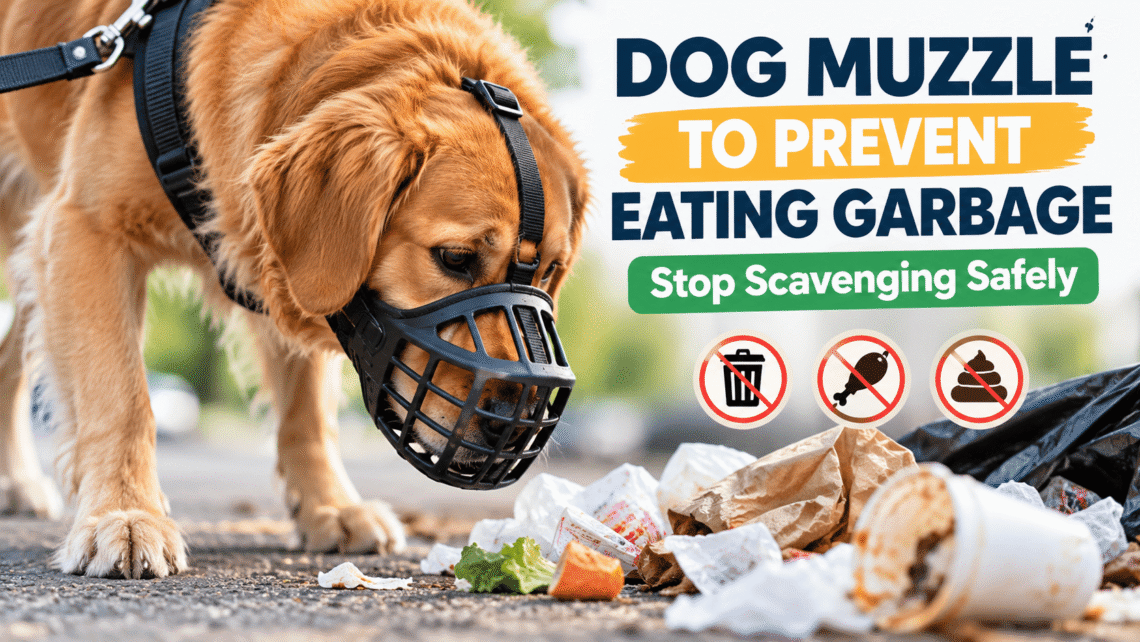
Dog Muzzle to Prevent Eating Garbage
Does your dog treat every walk like a buffet? Learn how the right muzzle can help prevent access to garbage, food scraps, feces, rocks, plastic, and other dangerous objects without treating the muzzle as a substitute for training.
Dog Muzzle to Prevent Eating Garbage
A complete guide to scavenging prevention, muzzle types, small-object protection, proper fit, panting room, training, troubleshooting, and safe walking.
Dog Muzzle to Prevent Eating Garbage: Does It Actually Work?
Yes—a properly selected muzzle can act as a physical barrier that helps prevent a dog from picking up unwanted objects during walks. But there is an important distinction: not every muzzle blocks every type of scavenging. The result depends on the muzzle’s design, the size of its openings, the dog’s facial shape, the fit, and the particular objects the dog is trying to eat.
A muzzle can manage access—but the design has to match the problem.
A basket-style muzzle is commonly used when a dog needs to pant, drink, and receive appropriate reinforcement while wearing it. For serious scavengers, however, the open front of a conventional basket may still leave enough access for small food items or other material. That is where anti-scavenge barriers or specialty designs can become important.
- The opening and barrier design
- Correct facial measurements
- Stable positioning during movement
- Appropriate panting space
- Gradual muzzle conditioning
Think of the muzzle as a four-part system
A successful anti-scavenging setup is more than the word “muzzle” on a product page. Each part of the system has a separate job.
Barrier
The front structure limits access to objects the dog would otherwise pick up.
Fit
The muzzle needs to remain correctly positioned without unnecessary pressure.
Function
Appropriate panting and other intended functions must remain possible.
Training
The muzzle manages access while training teaches the dog what to ignore.
What your dog eats changes the muzzle requirement
Select the behavior closest to what you see on walks.
What a suitable muzzle can do
- Create a physical barrier against unwanted objects
- Reduce opportunities for scavenging during walks
- Support safer management while training is underway
- Allow appropriate panting when the design and fit are suitable
- Help owners manage repeated outdoor object-seeking behavior
What a muzzle cannot do by itself
- Teach a dog the “leave it” behavior
- Guarantee that every opening will block every small object
- Correct a poor fit through tighter straps
- Replace veterinary evaluation for persistent non-food ingestion
- Make unsafe swallowing irrelevant if the muzzle is removed or improperly used
If the dog cannot pant appropriately, the muzzle shifts into an unsuitable position, causes significant rubbing or pressure, or interferes with normal function, the setup needs to be reassessed. Do not solve a sizing or design mismatch simply by tightening the straps.
Sources & References
Why Does My Dog Eat Garbage on Walks?
Dogs scavenge for different reasons, and the reason matters when you are deciding how to manage the behavior. A dog may be attracted to food smells, reinforced by previous finds, curious about objects, or repeatedly seek out non-food material. Understanding the pattern helps you avoid treating every scavenging problem as exactly the same thing.
Food-Seeking
Strong smells and rewarding finds can reinforce the behavior.
Exploration
Dogs naturally investigate their environment with the nose and mouth.
Learned Habit
Repeatedly finding something interesting can strengthen scavenging.
Opportunity
Easy access to sidewalks, bins, food, and discarded objects creates opportunities.
Persistent Ingestion
Repeatedly eating non-food items deserves closer attention.
Garbage smells like a reward
Discarded food can carry strong, interesting smells. When a dog successfully finds something edible on a walk, that discovery can reinforce the search behavior and make the next walk more challenging.
Dogs investigate the environment with their mouths
Sniffing, investigating, carrying, licking, and mouthing objects can all occur during normal exploration. Problems arise when investigation turns into repeated swallowing of unsafe material.
One successful find can teach the dog to keep looking
Scavenging can become self-reinforcing because the dog occasionally discovers food or another highly interesting object. The owner may see dozens of ignored items and then one successful find is enough to strengthen the pattern.
The walking environment creates repeated opportunities
Busy sidewalks, parks, bins, picnic areas, trails, and heavily used dog-walking routes can all contain material that attracts a scavenging dog. Reducing opportunities is therefore part of the management strategy.
Some dogs repeatedly ingest non-food material
A dog that repeatedly seeks and swallows non-food objects is different from a dog that occasionally grabs a discarded treat. Persistent non-food ingestion can have behavioral or medical contributors and is worth discussing with a veterinarian.
Identify your dog’s scavenging pattern
Choose the closest match to see what deserves the most attention.
Focus on preventing access to small food items, while reinforcing the habit of moving away from tempting objects. The muzzle design becomes especially important if your dog can still reach small pieces through the front opening.
Ordinary scavenging or something that needs a closer look?
Occasional opportunistic scavenging
The dog mainly targets appealing food or interesting smells when an opportunity suddenly appears.
- Behavior is strongly linked to available food or objects
- Dog can disengage with training and guidance
- Not every available object is swallowed
- Management can substantially reduce opportunities
Persistent non-food ingestion
Repeatedly swallowing non-food material is a different pattern and can warrant veterinary assessment.
- Frequently seeks non-food objects
- Repeatedly swallows material rather than simply investigating it
- Pattern occurs across different environments
- Medical or behavioral contributors may need evaluation
Why this matters when choosing a muzzle
The question is not simply “What muzzle stops a dog from eating?” Start by identifying what the dog targets and how the dog scavenges. A dog searching for small food scraps may need a different front-barrier strategy from a dog picking up larger objects. Once the behavior is understood, the next step is matching the muzzle design to that specific access problem.
Why Eating Garbage Can Be Dangerous for Dogs
The biggest problem with garbage scavenging is that you often cannot know exactly what a dog has picked up. A discarded food item may contain an unsafe ingredient, while a wrapper, bone, rock, medication, or other object can create a completely different type of hazard. The risk therefore depends on what was swallowed, how much was swallowed, and the dog’s individual circumstances.
Food scraps can contain hidden risks
Discarded food may contain ingredients or substances that are unsafe for dogs. Because the owner often cannot identify the full contents of garbage, preventing access can be safer than relying on the dog to choose correctly.
Common things dogs find—and why they matter
| Garbage Item | Possible Concern | Why Prevention Matters | Risk Type |
|---|---|---|---|
| Discarded food | Ingredients may be unsuitable or toxic to dogs, and the amount consumed may be unknown. | The contents are often impossible to identify before the dog eats them. | Food / Toxicity |
| Bones | May create choking, dental, or gastrointestinal problems depending on the object and circumstances. | A dog may grab a bone before the handler has time to intervene. | Physical |
| Plastic / wrappers | Non-food material can pass into the gastrointestinal tract and may contribute to obstruction. | Small wrappers can be especially difficult to notice on a busy walk. | Foreign Body |
| Rocks and stones | Swallowed rocks are among the objects associated with gastrointestinal foreign-body obstruction. | A determined dog may pick up an object before it can be safely removed. | Foreign Body |
| Medication | Some medications can cause poisoning even in relatively small amounts. | A discarded or dropped tablet can be difficult to spot outdoors. | Toxicity |
| Unknown objects | The material, size, sharpness, and contents may all be unknown. | Preventing access is easier than identifying a mystery object after ingestion. | Unknown |
Why the size and shape of the object matter
A muzzle does not have one universal “scavenging” capability. A design that blocks a large object may still leave enough access for a very small food scrap. Flat pieces, flexible wrappers, and small fragments can behave differently from larger rigid objects.
Often require the most attention to the front opening and any anti-scavenge guard.
Barrier design and overall basket shape can determine whether access is possible.
The muzzle may block mouth access, but the dog can still investigate the object.
Wrappers and thin material may require a different barrier approach from bulky objects.
What if your dog already swallowed something?
Prevention and medical response are different issues. If you know or strongly suspect that a dog swallowed a potentially dangerous object, contact a veterinarian promptly rather than assuming the object will pass safely.
- Swallowed bones or sharp material
- Rocks or other non-food objects
- Medication or potentially toxic material
- Plastic or other objects that may obstruct the digestive tract
The safest strategy is to prevent access before ingestion happens.
A suitable muzzle can provide one layer of physical management during walks, but the design needs to match what your dog is trying to pick up. Pair that management with training and environmental awareness rather than treating the muzzle as the entire solution.
Sources & References
Is a Muzzle Better Than “Leave It” Training?
For a dog that eats garbage, it does not have to be a choice between a muzzle and training. They solve different parts of the problem. A suitable muzzle can reduce physical access to dangerous objects right now, while training can teach the dog to disengage from things you do not want it to pick up.
Muzzle = management. “Leave it” = learned response.
A dog cannot learn a reliable “leave it” behavior if every walk repeatedly gives it opportunities to rehearse successful scavenging. A muzzle can reduce those opportunities while training is developed. Environmental management then lowers the number of tempting situations in the first place.
Dog Muzzle
Creates a physical barrier that can reduce access to unwanted objects during a walk.
- Works without requiring the dog to make the correct choice every time
- Can reduce access to garbage and other objects
- Useful while training is still developing
- Must be correctly sized, fitted, and introduced
“Leave It”
Teaches the dog to disengage from an item or target when given the cue.
- Builds a useful behavior that can apply beyond garbage
- Gives the handler an active response to emerging temptations
- Helps create better choices over time
- Requires repetition and appropriate reinforcement
Walk Management
Reduces how often the dog gets close enough to rehearse the scavenging behavior.
- Scan the route ahead
- Increase distance from known garbage hotspots
- Redirect before the dog reaches the object
- Keep the dog’s attention moving when appropriate
Which layer needs the most attention?
Answer these three quick questions to build a practical starting strategy.
How the three layers work together
A muzzle can reduce access, but it does not teach the dog what you want it to do when it notices garbage. The long-term goal is safer decision-making combined with appropriate physical management when necessary.
Sources & References
What Type of Dog Muzzle Stops Garbage Scavenging?
The best design depends on what your dog is trying to eat and how the dog approaches the ground. A conventional basket muzzle can provide useful access control while allowing appropriate panting and drinking, but a determined scavenger may still reach small items through its openings. For that situation, an anti-scavenge guard or another purpose-built front barrier may be more appropriate.
Match the barrier to the object—not just the dog.
“Basket muzzle” describes a broad category rather than one standardized design. For walking and scavenging management, look at the actual basket geometry, opening size, front barrier, retention system, and the space available for normal panting. A muzzle should be selected and fitted for the individual dog and the intended use.
Standard Basket Muzzle
A basket-style design is generally the starting point for longer walks where appropriate panting, drinking, and reinforcement access are important.
- Open basket structure
- Appropriate for extended-use applications when correctly fitted
- Usually easier for delivering treats
- May leave access to very small objects
Basket + Anti-Scavenge Guard
Adds a physical barrier across the lower/front portion of a basket to reduce access to food scraps, feces, rocks, and other small objects.
- Designed specifically around scavenging prevention
- Better suited to small-object access problems
- Can remain part of a basket-style system
- Treat delivery can be more limited depending on the exact design
Soft / Sleeve Muzzle
A snug fabric-style muzzle may restrict mouth opening and therefore is generally not the choice for prolonged outdoor use where panting and drinking are required.
- Useful for certain short-duration applications
- Restricts mouth opening more than a basket design
- Not the preferred option for prolonged walking needs
- Do not treat “covers the mouth” as equivalent to scavenging protection
Specialty-Shape Muzzle
Dogs with unusually short, broad, narrow, or otherwise distinctive facial proportions may need a design built around a different geometry.
- Useful when conventional basket proportions do not work
- Consider the complete dimensional requirements
- Fit should be evaluated on the individual dog
- A different shape can solve a mismatch that sizing alone cannot
Find the design direction
Choose what your dog does most often and how severe the access problem is.
Muzzle type comparison for scavenging
| Design | Small-Object Barrier | Panting / Drinking | Walking Use | Best Fit Scenario |
|---|---|---|---|---|
| Standard basket | Depends on openings | Generally designed to permit normal function | Often appropriate | General muzzle use where small-object access is not the primary concern |
| Basket + anti-scavenge guard | Stronger barrier | Depends on exact design and fit | Often appropriate | Dogs that specifically target food waste, feces, rocks, or similar objects |
| Soft / sleeve | Mouth access is more restricted | More limited | Short-duration focus | Temporary situations where prolonged panting and drinking are not required |
| Specialty geometry | Depends on design | Depends on design | Model-specific | Unusual facial shapes or cases where conventional proportions do not work |
The basket structure can provide the space needed for panting and drinking, but its openings may still permit a determined dog to reach small material. Manufacturer-specific anti-scavenge guards are designed to address that access problem. Check the exact product design rather than assuming that all basket openings provide the same level of scavenging prevention.
The selection logic is simple
Start with the dog’s behavior, then evaluate the barrier, then confirm fit and function. Do not reverse the process by choosing a size first and trying to make it solve a different problem.
Sources & References
The Small-Object Test: Will Your Muzzle Actually Stop Scavenging?
A muzzle can look highly restrictive from a distance and still leave an opening that a determined dog can use to reach a small object. This is particularly important for dogs that target food scraps, feces, wrappers, tiny fragments, or other objects close to the ground. The useful question is not simply “Does my dog wear a muzzle?” but “Does this muzzle’s front barrier actually address the size and shape of the objects my dog targets?”
Compare the access opening with the type of object your dog targets.
The exact geometry of a muzzle is more complicated than a single width measurement, so a simple dimension comparison is only a screening tool—not a guarantee of real-world performance. It can, however, help identify when a very small object may still have an obvious access path.
If you evaluate the opening, use a clean, inert object or gauge that cannot reasonably be swallowed and do not allow the dog to interact with it. Never use real food waste, medication, bones, sharp debris, plastic trash, or another object the dog might ingest. This article’s calculator is a geometry aid, not a safety certification.
Opening vs. object size
If an object’s relevant dimension is clearly smaller than an opening, that opening may present a possible access route. The dog, muzzle shape, angle, and object flexibility still determine what actually happens.
Ground-level movement matters
Dogs that scavenge often lower their heads, sniff closely, and push the muzzle toward the ground. A design that looks stable while standing may behave differently once the dog is moving through the environment.
Small-Object Access Screening Tool
Enter approximate dimensions to see whether the opening is obviously larger than the simulated object.
How to interpret the screening result
Object clearly smaller
Treat the opening as a possible access route that deserves further physical inspection, especially when your dog actively targets objects of that size.
Object near opening size
Borderline geometry needs more caution. The shape of the object and the actual basket structure may substantially change what the dog can reach.
Object same size or larger
The entered dimensions do not suggest an obvious straight-through opening path, but that still does not certify the muzzle as anti-scavenge protection.
Four checks that matter more than the calculator
The small-object test is a screening tool, not a guarantee.
If your dog specifically targets tiny objects, a wide-open basket should not be assumed to provide complete scavenging prevention. Use the opening comparison to identify questions, then evaluate the exact muzzle design, physical fit, movement, and intended use. When the barrier does not match the behavior, investigate an anti-scavenge or specialty design rather than trying to solve the mismatch through tighter straps.
How to Fit a Muzzle for a Dog That Scavenges
Fitting a muzzle for a scavenging dog requires more than finding a circumference that matches a chart. The muzzle must sit in the intended position, remain secure when your dog lowers its head, provide the functional space required by its design, and create the level of physical access control you actually need.
Snout Length
Use the exact starting and ending points specified by the manufacturer.
PrimarySnout Circumference
Record the circumference using the manufacturer's defined measuring position.
PrimaryHeight / Width
Important when the facial profile does not match a simple length-to-circumference shape.
GeometryNeck / Head
Check the retention measurement whenever the manufacturer requires it.
RetentionThe five-step scavenger-fit process
Match the manufacturer's measurement method
Start with the exact measuring points for the brand and model. Do not combine a length measurement from one sizing system with a circumference rule from another.
Check the complete dimensions
A circumference match does not automatically mean the muzzle has the correct internal length, height, width, or overall geometry for your dog.
Position the muzzle correctly
The basket should sit where the manufacturer intends it to sit and should not migrate excessively toward the eyes, backward toward the face, or sideways.
Test it when the dog moves and sniffs
Scavenging happens at ground level. Watch what happens when your dog lowers its head, sniffs, turns, walks, and investigates the environment under supervision.
Verify function
Confirm that the selected design provides the functional space required for appropriate panting and other intended uses. A tight fit is not a substitute for a suitable design.
Quick Muzzle Fit Audit
Mark each statement Yes or No. The score is only a screening aid.
Standing fit vs. sniffing fit
Looks fine while standing
The muzzle appears secure, but the dog has not yet been observed performing the movement that triggers its scavenging behavior.
- Basket shifts when the head lowers
- Front barrier moves closer to the ground
- Straps rely on excessive tension
- Dog finds a new access angle
Stable during supervised sniffing
The dog can move naturally while the muzzle remains in the intended position and keeps the appropriate functional space.
- Position remains stable
- No obvious rubbing or pressure
- Front barrier remains appropriate
- Appropriate panting function is preserved
Excessive tightening can create a different problem while failing to solve an underlying size or geometry mismatch. If the muzzle remains unstable, causes rubbing, restricts appropriate function, or does not provide the needed scavenging barrier, reassess the size, design, or model.
Use the full MuzzlesShop measurement guide before making a final size decision. It covers snout length, circumference, height, width, neck/head measurement, chart comparison, and the final fit test.
Open the Dog Muzzle Size Calculator & Fit Guide →Sources & References
Does the Muzzle Still Work When the Dog Is Sniffing the Ground?
This is one of the most useful checks for a dog that scavenges. A muzzle may appear perfectly positioned while the dog is standing still, yet its position can change when the dog lowers its head and investigates the ground. Because scavenging usually happens during that exact movement, the fit needs to be evaluated during normal supervised motion—not only in a stationary pose.
Yes—sniffing should be part of the fit check.
The goal is not to make the dog keep its head up. The goal is to see whether the muzzle remains in its intended position when the dog naturally lowers its head. Watch for excessive forward movement, sideways rotation, contact with the ground, or changes in the clearance around the face.
Interactive Sniffing-Position Check
Select the movement you want to inspect.
What should you watch when your dog lowers its head?
Forward / backward movement
Watch whether the basket repeatedly shifts toward the eyes or retreats excessively toward the face when the head angle changes.
Side-to-side movement
The muzzle should not swing dramatically from one side to the other simply because the dog changes its head position.
Front-barrier stability
The part intended to reduce scavenging access needs to remain in the position where it can perform that function.
Eye and face clearance
Head movement should not cause the muzzle to migrate into inappropriate contact with the eyes or surrounding facial areas.
Strap stability
If the muzzle only stays in place when the retention strap is excessively tight, reconsider the size or geometry instead of simply tightening further.
Functional space
The dog's change in head position should not create an obvious restriction of the functional mouth-opening space required for appropriate panting.
Signs that the sniffing test deserves a re-check
- The muzzle repeatedly moves toward the eyes
- The basket swings substantially from side to side
- The front barrier changes position enough to create a new access path
- The dog can reposition the muzzle by pushing against the ground
- The retention strap has to be tightened excessively to maintain position
- Head movement causes obvious rubbing or pressure
The most realistic fit test is the movement your dog actually performs.
For a scavenging dog, that often means walking with the head down, sniffing, and investigating the ground. A muzzle that remains stable through those movements gives you more useful information than a stationary fit check alone.
Sources & References
How Much Panting Room Does a Scavenging Dog Need?
A muzzle designed to reduce scavenging still has to leave the dog enough usable space for normal panting. That matters especially during walks, warm weather, exercise, excitement, and other situations where a dog may need to open its mouth substantially. The goal is not simply “smallest opening possible.” It is the right balance between access control, stability, and functional breathing room.
Do not trade panting function for a tighter anti-scavenge fit.
A properly selected basket-style muzzle should allow the dog to open its mouth and pant appropriately while the muzzle remains securely positioned. For a scavenging dog, the challenge is finding enough functional room without leaving an opening that defeats the purpose of the muzzle.
Functional panting space
The muzzle provides structural room for mouth opening while remaining positioned correctly.
Too restrictive
A smaller-looking opening may block scavenging more aggressively, but that does not automatically make it the right design.
What “enough panting room” means in practice
The mouth needs functional space
The muzzle should accommodate the mouth opening needed for appropriate panting rather than functioning like a tight sleeve around the muzzle.
Room must remain available during movement
Check the dog's head position while walking and sniffing. A muzzle can behave differently once the dog changes posture.
Anti-scavenge does not mean airtight
The objective is controlled access to unwanted objects, not sealing the muzzle closed. The design should retain appropriate ventilation and functional clearance.
Temperature changes the context
Heat, activity, excitement, and exertion can increase panting. A muzzle intended for walking should be evaluated with those real-world conditions in mind.
Sniffing should not collapse the usable space
When the dog lowers its head, observe whether the muzzle remains positioned rather than pressing back toward the face.
Fit and geometry work together
A different muzzle model may solve a clearance problem more effectively than simply tightening the same muzzle.
Panting-Room Fit Audit
Check each statement that is true for your dog's current muzzle.
“Make it tighter so the dog cannot get anything.”
Excessive tightening is not a substitute for choosing the right muzzle geometry. Pressure-based adjustments can create new fit concerns without solving the underlying access problem.
“Choose the barrier first, then confirm functional room.”
Start with the size and type needed to reduce the dog's access to the objects it targets. Then confirm that the resulting muzzle still supports appropriate panting and stable movement.
Test the muzzle before the difficult walk.
Introduce and check the muzzle in a controlled setting first. Observe the dog standing, walking, turning, and lowering its head. For a scavenging dog, the useful question is not merely “Can the dog wear it?” but “Can the dog wear it comfortably while the muzzle still performs its intended access-control function?”
The best scavenging muzzle is not the one with the least space—it is the one with the right space.
Panting room, stability, ventilation, and scavenging control all need to work together. A design that blocks garbage but compromises functional use is not solving the complete walking problem.
Sources & References
Can a Dog Still Eat Poop, Grass, or Tiny Food Through a Muzzle?
Sometimes the answer can be yes. A muzzle should not be judged only by its label—such as “basket muzzle.” The important question is whether the dog's particular target can still physically reach the mouth through the available openings. Small food scraps, feces, grass, and other tiny objects may require a different barrier strategy than larger pieces of garbage.
A muzzle can block an object without blocking every possible small object.
Opening size, opening shape, muzzle geometry, and fit all affect what the dog can physically reach. That is why a muzzle that works well for grabbing larger trash should not automatically be assumed to prevent access to tiny food, feces, or small ground debris.
Access depends on the openings
The available gap between parts of the muzzle can create an access path. A smaller target may behave very differently from a larger object.
Fit can change that access path
Movement, head position, and muzzle placement can alter the practical relationship between the muzzle opening and the ground.
Test the intended function
A design should be evaluated for the actual scavenging problem rather than assumed to work simply because it is marketed as a basket or anti-scavenge muzzle.
Different targets create different access problems
| Target | Why Access Can Be Different | What to Examine | Design Consideration |
|---|---|---|---|
| Small food scraps | Small pieces may fit through openings that comfortably stop larger rubbish. | Opening width, shape, and the dog's ability to position the muzzle near the ground. | High attention |
| Feces | A small or soft target may present a different access challenge than solid trash. | Front barrier coverage and whether the dog can reach the target through or around openings. | High attention |
| Grass | Grass blades and clumps can be narrow and flexible compared with ordinary garbage. | Whether the dog can place the muzzle against the ground and pull material through an opening. | Variable |
| Rocks | Larger solid objects may be blocked more readily, but dimensions vary greatly. | The actual size of the target relative to the available access opening. | Geometry matters |
| Mixed garbage | A walk may contain objects ranging from tiny food fragments to larger packaging. | The smallest realistic target—not just the average piece of trash. | Test carefully |
What is your dog's actual target?
Pick the closest match to see what deserves the most attention.
“Basket muzzle” does not automatically mean “cannot eat anything.”
Basket muzzles are designed to provide space around the dog's mouth while allowing appropriate functions such as panting and, depending on the design, drinking and treat delivery. But the size and shape of their openings vary. For a dog that scavenges very small targets, the opening itself becomes an important part of the problem to solve.
What should you do if the dog can still reach tiny objects?
Identify the smallest target
Think beyond “garbage.” Is the dog mainly after crumbs, feces, grass, small stones, wrappers, or another specific material?
Re-check the opening and geometry
Look at the actual front and lower access points. The relevant question is whether the dog's target can approach the mouth through the available space.
Re-check the fit during sniffing
A muzzle that looks secure while standing may behave differently when the dog's head moves downward toward the ground.
Consider a different anti-scavenge design
When the target is consistently tiny, choosing a model with a more suitable barrier can make more sense than repeatedly tightening a model that was not designed for the problem.
Keep training part of the solution
Physical management can reduce access while training teaches the dog what to do when it notices something interesting on the ground.
Escalate persistent non-food eating
If the dog repeatedly ingests non-food items, do not treat the muzzle as the entire solution. The underlying behavior may warrant veterinary discussion and a broader management plan.
The smallest thing your dog targets may determine the muzzle you actually need.
A muzzle that stops a sandwich wrapper may not stop every crumb. A design that limits larger objects may still leave a path to grass or other small material. Start with the real target, then evaluate opening size, barrier coverage, fit, and movement together.
Sources & References
Dog Muzzle for Garbage: What About Treats During Training?
A garbage-prevention muzzle is meant to manage access, but training still matters. That creates a practical question: how do you reward your dog when the muzzle is on? The answer depends on the muzzle's design, the way you train, and whether the muzzle allows safe access for the type of reward you use.
Choose a muzzle that supports the training method you actually plan to use.
Some muzzle designs make reward delivery easier than others. For scavenging work, this is important because the physical barrier and the training plan should complement each other, rather than forcing you to remove the muzzle every time you need to reward a behavior.
The muzzle manages access
It can reduce the opportunity to grab unwanted material while you work on the dog's behavior and walking habits.
Rewards reinforce choices
When the dog disengages from a tempting ground item, a suitable reward can help strengthen that response over repeated training sessions.
Design affects convenience
Opening shape, muzzle depth, and the location of the access point can influence how easy it is to deliver rewards without compromising the muzzle's intended function.
Common ways to reward a muzzled dog
Muzzle-compatible reward delivery
Some basket-style designs are intended to make reward delivery possible through the muzzle. Follow the manufacturer's guidance for the specific model.
Design dependentReward after the walking moment
You can also reinforce a successful disengagement after moving away from the trigger, using a reward delivery method that does not require repeatedly manipulating the muzzle.
Simple optionUse training setups with larger rewards
During controlled practice, you can plan reward delivery around the muzzle design rather than discovering mid-session that the chosen treat is impossible to deliver conveniently.
Plan firstWhich training situation are you working on?
Select the closest match to see the main design priority.
Before relying on treats through the muzzle, check these three things
A practical reward-training sequence for scavenging
Start with the muzzle away from distractions
Build a positive association with the muzzle before asking the dog to solve difficult scavenging situations outdoors.
Reward calm behavior
Reinforce looking toward you, walking calmly, or voluntarily engaging with you instead of immediately searching the ground.
Add low-level ground distractions
Practice at a difficulty level where the dog can notice the distraction and still respond to your cue.
Reward disengagement
When the dog turns away or follows your cue rather than pursuing the ground target, reinforce that choice consistently.
Gradually increase real-world difficulty
Move from controlled practice toward ordinary walks only as the dog can handle the distraction level without repeatedly rehearsing scavenging.
Keep the muzzle as management, not the lesson
The muzzle helps prevent access; training should continue teaching the dog how you want it to respond around tempting objects.
Do not assume every treat-delivery method works with every muzzle.
Some muzzle styles have restricted openings or specialized barriers that make conventional reward delivery difficult. The correct approach is model-specific: check the manufacturer's instructions and confirm the dog can receive rewards in a way that remains practical, comfortable, and consistent with the muzzle's intended purpose.
The muzzle should make training easier to manage—not replace training.
For a dog that eats garbage, the strongest routine combines physical prevention with reinforcement for disengaging from tempting objects. Choose a muzzle that supports the behavioral plan you can realistically use on walks.
Sources & References
How to Muzzle Train a Dog That Eats Everything
A muzzle works best when the dog is comfortable wearing it and you have already built a positive association with the equipment. For scavenging dogs, that means teaching muzzle comfort separately from the difficult outdoor behavior, then gradually combining the two. The objective is calm, predictable muzzle use—not simply getting the muzzle onto the dog.
Introduce the muzzle first. Add scavenging distractions later.
A dog that is still worried about the muzzle has less room to learn during a difficult walk. Build the association in small steps, reward calm participation, and increase difficulty gradually. Keep the physical barrier and the behavior training as two connected—but distinct— parts of the plan.
Comfort before challenge
Start in a low-distraction environment. The dog should have an opportunity to become comfortable with the muzzle before encountering the difficult scavenging triggers.
Reward voluntary participation
Reward calm investigation and wearing behavior so the muzzle predicts useful and positive experiences.
Increase difficulty gradually
Move from quiet practice to ordinary walking only when the dog can remain comfortable and responsive at the easier level.
Step-by-step muzzle training for a scavenging dog
Let the dog notice the muzzle
Present the muzzle calmly and pair its appearance with something pleasant. Avoid rushing directly to fastening it.
Start hereEncourage voluntary approach
Allow the dog to investigate the muzzle and reward calm, voluntary interaction rather than forcing the face into it.
No rushingBuild brief wearing periods
Once the dog is comfortable with the equipment, gradually introduce short periods of wearing it while maintaining a calm, positive experience.
GradualAdd normal movement
Practice standing, walking, turning, and other ordinary movements before adding tempting ground objects.
MovementAdd low-level scavenging distractions
Start at a distance and difficulty where the dog can still respond to you instead of repeatedly rehearsing the unwanted behavior.
ControlledGeneralize to real walks
Gradually introduce more realistic environments while continuing to monitor comfort, fit, movement, and the dog's response to ground distractions.
Real-worldBuild the next training step
Pick the stage closest to where your dog is today.
Focus on muzzle association first
Keep the environment easy. Let the dog investigate the muzzle, pair it with positive experiences, and avoid adding a difficult garbage-scavenging scenario too early.
Your next practical session
Increase difficulty only when the current level is working
Muzzle
Calm observation, approach, and positive association in an easy environment.
Wear
Brief wearing periods while the dog remains relaxed and engaged with normal activities.
Move
Walk, turn, and lower the head while checking both comfort and muzzle stability.
Distract
Add mild ground distractions where the dog can still respond to the handler.
Generalize
Gradually move toward more realistic outdoor environments and more challenging routes.
Do not simply push through the difficulty.
Repeatedly exposing the dog to a level it cannot handle can make the exercise less productive. Reduce the distraction, shorten the session, or return to an easier step.
Make the next repetition easier.
Increase distance from the trigger, simplify the environment, or return to a behavior the dog already performs reliably. Then build difficulty again more gradually.
A muzzle is management—not permission for unsupervised scavenging.
Continue supervising the dog when the muzzle is being used for scavenging management. Check fit, stability, panting room, and comfort throughout the session. A muzzle also does not address every reason a dog may repeatedly ingest non-food objects; persistent or concerning ingestion should be discussed with a veterinarian.
The goal is not merely to make a scavenging dog wear a muzzle.
The goal is to create a repeatable routine in which the dog is comfortable in the muzzle, the equipment manages access to unwanted objects, and the dog gradually learns to disengage from ground distractions and reconnect with the handler.
Sources & References
The Complete Anti-Scavenging Walking Plan
A dog muzzle can reduce access to garbage, but the most reliable walking routine does not depend on the muzzle alone. The strongest approach combines preparation, appropriate equipment, route awareness, handler timing, disengagement training, and ongoing observation. The plan below turns those pieces into one repeatable system.
Prevent the grab before it becomes a struggle.
The goal is to notice likely scavenging opportunities early, keep the dog within a manageable level of distraction, use the muzzle as a physical access-control layer, and reinforce appropriate disengagement. Good management reduces the number of times the dog gets to rehearse the unwanted behavior.
Prepare
Check equipment and choose a manageable route.
Observe
Scan the environment for likely scavenging triggers.
Manage
Use distance, positioning, and the muzzle to reduce access.
Cue
Ask for a known disengagement behavior at the right moment.
Reward
Reinforce the choice to disengage and reconnect.
Review
Learn from the walk and adjust the next session.
Before you leave the house
Check the muzzle
Confirm the muzzle is positioned correctly, stable, and appropriate for the dog's intended use. Recheck the areas covered in the earlier fit sections of this guide.
Choose the environment deliberately
A very difficult route can overwhelm training. Consider where food debris, trash, animal waste, or other ground targets are likely to appear.
Pick one training focus
Examples include checking in with you, responding to “leave it,” or walking past mild distractions. Avoid trying to solve every behavior during one session.
Plan your reward strategy
Use a reward method compatible with the muzzle and your training setup. You should know in advance how you will reinforce successful disengagement.
Build a walk around your dog's scavenging level
Choose the closest description of today's environment.
Use this walk to build reliability
Keep the environment manageable. Reward engagement with you, practice easy disengagement, and avoid unnecessarily difficult ground distractions.
A simple anti-scavenging walk sequence
Leave calmly
Start the walk without immediately heading into the highest-distraction area.
Scan ahead
Look for food, garbage, feces, rocks, or other objects your dog commonly targets.
Create distance
Move around or away from the trigger when doing so is practical and safe.
Cue early
Use the disengagement behavior before the dog is already committed to the target.
Reward
Reinforce the response using your planned muzzle-compatible reward strategy.
Keep moving
Continue the walk after the successful disengagement instead of lingering over the trigger.
Use the trigger as a training opportunity.
The ideal moment is often before the dog's nose is directly over the object. Early intervention gives you more room to create distance, cue a known behavior, and reward the dog's decision to disengage.
Prioritize management over a perfect training repetition.
Real walks are unpredictable. A sudden piece of food, open rubbish bag, or animal waste may appear before you have time to plan a clean training repetition. In those moments, focus on preventing access and regaining control, then return to easier practice later.
End-of-Walk Scavenging Scorecard
Check what went well so you can adjust the next walk intelligently.
Do not automatically make the next walk harder.
Frequent successful repetitions are more useful than repeatedly placing the dog in an environment that is beyond its current ability to disengage reliably.
Change one variable at a time.
Shorten the route, increase distance from triggers, choose a quieter area, or return to easier exercises before gradually increasing difficulty again.
Think of the muzzle as one layer in a complete anti-scavenging system.
The muzzle provides physical management. Your route, timing, distance, cues, rewards, and training history determine how effectively that management works in everyday situations. The best routine is the one you can repeat consistently and safely.
Sources & References
What If Your Dog Still Tries to Eat Everything?
A muzzle can reduce physical access, but some dogs will continue trying to investigate, grab, or ingest ground objects even after equipment and training are introduced. That does not automatically mean you need a tighter muzzle. First determine whether the remaining problem is related to fit, the environment, training difficulty, or a broader pattern of persistent ingestion.
When scavenging continues, diagnose the remaining gap instead of simply tightening the muzzle.
A dog may still make repeated attempts even when the muzzle is doing its physical job. Look at what is actually happening: Is the dog reaching the target? Is the muzzle shifting? Is the dog over-threshold around the trigger? Is the target unusually small? Or is the dog repeatedly ingesting non-food items across many situations? Each pattern points toward a different next step.
Four reasons the behavior may still look “unfixed”
The muzzle is not solving the access path
The dog may still be able to physically reach a very small target through or around an opening.
Re-check geometryThe environment is harder than the training level
A dog may understand a cue in a quiet area and still struggle when the ground contains multiple high-value distractions.
Lower difficultyScavenging is highly rehearsed
Dogs can develop strong habits around opportunities to search, grab, and consume interesting objects.
Manage + retrainThe ingestion pattern may be broader than scavenging
Persistent consumption of non-food items can warrant a veterinary discussion rather than being treated as only a walking-management problem.
Consider evaluationThe route itself creates repeated opportunities
A highly contaminated route may simply contain more triggers than your current training plan can realistically handle.
Change routeThe dog has not generalized the skill yet
Success in one environment does not necessarily transfer immediately to every street, park, trail, or unfamiliar surface.
Build graduallyIs this mainly a muzzle, training, or broader behavior problem?
Select the situation that most closely matches what you are seeing.
Re-check physical access first
If the dog is actually reaching target material, revisit the muzzle's opening, barrier geometry, and head-down fit before changing the training plan.
Match the symptom to the next thing to investigate
| What you see | What it may indicate | First thing to review | Direction |
|---|---|---|---|
| Dog physically reaches tiny food | Available access may still be large enough for the target. | Opening size, barrier coverage, and head-down positioning. | Fit / Design |
| Dog tries constantly but cannot grab anything | The muzzle may be restricting access while the scavenging behavior remains strong. | Training level, trigger distance, and route difficulty. | Training |
| Good at home, poor in busy areas | The environment may be substantially more distracting. | Generalization and difficulty progression. | Training |
| Eats rocks, fabric, plastic, or other non-food objects | The pattern may be broader than ordinary food-seeking on walks. | Frequency, variety, and persistence of non-food ingestion. | Veterinary review |
| Muzzle shifts whenever the dog pushes downward | Fit or retention may not be adequate for real-world movement. | Sizing, geometry, strap stability, and sniffing fit. | Fit / Design |
| Behavior gets worse after repeated difficult walks | Current exposure may be too challenging for the dog's training level. | Distance, environment, and frequency of difficult repetitions. | Training |
Tighten the same muzzle every time the dog still tries.
Repeated attempts do not automatically prove that the muzzle needs to become tighter. The dog may be showing a strong behavior response even though the physical barrier is already preventing access.
“Can the dog reach the target, or is the dog only trying?”
That distinction is extremely useful. Actual access points toward a fit or design issue; repeated unsuccessful attempts may call for easier training conditions and better disengagement practice.
When the pattern is bigger than ordinary walk scavenging
A dog that persistently consumes non-food objects across different environments deserves more than a muzzle-only plan. The broader pattern can be relevant to veterinary evaluation, particularly when the ingestion is frequent, escalating, difficult to interrupt, or associated with other concerning signs.
- Repeatedly consuming multiple types of non-food objects
- The behavior occurs both outdoors and indoors
- The dog repeatedly swallows objects rather than only carrying or investigating them
- The pattern is persistent despite substantial management
A dog can keep trying to scavenge even when the muzzle is working.
The important diagnostic question is whether the dog is still gaining access to the target. When access is already blocked, the next gains often come from training, environmental management, gradual exposure, and understanding why the dog repeatedly seeks or ingests certain materials.
Sources & References
When Eating Everything Could Be Pica or a Veterinary Issue
Some dogs occasionally pick up interesting things outside. Others repeatedly swallow non-food materials such as rocks, plastic, fabric, or other objects. When non-food ingestion is persistent or broad, it deserves a different level of attention than ordinary opportunistic scavenging. A muzzle can help with immediate access management, but it should not be the only part of the plan.
“Scavenging” describes what the dog does; it does not explain why.
A dog may search for food outdoors because the opportunity is rewarding, while another dog may repeatedly ingest non-food materials across different situations. Persistent non-food ingestion can have behavioral and medical considerations, which is why a veterinarian may be part of the evaluation.
Opportunistic scavenging
The dog mainly seeks edible or highly interesting items when an opportunity appears, often around walks, food debris, or other rewarding environmental triggers.
Persistent non-food ingestion
The dog repeatedly consumes non-food materials rather than simply sniffing or carrying them. This broader pattern may warrant veterinary assessment.
Patterns worth paying attention to
Variety of non-food objects
The dog targets several different types of materials rather than one predictable category of outdoor food debris.
Repeated swallowing
The behavior involves actual ingestion rather than occasional investigation, mouthing, or carrying.
Indoor and outdoor behavior
The dog seeks or consumes non-food materials in multiple environments, not only during scavenging walks.
Persistent despite management
The pattern remains frequent or concerning even when access to likely targets is actively managed.
Escalating frequency
The behavior appears to be becoming more frequent, more intense, or harder to interrupt.
Other concerning changes
Changes in appetite, digestion, energy, or general behavior can provide additional context for a veterinary conversation.
What pattern sounds closest?
This is a planning tool—not a diagnosis.
Continue management and focus on scavenging training.
When the pattern is mainly food-seeking outdoors, the earlier sections on muzzle design, walking management, and disengagement training may be especially relevant.
What information can help during a veterinary visit?
Record the actual objects
A useful history is more specific than “my dog eats everything.” Note the materials being targeted whenever you can do so safely.
Record the context
Patterns are often easier to understand when the setting and circumstances are documented over time.
Continue sensible access management.
Reduce opportunities for the dog to swallow dangerous objects. A correctly fitted muzzle can be part of that strategy when appropriate, alongside supervision and environmental control.
Do not treat the muzzle as the explanation.
The equipment may prevent access without telling you why the behavior happens. If the pattern is persistent or broad, continue looking beyond the physical barrier.
Swallowed objects can become an urgent problem
If you know or strongly suspect that your dog has swallowed a potentially dangerous object, contact a veterinarian promptly for guidance rather than waiting to see whether the object passes. This is especially important for objects that may cause injury, obstruction, or poisoning. Do not attempt to induce vomiting unless a veterinary professional specifically advises you to do so.
A muzzle can manage the immediate risk, but persistent ingestion deserves a bigger picture.
For occasional outdoor scavenging, equipment and training may address much of the problem. When a dog repeatedly consumes many kinds of non-food materials, occurs in multiple settings, or continues despite management, veterinary input becomes an important part of deciding what should happen next.
Sources & References
What to Do If Your Dog Already Swallowed Garbage
Prevention is the goal, but accidents happen. When a dog has already swallowed garbage, the right response depends on what was swallowed, how much may have been swallowed, when it happened, and whether the dog is showing signs of illness. Some swallowed objects pass without complications, while others can cause poisoning, gastrointestinal obstruction, or serious internal injury.
Contact a veterinarian promptly when the swallowed material could be dangerous.
Do not wait for severe symptoms before asking for guidance when the object or substance may be hazardous. A veterinary professional can assess the specific material, the timing, the amount involved, and your dog's circumstances to determine what should happen next.
The four questions to answer immediately
What did the dog swallow?
Identify the material as specifically as possible. Packaging, medication, chemicals, bones, rocks, string-like materials, and other objects can create very different risks.
How much was swallowed?
Approximate quantity can matter, particularly when the material may be toxic or when several pieces of an object are missing.
When did it happen?
Tell the veterinarian when you saw the ingestion or when you believe it occurred. Timing can influence the recommended evaluation.
Is the dog showing symptoms?
Watch for vomiting, abdominal pain, loss of appetite, lethargy, breathing difficulty, collapse, or other unusual changes.
What was swallowed?
Use this as a prompt for the conversation with your veterinarian.
Unknown material needs prompt veterinary guidance.
When the contents of the swallowed garbage are unknown, do not assume that the material is harmless. Give the veterinarian as much information as you can about the location, packaging, missing items, and timing.
Why some garbage requires especially quick attention
Potentially toxic substances
Some medications, chemicals, foods, and household products can be harmful even when the dog initially appears normal. Toxic exposures should be discussed promptly with a veterinarian or veterinary poison service.
Non-digestible foreign objects
Objects such as rocks, bones, toys, clothing material, or packaging can potentially lodge in the gastrointestinal tract and cause obstruction.
String-like or linear material
String, ribbon, or similar materials can create particularly serious gastrointestinal complications and should not be treated as ordinary disposable garbage.
Bones and rigid fragments
Certain swallowed fragments may create injury or obstruction. The appropriate response depends on the object and your dog's circumstances.
Food wrappers and packaging
Packaging may be non-digestible, while the food residue or original contents may add another potential risk.
Unknown mixed garbage
Mixed waste is difficult to assess because its contents may be unknown. A veterinarian can help determine what information and next steps are appropriate.
Make the veterinary conversation easier
Gather whatever information is available. Packaging, ingredient labels, photographs, a sample of the material when appropriate, and an estimate of the amount and timing can help the veterinary team assess the situation.
Get professional guidance based on the specific ingestion.
Keep the material or its packaging available when possible, record the timing, and describe any changes you observe. The appropriate response depends heavily on what was swallowed.
Do not induce vomiting unless a veterinary professional specifically directs you to.
Inducing vomiting is not appropriate for every ingestion and can sometimes create additional risk. Contact a veterinarian or veterinary poison service for case-specific instructions.
Signs that call for immediate veterinary attention
A swallowed object or toxic substance can become serious even when the dog initially seems normal. Seek urgent veterinary care when severe or rapidly worsening signs appear.
Do not guess when the swallowed material could be dangerous.
The safest approach is to identify the material as well as possible, contact a veterinary professional promptly when there is meaningful risk, and follow case-specific guidance. A dog that swallowed garbage should not automatically be placed into a “wait and see” category simply because it looks normal immediately afterward.
Sources & References
How to Clean a Dog Muzzle After Garbage Walks
A dog muzzle used around garbage, food scraps, feces, wet ground, or other outdoor debris can collect residue that you do not want sitting against the equipment between walks. Cleaning should remove visible contamination, protect the muzzle's materials, and leave the equipment fully dry before storage or its next use.
Clean the muzzle according to its material and the manufacturer's instructions.
There is no single cleaning method that is ideal for every muzzle. Plastic, rubber, silicone, metal components, fabric straps, padding, and adhesives can have different care requirements. Start with the manufacturer's cleaning instructions and avoid harsh methods that may damage the materials or fittings.
Remove debris
Clear visible dirt and residue from the muzzle and straps.
Wash
Use the cleaning method appropriate for the specific material.
Rinse
Remove cleaning residue according to the manufacturer's care guidance.
Dry
Allow the muzzle and straps to dry thoroughly before storage.
Inspect
Check straps, seams, fasteners, and the barrier for damage.
A simple post-walk cleaning routine
Remove visible debris first
Inspect the inside and outside of the muzzle, including the lower edge, front barrier, vents or openings, and areas around the attachment points. Remove loose debris before washing.
Use the manufacturer's approved cleaning method
Check the care instructions for the exact muzzle model. Some products can be cleaned with mild soap and water, while other materials or components may have additional restrictions.
Pay attention to straps and attachment points
Dirt and moisture can collect around buckles, clips, adjustment points, and fabric straps. These parts deserve the same attention as the basket itself.
Rinse away cleaning residue
When the care instructions call for rinsing, make sure visible cleaning residue is removed before the muzzle returns to use.
Dry the entire muzzle
Do not store the muzzle while it is still wet. Check seams, straps, padding, and attachment areas rather than drying only the main basket.
Inspect before putting it back on the dog
Look for cracks, worn straps, damaged buckles, loose fittings, sharp edges, or changes in shape that could affect the muzzle's fit or function.
What type of muzzle material are you cleaning?
Select the closest match for a focused cleaning reminder.
Clean the basket and its openings thoroughly.
Plastic-style basket components commonly collect dirt around the lower edge and openings. Follow the product's care instructions and make sure cleaning residue is removed before use.
Post-Garbage-Walk Cleaning Checklist
Check each task after the muzzle has been cleaned and dried.
Drying and storage matter too
Dry every contact area
Moisture can remain in places that are easy to overlook, especially around fabric, padding, seams, buckle areas, and the junction between the basket and retention system.
Store it where the equipment can stay clean
Once dry, keep the muzzle in a clean location where it is unlikely to be crushed, contaminated, or exposed to conditions that could damage the materials.
Cleaning is also a good time to inspect the muzzle
A scavenging muzzle may be exposed to more ground contact and repeated movement than a muzzle used only in controlled situations. Look for changes that could affect comfort, stability, or the intended barrier function.
Follow the exact product-care instructions.
Material-specific care protects the muzzle from unnecessary wear. When instructions are available for the specific model, they should take priority over a generic cleaning recipe.
Do not improvise with aggressive cleaners or heat.
Strong chemicals, unsuitable solvents, or excessive heat may damage certain materials, coatings, adhesives, padding, or straps. Check the manufacturer's instructions first.
A clean muzzle is easier to inspect, easier to maintain, and ready for the next walk.
After a garbage-heavy outing, use the same repeatable sequence: remove debris, clean according to the product instructions, rinse when required, dry completely, and inspect the equipment before putting it away.
Sources & References
Best Features to Look for in a Garbage-Prevention Muzzle
When a dog eats garbage, “best muzzle” is rarely about one universal feature. The useful design depends on what the dog targets, how small those targets are, how much panting space is needed, how much the dog moves while sniffing, and whether the muzzle has to support training during the walk. The right feature set is the one that solves your dog's actual scavenging problem without creating a new fit or function problem.
Prioritize barrier geometry, fit, panting room, stability, and real-world usability.
A strong scavenging design should do more than sit over the dog's nose. It needs to remain appropriately positioned during walking and sniffing, reduce access to the specific materials the dog targets, and preserve the functional space the dog needs. Additional conveniences—such as treat compatibility or easy cleaning—matter after those fundamentals are addressed.
Eight features that deserve attention
Appropriate anti-scavenge barrier
The front or lower barrier should address the actual access path your dog's target uses. A smaller target may require more attention than larger rubbish.
CoreEnough panting room
The dog needs functional mouth-opening space for appropriate panting. More restrictive does not automatically mean more suitable.
CoreStable retention
The muzzle should stay appropriately positioned during walking, turning, and normal head movement without relying on excessive strap tension.
CoreHead-down stability
For scavenging dogs, check what happens when the nose goes toward the ground. This is often more informative than standing fit alone.
Scavenging-specificOpening size that matches the problem
Consider the smallest realistic target your dog seeks. Opening dimensions matter when the dog can still physically reach material through the muzzle.
GeometryPractical reward compatibility
When the training plan uses rewards, the muzzle should support a practical delivery method appropriate for that model.
TrainingEasy cleaning
Garbage walks expose the equipment to outdoor residue. A design that can be cleaned according to its care instructions is easier to maintain.
MaintenanceCorrect size availability
A feature list does not matter if the muzzle cannot be fitted correctly to the dog's actual dimensions and face shape.
Fit firstWhich features matter most for each part of the problem?
| Feature | Main Purpose | Why It Matters for Scavenging | Priority Type |
|---|---|---|---|
| Anti-scavenge barrier | Reduce physical access to target material. | Directly addresses the main reason the muzzle is being used. | Core |
| Panting room | Preserve functional mouth-opening space. | Important during walking, exercise, excitement, and warm conditions. | Core |
| Stable retention | Keep the muzzle appropriately positioned. | Movement can create new access paths or fit problems. | Core |
| Head-down stability | Maintain function during ground-level sniffing. | This is the movement most closely associated with scavenging opportunities. | Core |
| Treat compatibility | Support reward-based training. | Useful when the training plan depends on frequent reinforcement. | Context |
| Easy cleaning | Simplify routine maintenance. | Helpful when the muzzle is used regularly around outdoor debris. | Model-dependent |
| Size availability | Make correct fitting possible. | A good design cannot compensate for an incorrect size or unsuitable shape. | Core |
Which feature should you investigate first?
Select the problem that best matches your dog.
Start with opening size and anti-scavenge geometry.
Tiny targets can create an access problem even when larger rubbish is blocked. Examine the actual front and lower access points and confirm the dog cannot reach the target during head-down movement.
Watch for these feature tradeoffs
Reduce access without sacrificing functional space.
The ideal selection balances the barrier needed for the target with enough usable room for appropriate panting and comfortable movement.
Smaller openings are not automatically better.
A very restrictive design may create other problems if the dog cannot use the muzzle appropriately. Evaluate the complete design rather than one dimension in isolation.
Stable positioning without excessive strap pressure.
The muzzle should remain appropriately positioned because the model and fit work together—not because the straps have simply been tightened further.
A convenient opening can create an access path.
Easy reward delivery or other convenience features can matter, but not when the opening unintentionally allows the exact material you are trying to block.
A better way to compare muzzle features
Identify the target
Start with what your dog is actually trying to eat.
Identify the smallest target
Small crumbs and tiny debris can change the design requirements.
Check barrier geometry
Look at the actual openings and front coverage.
Confirm panting room
Make sure the design still provides functional mouth-opening space.
Test movement
Check walking, turning, sniffing, and head-down positioning.
Check training usability
Confirm the muzzle works with your actual reward and training routine.
Before choosing a garbage-prevention muzzle
Use this as a final design screen. A muzzle is a complete system, so one impressive feature should not outweigh a poor fit, insufficient panting room, or an ineffective access barrier.
Choose the muzzle around the problem—not around the product label.
A “basket muzzle” or “anti-scavenge muzzle” label can be a useful starting point, but the real evaluation is deeper: Can it block the target, stay stable when the dog sniffs, preserve appropriate panting space, and work with your training and maintenance routine?
Sources & References
Dog Muzzle for Garbage Scavenging: Size & Design Checklist
The right muzzle for a scavenging dog is not simply the one with the smallest opening. It needs to match the object your dog is trying to eat, fit the dog's measurements, allow functional panting, stay stable during movement, and work alongside your training plan.
Your Garbage-Scavenging Muzzle Readiness Check
Check each item only when you have verified it for your dog's actual use case.
Work through the 12 checks before deciding that a particular muzzle is suitable for garbage-scavenging management.
Signs the setup is worth testing
The target object has been clearly identified.
The barrier is designed around the actual access problem.
The fit remains stable when walking and sniffing.
The dog retains appropriate functional panting room.
The dog can be trained to calmly wear and move in the muzzle.
You can clean and inspect the muzzle after use.
Re-measure or re-check before use
The dog can still reach the exact objects you are trying to block.
The muzzle moves significantly when the dog lowers its head.
The design compromises functional panting space.
You are solving a poor fit by simply tightening the straps.
The dog shows obvious discomfort or repeated rubbing.
The product is being chosen only because the label says “basket” or “anti-scavenge.”
Before ordering a dog muzzle for garbage scavenging, ask these six questions.
Pause before buying when the problem is still unclear.
Re-check the setup when you do not know the smallest target, cannot confirm the manufacturer's sizing method, cannot determine whether the openings block the problem, or have not tested the dog's comfort and movement. A smaller or tighter muzzle is not a substitute for resolving those unknowns.
Use the complete Dog Muzzle Size Calculator & Fit Guide
Measure the snout correctly, compare the dimensions required by the manufacturer, and perform the final fit checks before using the muzzle on a scavenging walk.
Still have questions? Get the answers in the garbage-scavenging muzzle FAQs.
Sources & References +
The checklist combines the fit, function, training, and management principles discussed throughout this guide. Product-specific measurements and usage instructions should always be checked against the manufacturer's documentation.
A Dog Muzzle Can Help Stop Garbage Scavenging — but the Fit and Function Matter Most
The most useful way to think about a dog muzzle for garbage eating is as part of a complete management system. The muzzle provides physical access control, while correct sizing, functional panting room, real-world fit checks, training, and route management address the rest of the problem.
Five decisions to carry into your next walk.
Garbage, feces, food scraps, rocks, wrappers, and sticks can create different access problems.
Do not assume a basket or anti-scavenge label automatically solves every small-object problem.
A stable muzzle should remain appropriately positioned while walking, turning, and lowering the head to sniff.
Access control should still leave appropriate functional panting and movement space for the intended activity.
Physical management and learned disengagement work on different parts of the scavenging problem and can be used together.
A different muzzle or veterinary guidance may be needed when the problem changes.
Reassess the setup when your dog can still access the target, the muzzle shifts, panting function is compromised, rubbing develops, or the dog repeatedly swallows non-food materials. Persistent non-food ingestion deserves more attention than simply changing equipment.
Measure first. Choose the barrier second. Test the fit in real movement.
Start with the complete muzzle measurement guide, then return to the scavenging checklist before using the muzzle on a garbage-heavy route.
Remember: the goal is not simply to put a muzzle on a dog that eats garbage. The goal is to create a setup that safely limits access, preserves appropriate function, and supports better behavior on future walks.