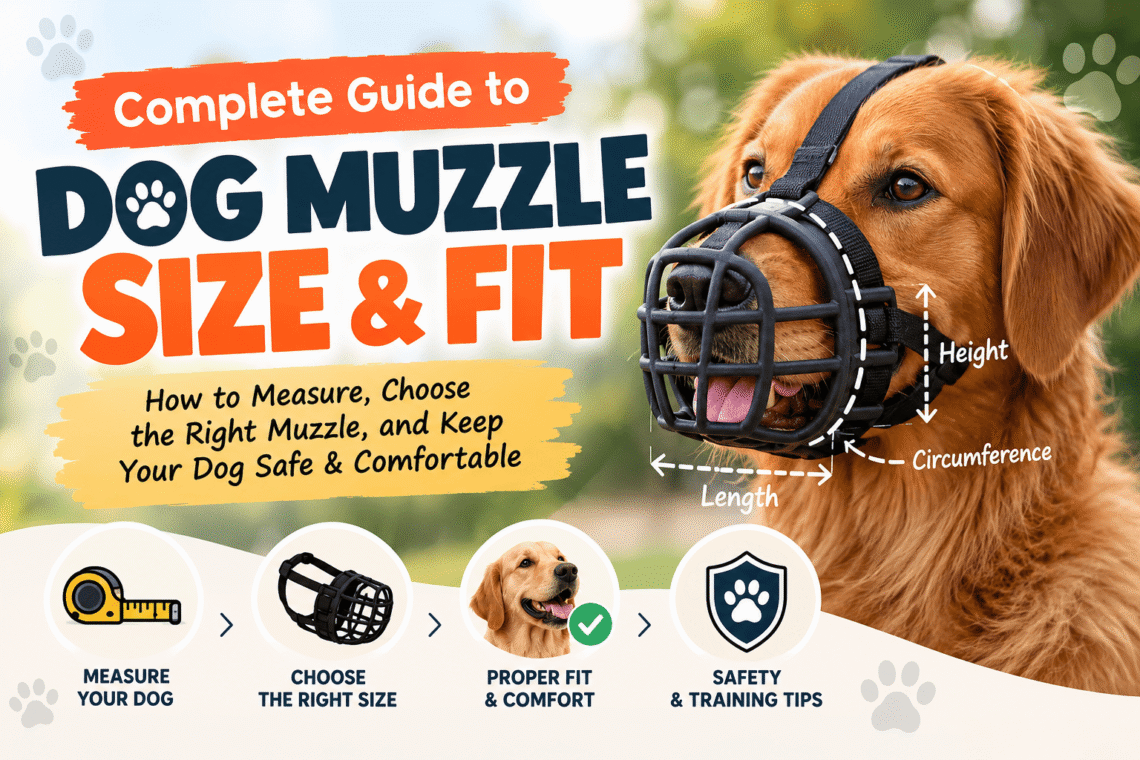
Dog Muzzle Size Calculator & Fit Guide
Measure your dog’s snout, check the numbers that matter, understand different sizing systems, and learn how to confirm the muzzle actually fits before relying on it.
Muzzle Measurement Tool
Enter your dog’s measurements to organize the sizing information.Enter at least your snout length and circumference to begin. This tool organizes your measurements; final sizing must still be checked against the specific manufacturer’s chart.
Size systems are manufacturer-specific. This calculator does not assign a universal muzzle size.
Dog Muzzle Sizing: Measure → Calculate → Fit
Jump directly to the measurement, sizing, fit, troubleshooting and tool sections you need.
Tip: Start with your dog’s measurements before comparing any manufacturer’s size chart.
↑ Back to CalculatorDog Muzzle Size Calculator
Start with your dog's actual measurements instead of choosing a muzzle from breed name alone. Enter the dimensions below to organize your measurements, convert units, and—when a verified manufacturer's chart is available—screen the measurements against that chart.
Enter Your Dog's Measurements
Measure as accurately as possible. Optional measurements can help with custom or specialty muzzle sizing.
The chart comparison is manufacturer-specific. A result here is a screening result, not a universal muzzle-size recommendation.
A muzzle should not be selected from this calculator alone. Check the exact product's manufacturer sizing information and then perform a physical fit check.
Baskerville Ultra Chart Screen
| Size | Length | Circ. | Screen |
|---|
Record the dimensions of the dog's individual muzzle rather than relying only on breed labels.
Compare the measurements with the specific manufacturer's published dimensions.
A chart match still needs a real fit check for clearance, stability, panting and drinking.
Sources & References
This calculator uses manufacturer-published dimensions where available and is designed as a measurement-screening tool rather than a substitute for fitting the exact muzzle on the individual dog.
Company of Animals — 2026 U.S. Catalog / Baskerville Size Information Preventive Vet — Choosing & Fitting a Dog Muzzle Cornell University College of Veterinary Medicine — Muzzle Choices Cornell University College of Veterinary Medicine — Basket Muzzle TrainingWhat Measurements Do You Need for a Dog Muzzle?
There is no single measurement that works for every muzzle. The exact requirements depend on the manufacturer and model, so the safest approach is to collect the measurements your chosen sizing chart asks for rather than guessing from your dog's breed, weight, or age.
Start with two core measurements: snout length and snout circumference. Depending on the muzzle, you may also need snout height, snout width, neck/head measurements, or additional information about the dog's facial shape.
Your Measurement Map
The exact measuring points can vary by product, so always follow the selected manufacturer's instructions.
Snout Length
CoreThe distance along the top of the snout between the manufacturer's specified starting point and the nose tip.
Snout Circumference
CoreThe measurement around the dog's muzzle at the location specified by the sizing instructions.
Snout Height
Model DependentThe vertical height of the muzzle at the location required by the specific product or custom-muzzle maker.
Snout Width
Model DependentThe width across the muzzle at the point specified by the particular sizing system.
Neck or Head Measurement
Model DependentSome muzzle systems or custom makers use a neck or head measurement to help determine strap placement and overall security.
Do not automatically add your own extra allowance to a manufacturer's measurement. Some brands build clearance into their sizing dimensions, while others instruct you to measure differently. Follow the chart for the exact muzzle you plan to buy.
The next section walks through the full measuring process step by step, including where to place the tape and what to record.
Sources & References
Measurement requirements vary by muzzle design. Independent fitting guidance recommends measuring the individual dog's muzzle and comparing those measurements with the manufacturer's sizing recommendations.
Preventive Vet — Muzzle Training: Choosing & Fitting a Dog Muzzle Cornell University College of Veterinary Medicine — Muzzle Choices Cornell University College of Veterinary Medicine — Basket Muzzle TrainingHow to Measure Your Dog for a Muzzle
Good muzzle sizing starts with consistent measurements. Work through the four steps below, record the numbers without pulling the tape too tightly, and then compare those measurements with the instructions for the exact muzzle model.
Have a soft measuring tape, a pen or notes app, and a calm dog. Take the measurements when your dog is comfortable and repeat any number that seems questionable.
Do not force your dog's mouth open or create a tight restraint just to measure. Follow the measurement method specified by the muzzle manufacturer whenever it differs from a generic guide.
Prepare Your Dog
Position first, measure secondLet your dog stand or sit naturally with the head in a comfortable position. Keep the tape or ruler ready before you begin so you do not need to repeatedly reposition your dog.
Measure Snout Length
Record the exact measuring pointsPlace the ruler or tape along the top of the snout and measure from the starting point specified by your muzzle's sizing guide to the tip of the nose. Do not guess the starting point from another brand's chart.
Measure Snout Circumference
Wrap the tape at the specified pointWrap a flexible tape around the snout at the location required by the manufacturer's chart. Keep the tape positioned consistently and avoid pulling it unnecessarily tight.
Repeat & Record
Check the numbers before choosing a sizeRepeat the two core measurements. If your second result is meaningfully different, measure again rather than averaging numbers that were taken from different positions.
You now have a measurement set ready for the next stage. Enter the numbers into the calculator above and compare them with the exact manufacturer's sizing chart.
Sources & References
Generic muzzle-measuring guidance should be used alongside the exact manufacturer's sizing instructions because measuring points and dimensions can differ between brands and models.
Preventive Vet — Choosing & Fitting a Dog Muzzle Giddy Pets — How to Measure a Dog for a Muzzle Cornell University College of Veterinary Medicine — Muzzle Choices Cornell University College of Veterinary Medicine — Basket Muzzle TrainingHow to Measure Snout Length
Snout length tells you how long the muzzle area is, but the difficult part is knowing exactly where the manufacturer wants you to measure from. Use the product's own measuring instructions whenever they define different reference points.
A generic “nose to eyes” measurement can be misleading because different muzzle brands may define their measuring points differently. Record the actual measurement method required by the model you are considering.
Length Measurement Map
Illustrative guide — always use the exact reference points in the manufacturer's sizing instructions.
Important: this illustration demonstrates the concept of measuring along the snout. The correct start point should come from the exact muzzle's sizing chart or fitting instructions.
01 Position Your Dog Naturally
Keep your dog comfortable and avoid pushing the head into an unnatural position. Have the ruler or soft tape ready before taking the measurement so you can work quickly and consistently.
02 Find the Manufacturer's Starting Point
Check the sizing instructions for the exact muzzle. Some guides describe a point near the eyes or base of the nose, while specialty muzzle makers may specify another reference point.
03 Measure Straight to the Nose Tip
Place the tape or ruler along the top of the snout and record the distance to the tip of the nose. Keep the measuring path consistent rather than following a curved path around the face.
Length Unit Converter
Useful when a sizing chart uses inches but your measurement is in centimetres—or vice versa.
Enter a measurement to convert it between centimetres and inches.
Length Measurement Check
Sources & References
Exact measuring points are product-specific. Independent fitting guidance recommends following the manufacturer's instructions and recording the individual dog's measurements rather than relying on breed-based assumptions.
Preventive Vet — Choosing & Fitting a Dog Muzzle Giddy Pets — How to Measure a Dog for a Muzzle Company of Animals — Baskerville Sizing Information Cornell University College of Veterinary Medicine — Muzzle ChoicesHow to Measure Snout Circumference
Circumference measures the space around your dog's muzzle. It is especially important because a muzzle that looks correct from the front can still be too restrictive around the dog's face.
For Baskerville sizing, Company of Animals specifies measuring around the widest part of the nose, usually just below the eyes. Other manufacturers can use different instructions, so the product-specific chart should take priority.
Circumference Measurement Map
The green loop represents the path of a flexible measuring tape around the specified part of the muzzle.
Do not pull the tape tight. The goal is to record the dog's measurement consistently, not compress the muzzle while measuring it.
Use a Flexible Measuring Tape
A soft sewing-style tape is easier to wrap around the muzzle than a rigid ruler. Keep it flat against the measurement area rather than allowing it to twist.
Find the Correct Measurement Point
First read the manufacturer's instructions. For Baskerville, the circumference point is the widest part of the nose, usually just below the eyes. Do not automatically use the same point for every muzzle.
Wrap the Tape Evenly
Bring the tape around the muzzle so that it forms one complete loop. Keep the tape level and avoid pulling it so tightly that it presses into the dog's coat or skin.
Tape Tension: The Sweet Spot
Your tape should sit against the measurement area without deliberately compressing the muzzle.
Mouth Closed
Useful for recording a baseline circumference when the manufacturer's chart calls for a closed-mouth measurement.
Chart dependentPanting Position
Some fitting guidance recommends checking an open-mouth measurement so there is enough room for normal panting in the finished muzzle.
Fit checkCircumference Unit Converter
Convert your measurement between centimetres and inches before comparing it with a size chart.
Enter a circumference measurement to convert it.
Circumference Measurement Check
Sources & References
Company of Animals states that Baskerville circumference measurement is taken around the widest part of the nose, usually just below the eyes. Its current guidance also discusses open-mouth measurement for adequate panting room. Independent fitting guidance similarly notes that manufacturers can require different measurements.
Company of Animals — How to Measure a Dog for a Muzzle Company of Animals — How to Choose a Safe Dog Muzzle Preventive Vet — Choosing & Fitting a Dog Muzzle Company of Animals — Baskerville Measurement GuideHow to Measure Snout Height
Snout height is a vertical measurement that can help describe your dog's facial dimensions more completely. Not every standard muzzle requires it, but it can become important for broad-faced dogs, custom muzzles, specialty designs, or any product whose sizing chart specifically lists height.
Do not invent a height measurement method and then compare it with a chart that uses a different definition. The manufacturer's measuring instructions should tell you exactly where the top and bottom points belong.
Vertical Measurement Map
Illustrative only — the exact upper and lower reference points depend on the muzzle's sizing system.
Keep the measuring plane consistent. If you measure height at one location but compare it with a chart defined at another, the number may not be useful.
Read the Exact Product Instructions
Before measuring, identify where the manufacturer places the height measurement. A generic internet diagram is only a starting point; the product's own chart controls which dimensions should be compared.
Measure Vertically at One Defined Point
Keep the ruler or measuring tool perpendicular to the measurement surface and record the distance between the specified upper and lower points. Avoid tilting the ruler forward or backward.
Record the Number in the Same Unit
Write down whether the result is in centimetres or inches. A correct measurement can still create a sizing error when it is compared with a chart using a different unit.
Use the upper point stated in the specific muzzle's measurement instructions.
Use the lower point stated by the same manufacturer and keep the measurement location consistent.
When Is Snout Height Especially Useful?
Height Difference Checker
Compare two height measurements to see the numerical difference. This is a calculation aid, not a fit recommendation.
Enter two measurements to calculate their difference.
Common Height-Measurement Mistakes
Measuring at the wrong location: the number may be accurate but still incompatible with the manufacturer's chart.
Tilting the ruler: an angled measurement can change the recorded distance.
Guessing from breed averages: individual facial dimensions can differ substantially within the same breed.
Using height as the only measurement: height is model-dependent and should not replace the measurements required by the exact product.
Sources & References
Snout height is not required by every muzzle manufacturer. Measurement systems differ, so the exact product documentation should determine whether height is needed and where it should be measured.
Preventive Vet — Choosing & Fitting a Dog Muzzle Giddy Pets — How to Measure a Dog for a Muzzle Cornell University College of Veterinary Medicine — Muzzle ChoicesHow to Measure Snout Height
Snout height is a vertical measurement that can help describe your dog's facial dimensions more completely. Not every standard muzzle requires it, but it can become important for broad-faced dogs, custom muzzles, specialty designs, or any product whose sizing chart specifically lists height.
Do not invent a height measurement method and then compare it with a chart that uses a different definition. The manufacturer's measuring instructions should tell you exactly where the top and bottom points belong.
Vertical Measurement Map
Illustrative only — the exact upper and lower reference points depend on the muzzle's sizing system.
Keep the measuring plane consistent. If you measure height at one location but compare it with a chart defined at another, the number may not be useful.
Read the Exact Product Instructions
Before measuring, identify where the manufacturer places the height measurement. A generic internet diagram is only a starting point; the product's own chart controls which dimensions should be compared.
Measure Vertically at One Defined Point
Keep the ruler or measuring tool perpendicular to the measurement surface and record the distance between the specified upper and lower points. Avoid tilting the ruler forward or backward.
Record the Number in the Same Unit
Write down whether the result is in centimetres or inches. A correct measurement can still create a sizing error when it is compared with a chart using a different unit.
Use the upper point stated in the specific muzzle's measurement instructions.
Use the lower point stated by the same manufacturer and keep the measurement location consistent.
When Is Snout Height Especially Useful?
Height Difference Checker
Compare two height measurements to see the numerical difference. This is a calculation aid, not a fit recommendation.
Enter two measurements to calculate their difference.
Common Height-Measurement Mistakes
Measuring at the wrong location: the number may be accurate but still incompatible with the manufacturer's chart.
Tilting the ruler: an angled measurement can change the recorded distance.
Guessing from breed averages: individual facial dimensions can differ substantially within the same breed.
Using height as the only measurement: height is model-dependent and should not replace the measurements required by the exact product.
Sources & References
Snout height is not required by every muzzle manufacturer. Measurement systems differ, so the exact product documentation should determine whether height is needed and where it should be measured.
Preventive Vet — Choosing & Fitting a Dog Muzzle Giddy Pets — How to Measure a Dog for a Muzzle Cornell University College of Veterinary Medicine — Muzzle ChoicesHow to Measure Neck or Head Size
Some muzzle designs use an additional head or neck measurement to help describe how the restraint system sits and stays positioned. This is a model-dependent measurement, so only take it when the manufacturer's chart or custom muzzle maker specifically asks for it.
Head or neck dimensions can help with strap placement or specialty sizing, but they do not replace the snout measurements required to size the muzzle itself.
Head & Neck Measurement Map
Illustrative view showing two different measurement concepts. Only use the one specified by the product instructions.
Use the exact requested measurement. “Head size,” “neck size,” and “neck circumference” are not automatically interchangeable terms.
Check Whether the Muzzle Actually Requires It
Begin with the exact product's sizing instructions. Many standard muzzle charts focus primarily on muzzle dimensions, while specialty or custom designs may request additional measurements around the head or neck.
Measure at the Defined Location
Place the flexible tape where the manufacturer says to measure. Keep the tape level, make one complete loop when circumference is requested, and avoid changing the measuring position halfway around the head or neck.
Record the Measurement Without Compression
Keep the tape comfortably in contact with the measurement area without deliberately squeezing the neck or head. Record the number immediately so you do not confuse it with your snout measurements.
Head Measurement
Use when the product or custom maker specifically asks for a head circumference or other head dimension.
Product dependentNeck Measurement
Use when the manufacturer specifies a neck circumference or asks for dimensions related to strap placement.
Product dependentHead & Neck Difference Checker
Record two measurements and calculate their numerical difference. This tool does not determine whether either measurement is an appropriate fit.
Enter two measurements to calculate their difference.
Head / Neck Measurement Check
Remember: a neck or head measurement can help describe positioning or specialty sizing, but a correctly measured muzzle still needs to be evaluated for the actual fit on the dog.
Sources & References
Head and neck requirements vary by muzzle design. The appropriate measurement should come from the exact product's sizing instructions rather than from a universal rule.
Preventive Vet — Choosing & Fitting a Dog Muzzle Giddy Pets — How to Measure a Dog for a Muzzle Cornell University College of Veterinary Medicine — Muzzle ChoicesShould You Measure With the Mouth Open or Closed?
This question causes confusion because a muzzle measurement and a muzzle fit check are not necessarily the same thing. The correct measuring position depends on the exact sizing instructions, while the finished muzzle must also provide enough room for normal breathing, panting and drinking when the design is intended for those activities.
Do not automatically measure every muzzle with the mouth fully open or fully closed. A product's sizing chart may define a particular position, while a separate fit check should confirm that the finished muzzle allows the dog to use its mouth appropriately for the muzzle's intended purpose.
Mouth Closed
A closed-mouth measurement can be appropriate when the manufacturer's sizing instructions specifically describe taking the measurement in that position.
Mouth Open / Panting
A basket muzzle intended for continued wear needs enough internal space for normal mouth opening and panting. This is a fit consideration, not necessarily the measurement method used by every sizing chart.
Measurement vs. Fit: Keep Them Separate
Two different checksThe manufacturer's measurement method takes priority over a generic online rule.
Keep the dog comfortable during measurement instead of forcing a position just to obtain a number.
Once the muzzle is selected, confirm the dog can use the design as intended, including appropriate panting and drinking space for a basket muzzle.
Mouth-Position Decision Helper
Choose what you are doing right now. The tool gives you the next measurement step—not a muzzle-size recommendation.
Size-chart stage: open the exact product's instructions and follow its specified measuring position before entering the number into your calculator.
The key distinction: the position used to obtain a sizing measurement and the room a dog needs while actually wearing the muzzle are two separate questions. Never assume that one measurement rule automatically answers both.
Sources & References
Cornell University College of Veterinary Medicine explains that a properly fitted basket muzzle should permit panting and drinking. Cornell also distinguishes basket muzzles from soft or sleeve-style muzzles, which can restrict panting and drinking. Manufacturer-specific sizing instructions should be followed for the actual measurement method.
Cornell University College of Veterinary Medicine — Basket Muzzle Training Cornell University College of Veterinary Medicine — Muzzle Choices Preventive Vet — Choosing & Fitting a Dog Muzzle Company of Animals — How to Measure for a Dog MuzzleDog Muzzle Measurement Calculator Explained
A useful muzzle calculator should make your measurements easier to understand—not give you false precision. The tool below shows how the numbers fit together, checks whether your measurement set is complete, and helps you prepare for comparison with the exact manufacturer's sizing chart.
A calculator can organize measurements, convert units, calculate differences and screen dimensions against a specific verified chart. It cannot replace the manufacturer's sizing instructions or the final physical fit check.
Build Your Measurement Profile
This tool calculates relationships between your measurements. It does not invent a size when the manufacturer chart is unknown.
Next step: compare your measurements with the exact manufacturer's chart.
What the Calculator Actually Does
The calculator receives measurements you provide and performs transparent calculations on those numbers. For example, it can convert units, identify missing core measurements, calculate differences, and describe simple measurement relationships.
Behind the Numbers
Length: recorded as the manufacturer's specified nose-to-reference-point measurement.
Circumference: recorded around the measurement point specified by the exact muzzle chart.
Additional dimensions: height and width can be recorded when a particular product requires them.
Final comparison: measurements must be checked against the exact manufacturer's sizing system.
What This Calculator Does Not Do
It does not create a universal size number. Different brands can use different dimensions and measuring methods.
It does not replace the product chart. The exact manufacturer's sizing information should be checked before purchase.
It does not prove physical fit. The finished muzzle still needs to be checked on the individual dog.
It does not determine suitability. Product choice depends on the intended use and the dog's individual circumstances.
Think of the Calculator as a Bridge
The useful workflow is not “enter measurements → receive a magic size.” It is “enter measurements → understand them → compare with the exact chart → perform the fit check.”
Sources & References
Current veterinary and manufacturer guidance emphasizes individual measurements, manufacturer-specific sizing, and physical fit checks. A properly fitted basket muzzle should provide appropriate room for panting and drinking.
Preventive Vet — Muzzle Training: Choosing & Fitting a Dog Muzzle Cornell University College of Veterinary Medicine — Muzzle Choices Cornell University College of Veterinary Medicine — Basket Muzzle Training Company of Animals — Baskerville Size InformationWhy Muzzle Sizes Differ Between Brands
A dog does not become a different size simply because you switched brands. What changes is the product's measurement system, basket geometry, sizing ranges, measuring points, and design. That is why a number such as “Size 5” should never be treated as a universal muzzle size.
The useful comparison is not the label printed on the package. Compare the dog's measurements with the dimensional information and measuring method supplied for the exact muzzle model.
Different Measuring Points
One manufacturer may define snout length and circumference differently from another. Even a small change in the reference point can change the number you record.
Measurement methodDifferent Internal Geometry
Two muzzles with similar external dimensions can have different basket shapes, depth, width, or usable internal space.
Product shapeDifferent Size Ranges
A manufacturer can divide its products into a small number of broad sizes or many narrower sizes. The same physical dog can therefore fall under different labels.
Size labelsBreed Suggestions Are Only Guidelines
Breed names can help narrow the search, but they do not measure the individual dog's snout. Facial dimensions can vary within the same breed.
Individual dogBrand-Size Comparison Lab
Enter one set of measurements and use the visual comparison below to understand why “Size 4,” “Size 5,” or “Large” cannot be compared by label alone. The illustrative bars are intentionally not presented as product sizing recommendations.
Brand A
Example systemWhat to check: read the actual size chart and measuring instructions rather than comparing the brand's size label with another brand's label.
Brand B
Example systemWhat to check: the same dog's measurements may map to a different size label because the chart and product geometry are different.
Enter your measurements to activate the comparison. The bars below will represent your recorded measurements as a neutral visual reference.
How to Read Any Manufacturer's Size Chart
Compare dimensions, not labelsConfirm exactly where the manufacturer wants length, circumference, height, width, or any other requested dimension measured.
Convert centimetres to inches or inches to centimetres before comparing numbers when the chart uses a different unit.
Do not stop after finding one matching number. A product may require several dimensions to fall within its specified range.
Keep one measurement record for your dog, then compare that same record against each manufacturer's own instructions and chart.
Do not assume that a size number, “medium,” “large,” or a breed recommendation means the same physical dimensions across different brands.
Sources & References
Independent fitting guidance notes that muzzle sizes vary between brands and recommends measuring the individual dog's muzzle and using the manufacturer's sizing instructions. Company of Animals likewise publishes product-specific measurement guidance for Baskerville muzzles.
Preventive Vet — Choosing & Fitting a Dog Muzzle Company of Animals — How to Measure for a Dog Muzzle Giddy Pets — How to Measure a Dog for a Muzzle Cornell University College of Veterinary Medicine — Muzzle ChoicesHow to Read a Dog Muzzle Size Chart
A muzzle size chart looks simple until you notice that different manufacturers can measure different parts of the dog's face and describe their product dimensions differently. Read the chart as a set of matching dimensions—not as a list of universal size labels.
“Length,” “circumference,” “height,” and “width” only become useful when the manufacturer's definitions match the way you measured your dog.
Example Size Chart
This is an educational example showing how a chart can be structured. It is not a product sizing chart.
| Size Label | Length | Circumference | Height | Interpretation |
|---|---|---|---|---|
| Small | 7–8 cm | 18–22 cm | 6–7 cm | Example range |
| Medium | 8–10 cm | 22–28 cm | 7–9 cm | Example range |
| Large | 10–12 cm | 28–34 cm | 9–11 cm | Example range |
| XL | 12–15 cm | 34–42 cm | 11–14 cm | Example range |
Example Range Checker
Enter your dimensions to see whether they fall inside any of the educational example rows above.
Enter both measurements to screen the educational example chart.
Start With the Measurement Definitions
Read the written measuring instructions before looking at the size numbers. This tells you where the manufacturer expects each dimension to be taken and prevents you from comparing unrelated measurements.
Length: check the start and end points described by the manufacturer.
Circumference: use the exact location and tape method specified in the chart.
Height / width: compare them only when the particular product's sizing system requires them.
Size label: treat “Small,” “5,” “Large,” or similar labels as identifiers for that product line—not universal measurements.
What If Your Measurement Sits Between Two Rows?
Do not automatically round up or down. First check every required dimension, read the manufacturer's between-size instructions, and then perform the physical fit check after selecting a model.
Five Common Size-Chart Mistakes
Comparing labels instead of dimensions. A “Large” in one product line does not establish the physical dimensions of “Large” elsewhere.
Using the wrong measuring point. A measurement taken correctly at the wrong location is still the wrong input for the chart.
Ignoring units. Centimetres and inches must be converted before they are compared.
Checking only one dimension. A product can appear close on length while failing another required dimension.
Stopping after the chart match. A numerical match is not the same as a verified physical fit.
The 10-Second Chart Reading Rule
Read instructions → identify measuring points → match units → compare every required dimension → follow the manufacturer's fit guidance.
Sources & References
Manufacturer sizing systems vary. Current muzzle-fitting guidance recommends using the exact product's measurement instructions and size chart rather than assuming that size labels are interchangeable. Baskerville sizing information from Company of Animals also uses product-specific measurements.
Preventive Vet — Choosing & Fitting a Dog Muzzle Company of Animals — How to Measure for a Dog Muzzle Cornell University College of Veterinary Medicine — Muzzle ChoicesWhat If Your Dog Falls Between Two Muzzle Sizes?
A dog can sit very close to the boundary between two published sizes. That does not automatically mean you should choose the larger size—or simply round your measurements up or down. The correct next step is to inspect the manufacturer's instructions, compare every required dimension, and then verify the actual fit of the selected muzzle.
A measurement that falls between two rows should be evaluated against the full sizing system. Check length, circumference, height, width, and any model-specific guidance before choosing which size to test.
See Where Your Measurement Sits
The graphic below illustrates the idea of a dog landing between two published size ranges.
Does the smaller size actually meet every required dimension? Check the complete chart rather than focusing on whichever number looks closest.
Does the larger size remain appropriately positioned? Extra space is not automatically better if the design becomes unstable or the fit changes.
Does the manufacturer provide between-size guidance? Use the published instructions for that specific product whenever they address borderline measurements.
Between-Sizes Decision Helper
Enter two dimensions from the same muzzle chart to compare how close the dog's measurements are to the published boundaries.
Enter your measurement plus the two published boundary values to see the numerical position.
Borderline results are worth measuring again using the same points and method described by the manufacturer.
A close match on one dimension does not establish a complete match when the chart requires several dimensions.
Some manufacturers provide explicit guidance for measurements that sit between published sizes.
When Considering the Smaller Size
Check whether the complete measurement set actually falls within the published range. Then examine the physical fit and intended movement of the muzzle. Do not choose a smaller size merely because the label seems closer.
When Considering the Larger Size
Check whether the larger model remains appropriately positioned on the dog's face. A larger label does not automatically mean better fit; the product still needs to be secure and appropriate for the dog's dimensions.
Do not solve every borderline case by adding an arbitrary “extra centimetre.” Different manufacturers build their sizing systems differently. Use the product's stated measuring method and any published between-size instructions instead of inventing your own allowance.
Sources & References
Current muzzle-fitting guidance recommends using the individual dog's measurements together with the exact manufacturer's sizing information. Manufacturer-specific dimensions and fitting instructions should take priority over generic between-size rules.
Preventive Vet — Choosing & Fitting a Dog Muzzle Company of Animals — How to Measure for a Dog Muzzle Cornell University College of Veterinary Medicine — Muzzle Choices Cornell University College of Veterinary Medicine — Basket Muzzle TrainingDog Muzzle Fit Test: Does It Really Fit?
A size chart can help identify a suitable starting size, but the real test happens when the muzzle is on your dog. The finished muzzle should be appropriately positioned, secure without being unnecessarily tight, and—when the design is intended for longer or basket-style use—provide enough room for normal panting, drinking, and other intended activities.
What a Fitted Basket Muzzle Should Look Like
This illustration is a simplified visual guide, not a scale-accurate template for any particular brand.
Exact clearances, strap positions, and measurement points vary by muzzle design. Always follow the specific manufacturer's fit instructions.
Interactive Muzzle Fit Checklist
Check each point while your dog is calm and supervised. This tool organizes the fit review; it does not replace the manufacturer's instructions or professional advice for a difficult fit.
Check the seven points above one by one. A completed checklist is a structured review, not a universal guarantee that a muzzle is suitable for every situation.
Before judging space, confirm that the muzzle is sitting where the manufacturer intended it to sit. A muzzle in the wrong position can make other measurements misleading.
For basket muzzles designed for panting, drinking, or treats, check those functions directly rather than judging fit only by appearance.
A muzzle can match a chart and still need adjustment or a different design if the finished product creates rubbing, pressure, or unstable positioning.
Do not use visual looseness as the only test. A muzzle that looks roomy may still be unsuitable if it shifts excessively, while a close-looking basket can be appropriate when it is designed and fitted correctly. The product's construction, intended use, and manufacturer's instructions all matter.
Sources & References
Veterinary and manufacturer guidance emphasizes that a properly fitted basket muzzle should be appropriately positioned and, where the design is intended for it, allow functions such as panting, drinking, and receiving treats. Exact fit requirements vary by muzzle design.
Cornell University College of Veterinary Medicine — Muzzle Choices Cornell University College of Veterinary Medicine — Basket Muzzle Training Preventive Vet — Choosing & Fitting a Dog Muzzle Company of Animals — How to Measure for a Dog Muzzle American Kennel Club — When, Why, and How to Correctly Use Dog MuzzlesHow Much Panting Room Does a Dog Need?
Panting room is not a number you can safely standardize across every muzzle model. The important question is whether the finished muzzle allows the dog to perform the functions the design is supposed to allow. For basket muzzles intended for extended or routine use, that includes appropriate room for normal panting and access to water.
Muzzle depth, basket shape, nose position, and the dog's facial anatomy all affect the available movement. Instead of adding a generic “extra” measurement, test the actual muzzle according to its design and manufacturer's instructions.
Visual Guide to Functional Panting Room
The open-mouth illustration shows why basket volume matters during panting.
This is a conceptual illustration only. It is not a product-specific clearance diagram or sizing template.
Panting Room Function Check
Use this after the muzzle is fitted. Check only functions that are appropriate for the particular muzzle design and intended use.
Check the relevant points one at a time. Completing this checklist does not create a universal fit approval; it helps structure your observation of the finished muzzle.
For basket muzzles designed for extended use, the dog should be able to pant normally. The basket needs enough usable volume for the mouth and tongue to move appropriately.
More space is not automatically a better fit. The muzzle still needs to stay appropriately positioned while providing the functional room required by the design.
Dogs rely on panting for heat regulation. Warm or humid conditions can increase the importance of appropriate breathing and panting ability, especially for short-nosed dogs.
Evaluate panting on the finished muzzle, check water access when the product is designed to provide it, and follow the exact manufacturer's fitting instructions.
Do not use a tight-fitting muzzle that restricts mouth opening as a substitute for a properly fitted basket design when the dog needs to pant normally.
Breathing difficulty is not a normal sizing problem. If a dog has obvious difficulty breathing, unusually labored breathing, weakness, collapse, or other signs of respiratory distress, remove the dog from the situation as appropriate and seek veterinary care promptly. Never “test” a muzzle by exercising a dog in heat or waiting for heavy panting to develop.
Sources & References
Veterinary guidance consistently distinguishes basket muzzles from restrictive sleeve-style muzzles. Properly fitted basket muzzles are designed to permit normal panting and, depending on the design, drinking and treat access. Heat and respiratory problems require particular caution.
Cornell University College of Veterinary Medicine — Basket Muzzle Training Cornell University College of Veterinary Medicine — Muzzle Choices Preventive Vet — Choosing & Fitting a Dog Muzzle Cornell University College of Veterinary Medicine — Recognizing and Responding to Canine Respiratory Distress Cornell University College of Veterinary Medicine — Summer Heat Safety Tips for DogsSigns a Dog Muzzle Is Too Small
A muzzle can look close to the correct size on a chart and still be too restrictive once it is fitted. Watch for pressure, rubbing, inadequate mouth movement, or a loss of the functions the muzzle is designed to provide. A dog should not have to struggle against the muzzle for the fit to be considered acceptable.
The muzzle should be appropriately positioned and secure without unnecessarily restricting the dog's normal mouth movement or creating obvious pressure points. For basket muzzles intended to permit panting, inadequate panting room is a serious fit concern.
Where an Undersized Muzzle Can Create Problems
Use the visual below as a checklist of areas to inspect—not as a product-specific fit template.
Exact pressure points depend on muzzle construction and your dog's facial shape.
Too-Small Warning Sign Checker
Check the signs you observe while the muzzle is correctly positioned. This tool helps organize the review; it does not diagnose an injury or determine a universal size.
Check the signs you can actually observe. One symptom may justify rechecking the measurements and manufacturer chart, while multiple functional or comfort problems suggest that the current fit needs closer review.
Many basket muzzles are designed so the dog can open its mouth and pant. A muzzle that prevents the intended movement may not be the correct fit or design.
Repeated contact or pressure around the nose, cheeks, eyes, or straps is a reason to stop and reassess the sizing, placement, or model.
When a product is designed to allow drinking or treat delivery, test that function directly. A smaller size should not be assumed to be acceptable simply because it stays attached.
A correctly fitted muzzle should remain appropriately positioned during its intended use, but secure attachment should not be confused with excessive pressure. Fit the muzzle according to the manufacturer's system.
Tightening a strap to keep an undersized or poorly shaped muzzle in position does not solve a dimensional mismatch. Recheck the measurements and the product's fit instructions instead.
What to Do When a Muzzle Seems Too Small
Work through the problem systematically rather than immediately changing to a different size.
A calm dog makes it easier to repeat the measurements and examine the areas that were making contact.
Confirm that the snout length, circumference, height, and width—where required—were taken exactly as described by the manufacturer.
Compare all required dimensions rather than selecting a size from only one number.
Confirm position, stability, comfort, and the functions the muzzle is intended to provide.
Stop using the muzzle for the situation being tested if your dog is having obvious difficulty breathing or showing signs of distress. A sizing guide cannot determine the cause of breathing problems or facial injury. Seek veterinary advice for concerning symptoms, especially when they persist after the muzzle is removed.
Sources & References
Muzzle-fitting guidance recommends checking the manufacturer's sizing instructions and assessing the finished muzzle for appropriate positioning, comfort, and function. Basket-style muzzles intended for extended use should permit normal panting, and obvious breathing difficulty should not be treated as an acceptable fit issue.
Preventive Vet — Choosing & Fitting a Dog Muzzle Cornell University College of Veterinary Medicine — Muzzle Choices Cornell University College of Veterinary Medicine — Basket Muzzle Training Company of Animals — How to Measure for a Dog Muzzle American Kennel Club — When, Why, and How to Correctly Use Dog MuzzlesSigns a Dog Muzzle Is Too Small
A muzzle can look close to the correct size on a chart and still be too restrictive once it is fitted. Watch for pressure, rubbing, inadequate mouth movement, or a loss of the functions the muzzle is designed to provide. A dog should not have to struggle against the muzzle for the fit to be considered acceptable.
The muzzle should be appropriately positioned and secure without unnecessarily restricting the dog's normal mouth movement or creating obvious pressure points. For basket muzzles intended to permit panting, inadequate panting room is a serious fit concern.
Where an Undersized Muzzle Can Create Problems
Use the visual below as a checklist of areas to inspect—not as a product-specific fit template.
Exact pressure points depend on muzzle construction and your dog's facial shape.
Too-Small Warning Sign Checker
Check the signs you observe while the muzzle is correctly positioned. This tool helps organize the review; it does not diagnose an injury or determine a universal size.
Check the signs you can actually observe. One symptom may justify rechecking the measurements and manufacturer chart, while multiple functional or comfort problems suggest that the current fit needs closer review.
Many basket muzzles are designed so the dog can open its mouth and pant. A muzzle that prevents the intended movement may not be the correct fit or design.
Repeated contact or pressure around the nose, cheeks, eyes, or straps is a reason to stop and reassess the sizing, placement, or model.
When a product is designed to allow drinking or treat delivery, test that function directly. A smaller size should not be assumed to be acceptable simply because it stays attached.
A correctly fitted muzzle should remain appropriately positioned during its intended use, but secure attachment should not be confused with excessive pressure. Fit the muzzle according to the manufacturer's system.
Tightening a strap to keep an undersized or poorly shaped muzzle in position does not solve a dimensional mismatch. Recheck the measurements and the product's fit instructions instead.
What to Do When a Muzzle Seems Too Small
Work through the problem systematically rather than immediately changing to a different size.
A calm dog makes it easier to repeat the measurements and examine the areas that were making contact.
Confirm that the snout length, circumference, height, and width—where required—were taken exactly as described by the manufacturer.
Compare all required dimensions rather than selecting a size from only one number.
Confirm position, stability, comfort, and the functions the muzzle is intended to provide.
Stop using the muzzle for the situation being tested if your dog is having obvious difficulty breathing or showing signs of distress. A sizing guide cannot determine the cause of breathing problems or facial injury. Seek veterinary advice for concerning symptoms, especially when they persist after the muzzle is removed.
Sources & References
Muzzle-fitting guidance recommends checking the manufacturer's sizing instructions and assessing the finished muzzle for appropriate positioning, comfort, and function. Basket-style muzzles intended for extended use should permit normal panting, and obvious breathing difficulty should not be treated as an acceptable fit issue.
Preventive Vet — Choosing & Fitting a Dog Muzzle Cornell University College of Veterinary Medicine — Muzzle Choices Cornell University College of Veterinary Medicine — Basket Muzzle Training Company of Animals — How to Measure for a Dog Muzzle American Kennel Club — When, Why, and How to Correctly Use Dog MuzzlesCommon Dog Muzzle Measuring Mistakes
Even a good muzzle can seem poorly sized when the original measurements were taken at the wrong location, recorded in the wrong unit, or compared with the wrong sizing chart. Before changing sizes, audit the measurement process itself.
Use the manufacturer's measuring points, keep the measurement method consistent, record the exact values, and compare those values with the chart for the specific muzzle model—not another brand or a generic breed guide.
Measurement Mistake Audit
Select every mistake that may have happened during your sizing process.
Your Measurement Audit
This score counts possible process errors. It is not a muzzle-size score and does not diagnose a fit problem.
Your measurement process looks clear from the items selected.
The most basic problem is measuring the wrong part of the dog's muzzle. Product instructions should define where each measurement begins, ends, or wraps around.
Unit changes, handwritten transcription errors, or forgotten dimensions can make an otherwise accurate measurement difficult to use.
A correct number can still be interpreted incorrectly when it is compared with the wrong product chart or treated as a universal muzzle-size number.
Read the product instructions → measure at the stated locations → record exact values → repeat the measurement → compare with that manufacturer's chart → perform a physical fit check.
Guess from breed → take one quick measurement → add a random amount → choose the familiar size number → tighten the straps if it moves.
The 30-Second Measurement Reset
00:30The biggest mistake is transferring a measurement method from one muzzle to another. A brand may define the start point, circumference location, required dimensions, and fit criteria differently. When changing products, restart from that product's own instructions instead of reusing an old “size 4” or “length” assumption.
Sources & References
Current muzzle-fitting guidance stresses accurate, product-specific measurements and warns that muzzle sizing varies between brands and face shapes. Manufacturer instructions should take priority over generic size assumptions, and the completed muzzle should be physically checked for appropriate fit and function.
Preventive Vet — Choosing & Fitting a Dog Muzzle Company of Animals — How to Measure for a Dog Muzzle Cornell University College of Veterinary Medicine — Muzzle Choices Giddy Pets — Dog Muzzle Size Guide Loadline — How to Measure and Fit a Basket MuzzleMeasuring Short-Nosed and Broad-Faced Dogs
Short-nosed and broad-faced dogs can be harder to fit with a conventional muzzle because their facial proportions are different from the long, narrow snout assumed by many standard designs. For these dogs, the measuring process should be more than a single length number: consider the circumference, width, height, eye position, and the actual geometry of the muzzle.
A short muzzle may have less usable bridge length for a conventional basket to anchor securely. The manufacturer may therefore use a specialty design, different measurement points, or a custom-fit approach. Start with the product's own instructions rather than forcing a standard length formula onto a different facial shape.
Short-Nose Measurement Map
Width and height can become especially useful when length alone does not describe the dog's facial shape.
The illustrated mask is conceptual and does not represent the dimensions of a specific muzzle.
Short-Face Measurement Profile
Enter the measurements you have to see which dimensions are present in your profile. This tool does not assign a universal size.
At minimum, use the dimensions required by your chosen manufacturer's size chart. Width and height are especially useful when the product asks for them.
Short-faced dogs can have substantial width and circumference relative to their snout length. When the manufacturer requests extra dimensions, record all of them.
A muzzle should be compatible with the dog's facial structure. The product's shape and opening positions matter, not just whether one measurement matches a chart.
Brachycephalic dogs can have more difficulty cooling themselves efficiently, so a muzzle that restricts normal breathing or panting is particularly concerning.
Specialty or custom designs can account for facial proportions that do not fit a conventional long-snout basket. This can be useful when ordinary sizing leaves the muzzle unstable or incompatible with the dog's face.
Breed names do not provide the exact dimensions needed for a reliable fit. Dogs within the same broad facial category can still differ in width, circumference, nose length, and overall shape.
Short-Nose Fit Preparation Checklist
Complete these preparation steps before selecting or ordering a muzzle for a short-nosed or broad-faced dog.
May work for some short-faced dogs, but only when the dimensions and facial geometry match the particular product.
A design created specifically around a shorter facial profile can provide a more appropriate starting geometry.
A custom approach may be worth considering when standard models repeatedly fail to align with the dog's anatomy or intended function.
Short-nosed dogs deserve extra caution in warm or stressful conditions. Brachycephalic dogs can have more difficulty cooling themselves through panting. Never rely on a generic sizing rule if the muzzle interferes with breathing or normal panting. A dog showing obvious respiratory distress needs prompt veterinary attention rather than a further sizing experiment.
Sources & References
Veterinary and muzzle-fitting guidance notes that facial shape varies significantly between dogs. Preventive Vet specifically identifies brachycephalic dogs as a challenging fit category and notes that specialty or custom-made muzzles may be appropriate. Cornell also notes that short-muzzle breeds can have more difficulty cooling themselves through panting, making appropriate breathing and panting ability especially important.
Preventive Vet — Choosing & Fitting a Dog Muzzle Cornell University College of Veterinary Medicine — Muzzle Choices Cornell University College of Veterinary Medicine — Basket Muzzle Training Cornell University College of Veterinary Medicine — Summer Heat Safety Tips for Dogs Cornell University College of Veterinary Medicine — Brachycephalic Obstructive Airway Syndrome American Kennel Club — When, Why, and How to Correctly Use Dog MuzzlesMeasuring Long-Nosed Dogs
Long-nosed dogs may have substantially more distance between the face and nose tip than a broad or short-faced dog. That makes accurate snout length particularly important, but length should still be considered together with circumference and the muzzle's actual construction. A longer dog does not automatically need a longer muzzle in every product range.
Company of Animals defines its Baskerville measurement from the tip of the nose to the base of the nose just below the eyes. Other products may define their measuring points differently, so use the instructions for the exact muzzle you are considering.
Long-Snout Measurement Map
Length gives the front-to-back dimension; circumference describes the usable wraparound measurement at the manufacturer's specified location.
Illustration is conceptual and not drawn to scale. Actual measuring points depend on the product.
Long-Snout Measurement Profile
Enter your dog's measurements to organize the profile and calculate a simple proportion. The result does not assign a muzzle size.
These are useful starting measurements. Check whether the chosen manufacturer also requires neck, head, width, or height measurements.
Measure from the manufacturer's stated starting point to the stated nose-tip endpoint. Moving the starting point even slightly can change the number substantially on a long snout.
A muzzle can have adequate front-to-back length while still being inappropriate in circumference. Compare both dimensions whenever the product chart requires them.
Long-nosed dogs can differ in snout thickness, circumference, head shape, and neck size. Breed or nose length alone cannot establish the correct product size.
Confirm that the muzzle has the required length according to its sizing chart and that the dog's nose sits in the intended position. Avoid using a generic “long nose” allowance in place of the product's measurements.
Compare snout circumference at the location specified by the manufacturer. A long muzzle still needs enough usable space for the functions the particular basket design is intended to provide.
Long-Nose Measurement Checklist
Complete these checks before comparing your measurements with a manufacturer's size chart.
If the dog's nose is contacting the end of the basket when the muzzle is fitted, do not assume that appearance alone proves the product is acceptable. Recheck the manufacturer's fitting instructions and sizing dimensions.
A long snout can have relatively modest circumference. Compare the actual length and circumference requirements rather than selecting a size from length alone.
Some dogs combine substantial length with greater depth or width. When the manufacturer supplies additional dimensions, use them to screen the product before completing the physical fit test.
Do not extend a muzzle simply because the dog has a long nose. The basket's internal shape, nose position, circumference, depth, and attachment system all affect fit. A longer product is not automatically the correct product if its geometry does not match the dog's face.
Sources & References
Muzzle-fitting guidance emphasizes measuring the individual dog rather than relying on breed or general size labels. Company of Animals gives specific Baskerville measuring points for snout length and circumference, while Preventive Vet notes that long, thin snouts can require different muzzle designs and that measurements should be compared with the manufacturer's recommendations.
Company of Animals — How to Measure Your Dog for a Muzzle Company of Animals — Safe Dog Muzzles: How to Prioritise Comfort & Welfare Preventive Vet — Choosing & Fitting a Dog Muzzle Cornell University College of Veterinary Medicine — Muzzle Choices Cornell University College of Veterinary Medicine — Basket Muzzle TrainingMuzzle Size Comparison by Manufacturer
There is no universal meaning behind a muzzle label such as “Size 3,” “Size 4,” or “Large.” Different manufacturers can use different measurement points, different dimensions, different product geometries, and different instructions for interpreting borderline measurements. Compare the actual dimensions and instructions instead of transferring a size number from one brand to another.
For example, current official charts show Baskerville Ultra/Invais using length and circumference, JAFCO publishing its own length and circumference system, and a current Leerburg Lightweight Conditioning Muzzle chart that also includes width and height. Treat each chart as a separate sizing language.
Cross-Brand Measurement Screen
Enter your measurements once, then highlight the published chart rows that contain both your length and circumference values. This is a numerical screen—not a physical fit recommendation.
Width is included as an optional field because some manufacturer charts require it. The comparison screen below uses length and circumference for the first two published chart families; the detailed model notes explain additional dimensions.
Baskerville Ultra / Invisa
Current Company of Animals chart values. Length and circumference are maximum published dimensions for each size.
| Size | Length | Circumference | Typical Breed Examples |
|---|---|---|---|
| 1 | 2 in | 8.5 in | Bichon Frise, Maltese, Mini Dachshund, Toy Poodle |
| 2 | 2.25 in | 10.25 in | Bedlington Terrier, Border Terrier, Mini Poodle |
| 3 | 2.75 in | 11 in | Beagle, Border Collie, Cocker Spaniel, Corgi |
| 4 | 3 in | 12.5 in | Australian Cattle Dog, Dalmatian, Husky, Springer Spaniel |
| 5 | 3.75 in | 14.25 in | Boxer, Bull Terrier, Doberman, Golden Retriever, Labrador |
| 6 | 4 in | 16.5 in | German Shepherd, Giant Schnauzer, Rottweiler, St. Bernard |
Baskerville Ultra / Invisa
The current Company of Animals chart lists maximum length and circumference values. Its FAQ also states that when length and circumference fall into different categories, the nose-length category is used for Baskerville sizing.
One manufacturer can define the base of the snout differently from another.
One chart may use length and circumference while another also publishes width and height.
A numeric label identifies a row inside that manufacturer's own sizing system.
The chart is only one part of the process. Finished fit and intended function still need checking.
What Changes From One Manufacturer to Another?
Use this matrix as a chart-reading guide rather than a product ranking.
| Feature | Baskerville Ultra / Invisa | JAFCO | Leerburg Lightweight Conditioning |
|---|---|---|---|
| Snout length | Yes | Yes | Yes |
| Circumference | Yes | Yes | Yes |
| Width | Not in the basic Ultra/Invaisa chart | Not in the published basic chart | Published |
| Height | Not in the basic Ultra/Invaisa chart | Not in the published basic chart | Published |
| Breed examples | Yes | Yes | Chart focuses on dimensions |
| Different interpretation rule | Company of Animals FAQ addresses mixed categories | Published circumference instruction includes pant-room guidance | Additional geometry dimensions published |
Keep your dog's actual measurements, but restart the interpretation process. Read the new manufacturer's instructions from the beginning instead of carrying over the previous size number.
Do not combine one brand's length range with another brand's circumference range and call the result a universal size. Each chart describes a different physical product.
Three Manufacturer-Comparison Rules
The useful comparison is the actual measurement system: length, circumference, width, height, and any other dimension the product asks you to record.
Some companies publish explicit instructions for mixed measurements or panting room. Those rules belong to that manufacturer's product and should not be generalized to another brand.
A numerical match can identify candidate rows, but it does not establish finished comfort, stability, or functional fit on an individual dog.
Do not treat this comparison tool as a universal sizing calculator. The tables reproduce published manufacturer dimensions for specific product families. Models can change, and two products from the same company may use different sizing systems. Always verify the current product page or manufacturer's chart before ordering.
Sources & References
The comparison above uses current published sizing information from the manufacturers. Company of Animals publishes separate Baskerville size tables and measurement instructions; JAFCO publishes its own length/circumference system and pant-room instruction; Leerburg's Lightweight Conditioning Muzzle chart includes length, circumference, width, and height.
Company of Animals — 2026 USA Catalogue: Baskerville Sizing Company of Animals — Baskerville Sizing Tables & Measurement Instructions Company of Animals — Baskerville Ultra Muzzle Company of Animals — FAQs: Mixed Baskerville Size Categories JAFCO Muzzles — Official Sizing Information Leerburg — Lightweight Conditioning Muzzle Sizing Chart Leerburg — How to Size Your Dog's MuzzlePrintable Dog Muzzle Measurement Sheet
Once you have measured your dog, record the numbers in one place. This reusable worksheet gives you a clean measurement profile for checking manufacturer size charts, comparing products, repeating measurements, and documenting the final fit test.
A size number belongs to a particular product's sizing system. Keeping the actual measurements lets you reuse the information when comparing a different muzzle or manufacturer later.
Dog Muzzle Measurement Record
Record measurements using the exact method specified by the muzzle manufacturer. Repeat measurements when needed and keep the product-specific sizing chart with this record.
Primary Measurements
| Measurement | First | Second | Final / Recorded | Measuring Point / Notes |
|---|---|---|---|---|
| Snout Length | Use manufacturer's stated start/end points. | |||
| Snout Circumference | Wrap at the exact location specified by the product. | |||
| Snout Height | Complete when required by the manufacturer. | |||
| Snout Width | Complete when required by the manufacturer. | |||
| Neck / Head | Record the specific head or neck location required by the product. |
Why Record Two Measurements?
Repeating the same measurement helps identify accidental changes in tape position, tension, or endpoint placement.
Manufacturer Chart Reference
Write down the exact chart or product page used so you know which sizing system these numbers were compared against.
Final Physical Fit Check
Do not replace the measurements with only “Medium” or “Size 4.” The actual dimensions are much more useful when you later compare another manufacturer.
A measurement is easier to reproduce when you know exactly where the tape started, where it ended, and which product instructions were followed.
Your dog's measurements can change over time. Recheck them when buying a new muzzle, after significant growth, or whenever a previous fit no longer seems appropriate.
Printing tip: Complete the digital fields first, then select “Print Sheet.” The print layout hides the surrounding article content and keeps the measurement record in a clean worksheet format.
Sources & References
Muzzle-fitting guidance recommends following the individual manufacturer's measurement method, recording the actual measurements, and checking the finished muzzle for appropriate positioning and function. Different products can require different dimensions, so keeping the original measurements is more useful than relying only on a size label.
Preventive Vet — Choosing & Fitting a Dog Muzzle Company of Animals — How to Measure for a Dog Muzzle Cornell University College of Veterinary Medicine — Muzzle Choices Cornell University College of Veterinary Medicine — Basket Muzzle TrainingWhat to Do When No Standard Muzzle Fits
Sometimes your dog's measurements simply do not line up with a standard muzzle chart. That does not mean the measurements are wrong. A mismatch can come from facial shape, product geometry, unavailable dimensions, or a sizing range that does not cover your dog's particular proportions. The solution is to diagnose the mismatch before choosing a different design.
Start by repeating the measurements, then verify the manufacturer's measuring points. If the numbers are correct but the available products still do not align with your dog's facial geometry, investigate a different design, an adjustable or reshapable model, or a custom-fit option.
Find the Likely Mismatch
Select the description that best matches what happened when you compared your measurements with a standard product chart.
Re-measure First
Before moving to another product, repeat the measurements using the exact points and method specified by the manufacturer.
The first response to a surprising result should usually be to verify the measurement method and values.
A different muzzle shape may suit the dog's facial proportions better than trying to force the same design into a new size.
Some basket designs can be reshaped or adjusted to accommodate different nose shapes within the manufacturer's instructions.
A custom-made muzzle can be an option when standard products repeatedly fail to match the dog's dimensions or facial geometry.
Standard-Muzzle Mismatch Matrix
Use the pattern you see to decide what needs to be investigated next.
| What You See | Possible Reason | Next Step | Do Not Assume |
|---|---|---|---|
| Length fits; circumference does not | Different facial proportions or product geometry | Compare the complete chart and another compatible design | Do not automatically choose a longer muzzle |
| Circumference fits; length does not | Snout length or measuring endpoints may differ | Recheck length using the manufacturer's stated points | Do not transfer the length allowance from another brand |
| Chart match but physical fit fails | Facial shape does not match the product geometry | Investigate another design or fit system | Do not rely on the chart alone |
| Dog exceeds all available rows | Product range may not cover the dog's dimensions | Look for a suitable larger range or custom solution | Do not squeeze into the largest standard size |
| Dog is unusually broad or short-faced | Conventional basket geometry may not suit the face | Investigate specialty or adjustable designs | Do not judge suitability from breed name alone |
Some manufacturers offer basket designs that can be reshaped according to their instructions. For example, Company of Animals describes its Baskerville Wide Fit as heat-shapable for different dog nose shapes. Follow the manufacturer's exact process when using such a feature.
Short, broad, very narrow, or unusually shaped snouts may require a product designed around that geometry rather than a conventional basket shape.
Custom sizing can be worth investigating when standard products repeatedly fail to match the dog's measurements or physical shape. Custom products generally require more detailed measurements and manufacturer-specific instructions.
When a Custom-Fit Muzzle Becomes Worth Investigating
There is no single measurement that automatically requires a custom muzzle. Look for a repeated pattern of mismatch.
Several reputable products have been checked using their own measurement systems and none provides a suitable numerical match.
The dog repeatedly falls within a chart but the finished muzzle does not sit correctly on the face.
A very broad, short, narrow, or unusually long facial structure may not align with the geometry of common standard models.
The product meets a numerical range but cannot provide the intended panting, drinking, movement, or positioning required for its use.
Never solve a dimensional mismatch by forcing the muzzle into place. Tightening straps, stretching the basket beyond its intended adjustment system, or adding arbitrary clearance does not create a reliable fit. Recheck the measurements and investigate a product or design that actually matches the dog's anatomy and intended use.
Sources & References
Current veterinary and manufacturer guidance recognizes that standard muzzles do not fit every facial shape. Preventive Vet specifically discusses hard-to-fit dogs and custom-made options, while Company of Animals publishes specialty Baskerville designs for broad or short noses and describes heat shaping for its Wide Fit model. Cornell recommends properly fitted basket muzzles that allow panting, drinking, and treats when the design is intended for those functions.
Preventive Vet — Choosing & Fitting a Dog Muzzle Company of Animals — Baskerville Wide Fit Muzzle Company of Animals — 2026 USA Product Catalogue Cornell University College of Veterinary Medicine — Muzzle Choices Cornell University College of Veterinary Medicine — Basket Muzzle TrainingHow to Introduce a Newly Sized Muzzle
Getting the dimensions right does not automatically make a dog comfortable wearing a new muzzle. A newly sized muzzle should be introduced gradually and positively, with short sessions that help your dog associate the equipment with calm, rewarding experiences rather than forcing the muzzle into place.
Cornell's basket-muzzle training guidance emphasizes gradual conditioning and positive associations. If the dog becomes distressed, back up to an easier step rather than forcing the next stage.
The Muzzle Introduction Path
Progress only when your dog is comfortable with the current stage.
Let your dog see and investigate the muzzle while rewarding calm interest. Keep the first exposure brief and low-pressure.
No Wearing YetEncourage the dog to place its nose near or into the muzzle voluntarily, using rewards appropriate for the design.
Choice MattersOnce the dog is comfortable with the previous steps, introduce a very short fastening period while keeping the experience calm and rewarding.
Very ShortIncrease wearing time in small increments only while your dog remains comfortable and the muzzle continues to fit correctly.
Small IncrementsAfter calm stationary wearing is established, progress to ordinary supervised movement appropriate to the muzzle's intended use.
SupervisedIntroduction Readiness Checklist
Use the checklist before increasing the session difficulty. A checked item means you observed that point during the current training stage.
Introduce the muzzle gradually. When the dog shows discomfort or resistance, return to the previous comfortable step rather than forcing the next one.
A Better Training Session Structure
Keep sessions short, calm, and easy enough that the dog can succeed.
The dog gets repeated opportunities to investigate the muzzle, receive positive reinforcement, and progress through increasingly difficult steps while remaining comfortable.
The muzzle is immediately fastened for a long period or the dog is physically pressured through resistance. This skips the conditioning process and can make future muzzle use more difficult.
If your dog can perform the current step calmly but struggles with the next step, repeat the easier step rather than pushing forward.
New resistance can sometimes coincide with a fit problem. Inspect the muzzle for rubbing, pressure, slipping, or restricted function.
Muzzle introduction and early wearing practice should be supervised. Do not use training sessions as an opportunity to leave the dog unattended.
Pause the progression when your dog is showing clear distress or the equipment is creating a physical fit problem. Return to an easier training step, reassess the fit, and seek veterinary or qualified behavior guidance when the concern is persistent or difficult to resolve.
Sources & References
Veterinary guidance recommends gradual muzzle conditioning using positive associations rather than forcing a dog to wear a muzzle. Cornell's basket-muzzle training guidance describes progressive steps that begin with making the muzzle a positive object, followed by voluntary nose placement, fastening, and gradually increasing wearing time.
Cornell University College of Veterinary Medicine — Basket Muzzle Training Cornell University College of Veterinary Medicine — Muzzle Choices Preventive Vet — Choosing & Fitting a Dog Muzzle American Kennel Club — When, Why, and How to Correctly Use Dog MuzzlesDog Muzzle Measurement FAQs
Dog muzzle sizing becomes much easier once you separate the numbers from the fit. The questions below cover the most common issues involving snout length, circumference, height, width, manufacturer charts, units, panting room, between-size situations, and the final physical fit. A measurement can tell you where to start, but the finished muzzle still needs to sit securely without unnecessarily restricting normal function.
01 How do I measure a dog for a muzzle?
Start with the measurements required by the specific muzzle manufacturer. In many sizing systems, the key measurements are snout length and snout circumference. Some designs also require snout height, snout width, and neck or head circumference.
Use the manufacturer's stated measuring points rather than copying a measurement from another brand's chart. Then compare your results with the exact model's sizing information and complete a physical fit check.
02 What are the most important muzzle measurements?
There is no single universal measurement set for every muzzle. The most commonly useful starting measurements are snout length and snout circumference, while some manufacturers use additional dimensions to describe the shape of the dog's muzzle more accurately.
For example, a dog may have a suitable circumference but not enough height or width for a particular basket design. That is why a complete dimension set can be more useful than relying on one number.
03 Should I measure with my dog's mouth open or closed?
Follow the instructions for the exact muzzle you are buying. A basic facial measurement is generally taken with the dog in a normal, relaxed position, but the functional space required inside a muzzle is a separate fit consideration.
Do not try to create the required panting space simply by pulling the tape farther away from the face. Measure using the manufacturer's method, then verify that the finished muzzle allows the necessary mouth movement and normal function.
04 How tight should the measuring tape be?
The tape should be positioned consistently and snug without being pulled tightly into the face. The goal is to record the dog's actual measurement, not compress soft tissue to make the number smaller.
Repeat each measurement and write down the results. Consistency matters because even a small change in the measuring point can alter the result enough to affect which chart range appears to fit.
05 Is muzzle size the same across different brands?
No. A size number is not a universal industry measurement. One manufacturer's size 4 may be built around completely different dimensions from another manufacturer's size 4.
Different brands can also measure different parts of the muzzle, use different size labels, or design the basket with a different shape. Always match your dog's measurements to the chart for the exact model you are considering.
06 What if the length and circumference point to different sizes?
Treat that as a muzzle-shape mismatch signal, not as a reason to automatically choose a larger or smaller size.
Recheck both measurements first. Then examine all dimensions required by the manufacturer. A muzzle that matches circumference but fails the required length, height, width, or overall geometry may not be the correct model even when one number looks perfect.
07 How much panting room does a dog need?
There is not one universal extra number that should simply be added to every muzzle measurement. The correct amount of space depends on the design and the manufacturer's fit method.
Functionally, a properly selected basket muzzle should allow appropriate mouth opening for panting and, where the model is designed for it, normal access to water and treats. This is why the final test is more than checking whether the muzzle can be fastened.
08 Can I choose a muzzle by breed or weight alone?
Breed and weight can be useful as rough starting references, but they do not replace actual measurements. Dogs of the same breed can have noticeably different facial proportions, and dogs with similar body weights can have very different snout shapes.
Use breed guidance only as a shortcut to the right type of chart. The actual selection should be based on the manufacturer's measurement method and a physical fit check.
09 What if my dog falls outside the manufacturer's size chart?
First, remeasure carefully and confirm that you are using the correct chart for the exact model. If the measurements are still outside the published range, look for a muzzle designed around a different size range or facial geometry.
Some dogs are better served by an adjustable, specialty-shaped, or custom-fit design rather than forcing a standard product into a size range it was not designed to cover.
10 How often should I remeasure my dog?
Remeasure whenever there is a reasonable chance that the dog's dimensions have changed or whenever the fit no longer behaves as expected. This is especially relevant for growing dogs, dogs whose body condition changes, or dogs switching to a different muzzle design.
A previously recorded measurement is useful for reference, but it should not be treated as permanent data for every future muzzle.
11 Can a muzzle be too large even if it does not fall off?
Yes. A muzzle can remain attached while still being poorly positioned or excessively mobile. Too much forward/backward or side-to-side movement can change where the basket sits relative to the eyes, nose, and mouth.
A secure muzzle should stay in its intended position during normal supervised movement without requiring excessive strap tension to keep it there.
12 What if the size chart says it fits, but the physical muzzle does not?
Use the physical fit as the final checkpoint. A chart is a sizing guide, not a guarantee that one geometry will work for every facial shape.
Recheck the measurement points and compare the full set of dimensions. If the numbers appear correct but the basket still sits incorrectly, restricts normal function, moves excessively, or creates rubbing or pressure, another size or another muzzle geometry may be more appropriate.
13 How should short-nosed or broad-faced dogs be measured?
Measure all dimensions the manufacturer requests and pay particular attention to height and width as well as circumference. A short face can make a simple length-plus-circumference comparison less informative.
For dogs with flatter or broader facial proportions, a muzzle specifically designed for that geometry may provide a better starting point than a conventional long, narrow basket.
14 How should long-nosed dogs be measured?
The same core principle applies: record the exact measurements required by the manufacturer, beginning with the stated snout-length and circumference points.
For long-nosed dogs, pay close attention to how the basket's internal length and structure position the nose. Do not assume that extra length is automatically better; the basket still needs to sit in the intended location and preserve appropriate clearance and function.
Jump to a Specific Measurement
Four Sizing Rules Worth Remembering
“Every size 4 muzzle is roughly the same.”
Size numbers are manufacturer-specific. The number only becomes meaningful when paired with the exact brand and model chart.
Compare measurements to the exact model.
Start with the manufacturer's measuring method, not a size label copied from another product.
“Just add a fixed amount for panting.”
There is no one universal allowance that works for every muzzle design. Functional space must be evaluated within the actual product and its sizing method.
Measure first, then test the finished fit.
The right result is not merely a matching number. The muzzle should remain correctly positioned while allowing the functions the design is intended to permit.
The reliable sizing process is to use the manufacturer's measurement points, record consistent numbers, compare the complete dimension set, and then verify the physical fit. This is especially important when dogs have short, broad, narrow, or unusually proportioned faces.
Sources & References
Final Muzzle Fit Checklist
You have measured the dog, compared the dimensions, reviewed the manufacturer's chart, and checked the important fit principles. Before treating the muzzle as properly sized, run through this final checklist. The goal is not simply to find a muzzle that closes around the dog's face—it is to verify that the selected design is correctly positioned, secure, and suitable for the functions it is intended to allow.
Work through all 10 checks. A complete checklist means you have reviewed both the measurements and the practical fit instead of relying on the size label alone.
Before you finalize the size
The numbers should come from a consistent measuring process and be compared with the exact product's sizing instructions.
- Use the manufacturer's measuring points.
- Keep units consistent.
- Repeat measurements when a result looks questionable.
- Check all dimensions the product actually requires.
- Do not choose by breed or weight alone.
After you put the muzzle on
A chart match is only the starting point. Look at how the muzzle actually behaves on the individual dog.
- Correct position is maintained.
- The muzzle is secure without excessive tightening.
- There is no obvious rubbing or pressure.
- Appropriate panting space is available.
- The intended functions remain possible.
Remember the complete sizing formula
Stop and reassess the sizing whenever the muzzle causes breathing difficulty, prevents necessary panting, creates significant rubbing or pressure, or cannot remain in its intended position. A different size, shape, design, or professional fitting approach may be needed rather than simply tightening the straps.