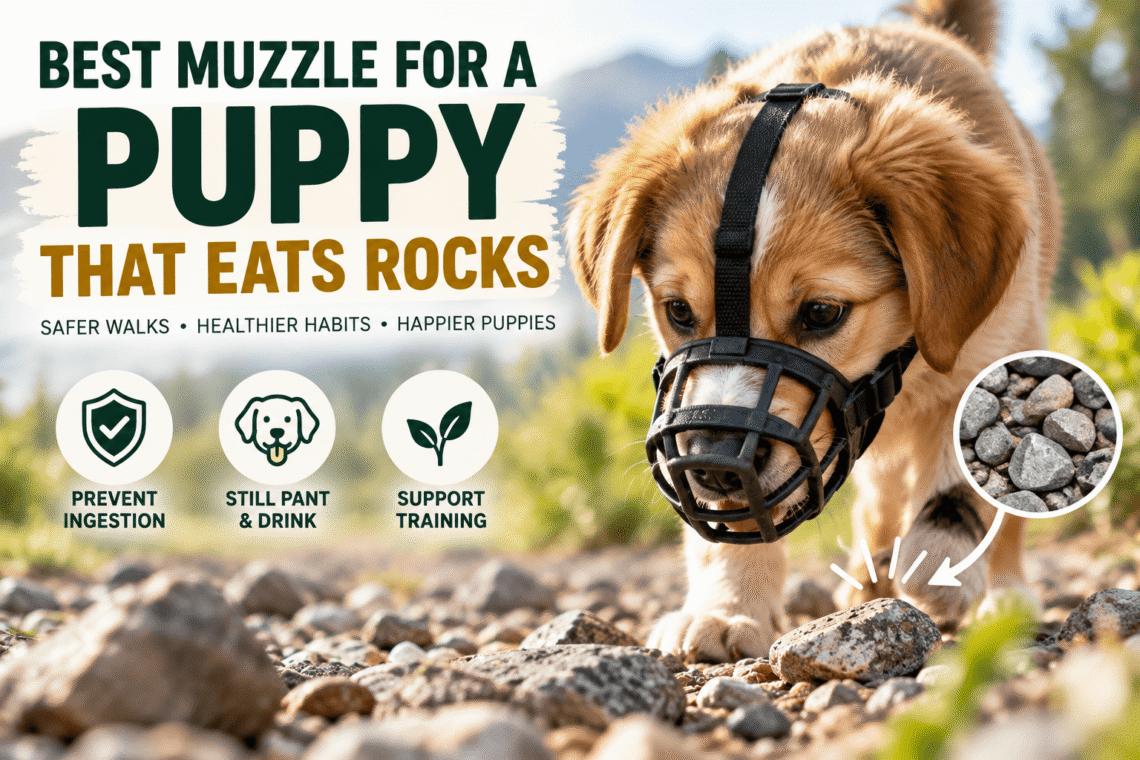
Muzzle for Puppy Eating Rocks: How to Choose the Right One
A properly selected muzzle can help prevent a puppy from picking up rocks outdoors while allowing room for normal panting and drinking. Learn what to look for, how to get the fit right, and how to combine muzzle use with training.
Table of Contents
Jump to the section you need or explore the complete puppy rock-eating and muzzle guide.
Why Do Puppies Eat Rocks?
Puppies naturally explore their surroundings with their mouths, but repeatedly chewing or swallowing rocks can become a safety concern. Understanding why it happens is the first step toward preventing it.
Curiosity & Exploration
Young puppies investigate unfamiliar objects by sniffing, licking and mouthing them. Rocks can simply become another interesting object in their environment.
Teething
During teething, puppies may chew more frequently as they explore ways to relieve discomfort. Hard objects such as stones may attract their attention, even though they are not appropriate things to chew.
Boredom or Lack of Stimulation
Puppies need regular physical activity and mental enrichment. When an outdoor environment offers few appropriate activities, a puppy may become interested in rocks and other objects.
Persistent Scavenging
Some puppies develop a repeated habit of searching for and swallowing non-food objects. Persistent or compulsive ingestion can have behavioral or medical causes and deserves closer attention.
Occasional mouthing can be part of normal puppy exploration, but regularly swallowing rocks is different. A veterinarian can help determine whether an underlying medical or behavioral issue needs to be considered.
The next question is whether eating rocks can actually harm a puppy.
Learn About the Risks →Is Eating Rocks Dangerous for Puppies?
Yes. Swallowing rocks can create several health risks for a puppy, especially when the behavior happens repeatedly. The danger depends on factors such as the object, the puppy, and whether the rock is swallowed or simply carried.
Choking
A rock can become a choking hazard if a puppy tries to swallow an object that is too large or difficult to pass safely.
Damaged Teeth
Hard rocks can put significant stress on a puppy's teeth and may cause dental damage when repeatedly chewed.
Intestinal Obstruction
A swallowed rock may become lodged in the digestive tract. An obstruction can become serious and may require veterinary treatment.
Repeated Ingestion
Regularly swallowing non-food objects is different from ordinary puppy mouthing and may indicate a behavioral or medical issue that deserves attention.
A puppy that picks up a stone is not necessarily experiencing an emergency. The bigger concern is when the puppy repeatedly attempts to swallow rocks or may already have swallowed one.
What Should Owners Watch For?
Suspected rock ingestion should be discussed with a veterinarian, particularly when the object may be large or the puppy develops concerning symptoms.
Because preventing access is often easier than reacting after ingestion, many owners consider a suitable basket or anti-scavenging muzzle.
Can a Muzzle Stop Rock Eating? →Can a Muzzle Stop a Puppy From Eating Rocks?
A suitable muzzle can help prevent a puppy from picking up and swallowing rocks, but it should be viewed as a management tool—not a replacement for training, supervision, or veterinary guidance when the behavior is persistent.
A muzzle can limit access to rocks while you work on the behavior.
The effectiveness depends on the muzzle's design and fit. A puppy that scavenges small objects may need a design specifically intended to reduce access to unwanted items rather than a general-purpose muzzle.
Prevent Access
A properly selected muzzle can make it harder or impossible for a puppy to pick up certain objects while outdoors, depending on the design.
Reduces immediate access to rocksTeach Better Choices
Use positive-reinforcement training to teach behaviors such as attention, “leave it,” and moving away from objects on the ground.
Builds useful alternative behaviorsManage the Environment
Reduce opportunities for scavenging where practical by limiting access to gravel, loose rocks and other objects that attract your puppy.
Fewer opportunities to rehearse scavengingWhat matters most for a rock-eating puppy?
A basket-style design should provide enough space for normal mouth opening and panting when correctly fitted. The muzzle should not force the mouth shut during normal outdoor activity.
For outdoor use, choose a design that allows the puppy to drink normally when properly fitted. Always confirm this with the specific product and sizing instructions.
This is especially important for a puppy that actively scavenges. Basket spacing and the front opening vary by design, so look for a muzzle specifically suited to scavenging prevention when that is the primary concern.
A puppy's muzzle dimensions can change as it grows. Check the fit regularly and replace the muzzle when its dimensions are no longer appropriate.
Think of it as a safety and management layer while you work on training and environmental changes. Persistent ingestion of non-food objects should also be discussed with a veterinarian.
What Is the Best Muzzle for a Puppy That Eats Rocks?
For a puppy that actively scavenges rocks, look for a muzzle that limits access to objects while providing enough room for normal panting and drinking. The design, fit, and intended use matter more than simply choosing the largest or most restrictive muzzle.
A properly fitted basket-style or anti-scavenging design is often the most relevant option for this specific problem.
The exact choice depends on your puppy's measurements, behavior, and the product's design. A muzzle intended for short-term grooming or mouth restriction is a different tool from one used for outdoor scavenging management.
Scavenging Prevention
If rocks are the main problem, pay close attention to the front opening and basket spacing. Some designs include additional protection specifically intended to reduce access to unwanted objects.
Room to Pant
For outdoor activity, the puppy needs sufficient room inside the muzzle for normal mouth opening and panting when the muzzle is correctly fitted.
Ability to Drink
A suitable outdoor muzzle should allow drinking when properly fitted and when the specific design permits it. Always check the manufacturer's instructions.
Puppy-Friendly Sizing
Puppies grow quickly, so the muzzle needs to fit the puppy you have now. A muzzle that is too small can become uncomfortable as the puppy's facial dimensions change.
Which Design Fits the Problem?
| Muzzle Type | Rock Scavenging | Outdoor Use | Main Consideration |
|---|---|---|---|
| Basket Muzzle | Design dependent | Generally relevant | Check opening and fit |
| Anti-Scavenging Basket | Specifically relevant | Potentially suitable | Designed to restrict access |
| Soft / Occlusion Muzzle | Not the main choice | Limited use case | Mouth opening is restricted |
| Grooming Muzzle | Not designed for this | No | Intended for a different purpose |
Start With the Problem, Then Choose the Design
Prioritize a design that specifically limits access to small unwanted objects.
Make sure the design provides appropriate room for panting and practical drinking access when fitted correctly.
Measure carefully and be prepared to move to another size as the puppy's facial dimensions change.
Can a Puppy Pick Up Rocks Through a Basket Muzzle?
Sometimes. A basket muzzle does not automatically prevent every dog from reaching small objects. The result depends on the basket's spacing, front opening, shape, fit, and how determined the puppy is to scavenge.
“Basket muzzle” does not always mean “cannot reach rocks.”
Some basket designs leave more space at the front than others. A puppy may still be able to nudge, manipulate, or pick up very small objects depending on the specific design.
Four design details matter
Basket Spacing
Wider openings can provide more room around the mouth, but may also leave more opportunity for a puppy to interact with small objects.
Front Opening
The shape and size of the opening at the front can affect how easily a puppy can reach toward the ground.
Muzzle Fit
Even a well-designed muzzle can perform differently when it is fitted incorrectly. A loose or poorly positioned muzzle may allow more movement than intended.
The Puppy Itself
Persistent scavengers can be surprisingly creative. A muzzle should be considered together with supervision and training, not as a guarantee that every outdoor object becomes irrelevant.
Check these features for a rock-eating puppy
Look closely at how much access the puppy has to objects in front of the muzzle.
A design specifically intended to reduce scavenging may be more relevant than a general-purpose basket muzzle.
Restricting access to rocks should not mean restricting the puppy's ability to pant normally during outdoor activity.
Check the manufacturer's measurements and recheck the fit as your puppy grows.
“Any basket muzzle will automatically stop my puppy from eating rocks.”
BETTER WAY TO THINK ABOUT ITChoose based on the puppy's actual scavenging behavior, the muzzle's object-access design, and whether it provides appropriate room for normal panting and drinking when properly fitted.
Practical tip: When comparing two basket muzzles, don't judge them only by the overall shape. Look at the front of the muzzle first. For a puppy that eats rocks, that is one of the most important areas to inspect.
Some muzzle styles are designed for purposes that are very different from outdoor scavenging prevention.
Which Muzzle Types Are Not Suitable for Rock Eating?
Not every dog muzzle is designed for outdoor scavenging. Some are intended for short-term grooming or situations where mouth opening is deliberately restricted. For a puppy that eats rocks, the design needs to match the actual problem.
Basket Muzzle
A properly fitted basket muzzle can provide space for mouth opening and panting. Its suitability for scavenging depends on the particular basket design, opening and spacing.
Anti-Scavenging Muzzle
Designs specifically intended to reduce scavenging can be more relevant when a puppy repeatedly tries to pick up rocks, food, trash or other small objects.
Soft or Occlusion Muzzle
These designs can restrict mouth opening. Because dogs need to open their mouths to pant effectively, they are generally not the design to choose for sustained outdoor activity.
Grooming Muzzle
Grooming muzzles are intended for short, specific situations. They are not designed as an everyday solution for a puppy that scavenges rocks outdoors.
What should you look for first?
Prioritize object-access control and a design appropriate for outdoor use.
Look for an appropriate basket-style design with enough internal space for normal panting.
Choose based on current measurements and plan to recheck the fit as the puppy develops.
The goal is to balance scavenging prevention with the puppy's ability to breathe and pant comfortably, plus practical factors such as drinking, secure fit and the intended duration of use.
Once you've identified the right type, accurate measurements become the next important step.
How to Measure a Puppy for a Muzzle
Correct measurements are essential when choosing a muzzle for a puppy. A muzzle that is too small may become uncomfortable, while one that is poorly fitted may shift or fail to provide the intended level of object control.
Measure the puppy's muzzle, then compare those measurements with the manufacturer's sizing chart.
Breed names and age ranges can help narrow down an option, but individual puppies can differ substantially in muzzle shape and size. Measurements are more useful for choosing the correct size.
Measure Muzzle Length
Measure from the tip of the puppy's nose to the base of the nose, following the measurement points specified by the muzzle maker.
MUZZLE
Measure Muzzle Circumference
Measure around the widest part of the puppy's muzzle according to the manufacturer's instructions. Some sizing guides specify measuring around the muzzle with the mouth open to account for panting space.
Compare With the Brand's Chart
Enter the puppy's measurements into the manufacturer's size chart. Do not select a size solely because the packaging lists your puppy's breed.
Recheck as Your Puppy Grows
Puppies don't stay the same size. Check the muzzle fit regularly and be prepared to move to another size when your puppy's facial dimensions change.
Your Puppy Muzzle Measurement Checklist
Use the measurement points required by the manufacturer.
Follow the brand's instructions for the correct position.
Use the specific product's sizing chart before ordering.
Confirm the puppy has appropriate room for normal panting and that the muzzle is positioned correctly.
Don't guess from the label alone.
Recheck your measurements and read the manufacturer's fitting guidance for that particular muzzle. A size that looks correct based on breed or weight alone may not provide the right fit for your puppy's actual muzzle shape.
Measure now. Fit now. Recheck later.
Measurements tell you which size to start with. The next step is making sure the muzzle actually fits your puppy correctly.
How Should a Muzzle Fit a Puppy?
A muzzle should be secure without being excessively tight. For a puppy using a basket-style muzzle outdoors, the fit should provide appropriate room for normal mouth opening and panting while keeping the muzzle safely positioned on the head.
Secure enough to stay in place, roomy enough for normal panting.
Don't judge fit by tightness alone. The puppy should have enough internal space for the muzzle to function as intended, without unnecessary pressure on the nose, eyes, or skin.
Signs the muzzle fits properly
The puppy can open its mouth appropriately inside the basket and pant normally.
The muzzle sits securely without constantly shifting from side to side.
The nose is not being forced against the end of the muzzle.
The muzzle does not press against the eyes or create obvious rubbing points.
The puppy can use the muzzle for its intended activity without repeatedly pulling or pawing at it.
Signs the muzzle needs attention
The puppy cannot open its mouth enough for normal panting.
The muzzle repeatedly moves out of position or can be easily removed.
The nose is pressed against the muzzle or the puppy appears cramped inside it.
The muzzle creates rubbing or pressure around the nose, eyes, or facial area.
The puppy's facial dimensions have changed but the existing size has not been reassessed.
Check these five things after putting the muzzle on
Is the muzzle sitting where the manufacturer intended?
Can the puppy open its mouth appropriately and pant?
Is the nose clear of unnecessary pressure at the front?
Are there any obvious rubbing or pressure points?
Does the muzzle remain safely positioned during normal movement?
Don't use tightness as your definition of a good fit.
Dogs rely on panting to regulate body temperature. For outdoor activity, a muzzle must be appropriate for normal mouth opening and panting. This is one reason an open basket-style design is different from a muzzle that deliberately restricts mouth opening.
Fit is not a one-time check.
Puppies grow and their facial dimensions can change quickly. Recheck the muzzle periodically and compare the puppy's current measurements with the manufacturer's sizing guidance. Replace the muzzle when the current size is no longer appropriate.
Four fitting mistakes to avoid
Choosing by breed name alone
Assuming tighter always means safer
Ignoring the front opening and object access
Forgetting to recheck a growing puppy
Puppies change quickly, so the muzzle that fits today may not be the same size they need later.
Will a Puppy Outgrow Its Muzzle?
Very possibly. Puppies grow quickly, and the shape and dimensions of the face can change as they develop. A muzzle that fits correctly today may not remain the right size later.
Treat puppy muzzle fitting as an ongoing process, not a one-time purchase.
Start with your puppy's current measurements, follow the specific manufacturer's sizing guide, and reassess the fit as your puppy grows.
Measure, fit, monitor, and recheck
Measure Current Size
Take the measurements required by the muzzle manufacturer before selecting a size.
Check the Actual Fit
Confirm that the muzzle sits correctly and provides the appropriate internal space for its intended use.
Watch for Changes
Pay attention to changes in the puppy's facial dimensions, muzzle position, and overall comfort.
Re-measure When Needed
Compare the puppy's current measurements with the product's sizing chart and replace the muzzle when the current size is no longer appropriate.
Don't wait for the muzzle to become obviously too small
Your puppy appears more cramped than when the muzzle was first fitted.
The muzzle no longer sits in the same position relative to the nose.
Areas that previously looked comfortable now show signs of rubbing.
A fresh measurement places the puppy outside the product's current recommended range.
Don't buy a much larger muzzle simply to “allow room to grow.”
A muzzle still needs to fit the puppy correctly today. Using an unnecessarily large muzzle can affect stability and how the muzzle performs. Choose according to the manufacturer's current sizing guidance rather than trying to predict your puppy's adult size.
Ask these questions every time you reassess the fit
Does the puppy's current measurement still match the manufacturer's recommended size range?
Does the muzzle still sit in the correct position?
Does the puppy still have the appropriate room for normal panting?
Are there any new signs of rubbing, pressure, or discomfort?
Once the size is right, the next step is teaching your puppy that wearing a muzzle is a normal and positive experience.
How to Muzzle-Train a Puppy
A puppy is more likely to accept a muzzle when it is introduced gradually and associated with positive experiences. Start in a calm environment and let your puppy progress at a comfortable pace.
Teach your puppy that the muzzle predicts good things.
Don't make the first muzzle experience a long walk or stressful situation. Build familiarity first, then gradually introduce wearing, movement, and eventually normal outdoor activities.
Six small steps are better than one big step
Let Your Puppy Investigate
Place the muzzle nearby and allow your puppy to investigate it voluntarily. Reward calm interest rather than moving the muzzle toward the puppy's face.
Choose a quiet setting where your puppy is relaxed. You are building a positive association before asking the puppy to wear anything.
Encourage Nose-In
Use a reward to encourage your puppy to place its nose inside the muzzle. Let the puppy approach it rather than forcing the muzzle onto the face.
Once your puppy willingly puts its nose inside, reward and remove the muzzle. Repeat until the action looks relaxed and predictable.
Build Positive Repetitions
Repeat the nose-in exercise during short sessions. Stop while the puppy is still comfortable so the muzzle remains associated with rewarding experiences.
Cornell recommends keeping muzzle-training sessions short. Several brief, successful experiences are preferable to pushing through when the puppy becomes uncomfortable.
Add the Strap
When your puppy is consistently comfortable placing its nose inside, introduce the strap. Fasten it briefly and immediately reward the puppy.
Follow the manufacturer's fitting instructions when adjusting the strap. The muzzle should stay safely positioned without becoming uncomfortably tight.
Introduce Movement
Once wearing the muzzle is comfortable, practice simple movement indoors before moving into more distracting environments.
Keep the first movement exercises easy. Reward calm walking and return to an earlier step if your puppy begins struggling with the muzzle.
Practice Outside Gradually
Move to the yard or another controlled outdoor environment only after your puppy is comfortable with the earlier steps.
Keep early outdoor sessions short and supervised. The puppy should already understand that wearing the muzzle is a normal, rewarding experience before introducing more distractions.
Keep the experience positive
Make the muzzle part of a positive routine.
Move forward only when the puppy is comfortable with the previous step.
Forcing an uncomfortable puppy can create a negative association with the muzzle.
Muzzle use should be supervised rather than treated as a leave-on device.
Keep early training short
The aim is not to make your puppy wear the muzzle for as long as possible during the first session. The aim is to create repeated experiences where the puppy remains comfortable.
A useful starting point for short training sessions.
Once your puppy accepts the muzzle, combine it with “leave it” training and environmental management to reduce rock scavenging.
Muzzle + Leave-It Training: Using Both Together
A muzzle can reduce a puppy's access to rocks while training teaches the puppy to ignore them. Using both approaches together creates a practical management and training strategy for outdoor scavenging.
Muzzle
Helps limit access to unwanted objects during situations where scavenging is difficult to control.
Leave It
Teaches the puppy to disengage from objects and pay attention to you instead.
Safer Outdoor Habits
Reduce opportunities to rehearse scavenging while building better behavior.
Build the behavior before increasing the challenge
Practice “Leave It” Indoors
Start with low-distraction exercises where your puppy can learn that ignoring an object leads to a better reward from you.
Introduce Safe Ground Objects
Gradually practice around objects your puppy finds interesting, while preventing access to the item you are asking the puppy to leave.
Practice in Controlled Outdoor Areas
Move the training into the yard or another controlled location and gradually introduce more realistic distractions.
Use the Muzzle During Higher-Risk Situations
When the environment contains many rocks or other hazards, appropriate muzzle management can add another layer of prevention while training continues.
Reward Looking Away
When your puppy notices an object and chooses to disengage, mark the behavior and provide the planned reward.
Increase Distractions Gradually
Make the training harder only when your puppy is consistently successful at the current level.
“Leave It” and “Drop It” are not the same
Teaching both gives you different tools for different moments.
Leave It
Ask the puppy to disengage from an object before picking it up. This is especially useful when walking toward something on the ground.
Drop It
Teaches the puppy to release something already in its mouth. This can be useful when the puppy manages to pick up an inappropriate object.
Make success easier instead of testing failure
Give your puppy a reason to choose you over the object.
Move from easy environments toward more distracting ones.
Management helps stop the puppy from repeatedly practicing the unwanted behavior.
If the puppy is unlikely to respond, reduce the difficulty rather than repeatedly giving a cue it cannot follow.
What this can look like on a walk
You notice the puppy looking toward the ground.
Ask for the behavior before the puppy reaches the rocks.
Mark the choice and provide the planned reward.
Use the muzzle as an added management layer where appropriate.
Training should not depend on the puppy being able to fail safely.
A puppy that has a strong history of swallowing rocks may need additional management while training is underway. A muzzle can help prevent access, but it does not replace supervision, environmental management, or veterinary assessment when persistent ingestion is a concern.
There are several practical ways to reduce a puppy's access to rocks before relying on a muzzle.
How to Prevent a Puppy From Eating Rocks Without a Muzzle
A muzzle is only one management tool. For many puppies, the first step is to reduce access to rocks, supervise outdoor time, redirect the behavior, and teach the puppy what to do instead.
Make the wrong choice harder and the right choice easier.
Puppies naturally investigate objects with their mouths. The goal is to prevent repeated rock access while rewarding safer behaviors such as looking away, following you, playing with an appropriate toy, or responding to a trained cue.
Start with management, then build better habits
Remove Rocks Where You Can
Clear loose stones from the puppy's main play area, exercise space, or frequently used part of the yard whenever practical. You do not need to make every outdoor area completely rock-free to reduce exposure.
Stay Close During Outdoor Time
Keep the puppy within easy reach when rocks are present. A leash can give you better control during training and makes it easier to redirect the puppy before it grabs something from the ground.
Carry a Better Alternative
Bring an appropriate toy or another planned reward outdoors. When the puppy shows interest in rocks, redirect attention toward the alternative and reward the puppy for choosing it.
Practice “Leave It”
Start training in an easy environment before expecting the puppy to ignore highly interesting rocks outdoors. Gradually increase distractions as the puppy becomes more reliable.
Add Mental and Physical Enrichment
Boredom can contribute to unwanted object-chewing and scavenging. Age-appropriate play, exploration, training, and enrichment can give the puppy safer outlets for curiosity and activity.
Investigate Persistent Ingestion
Occasional puppy exploration is different from repeatedly swallowing non-food objects. Persistent ingestion can have behavioral or medical causes, so discuss recurring rock eating with your veterinarian.
Turn outdoor time into a controlled training environment
Completely removing every rock may not be realistic. Instead, focus on controlling the areas and situations where the puppy is most likely to scavenge.
Find the places where the puppy repeatedly searches for rocks.
Remove loose stones or create a puppy-safe area where practical.
Stay close enough to redirect the puppy before it grabs a rock.
Reinforce calm behavior and choosing an appropriate alternative.
Which prevention step should you use first?
Avoid relying on one solution
Waiting until the puppy has the rock
Early redirection is usually easier than dealing with an object the puppy has already picked up.
Giving unlimited unsupervised yard access
A puppy that repeatedly practices scavenging can get more opportunities to repeat the behavior.
Assuming it is always just a puppy phase
Puppy exploration can be normal, but persistent ingestion deserves closer attention.
Using training without management
Training works alongside environmental control; it does not make hazardous objects safe to swallow.
Management and training can work together
When rocks cannot be removed and the puppy continues trying to swallow them despite supervision and training, a properly fitted basket muzzle may provide an additional layer of management. It should be introduced gradually and should not replace supervision or training.
Review Puppy Muzzle Features →What should you do if your puppy has already swallowed a rock?
What to Do If Your Puppy Swallowed a Rock
A swallowed rock is different from a puppy simply carrying or chewing a stone. Because rocks are non-digestible foreign objects, contact your veterinarian promptly for advice, especially if you saw your puppy swallow one or do not know where the rock went.
Don't wait for symptoms before taking a possible swallowed rock seriously.
Some foreign objects can pass through the digestive tract, but others can become lodged and cause a gastrointestinal obstruction. A veterinarian can determine what evaluation or monitoring is appropriate based on the puppy, the rock, and when the ingestion occurred.
What to do after you see a puppy swallow a rock
Prevent more ingestion
Move your puppy away from the rock-filled area and supervise closely so another object is not swallowed.
Note what happened
Remember approximately when the rock was swallowed, its approximate size and shape, and whether you saw the puppy swallow it completely.
Call your veterinarian
Tell the veterinary team what happened and provide the details you observed. They can advise whether your puppy needs to be examined promptly.
Follow veterinary instructions
Do not assume that a puppy is safe simply because it initially appears normal. Follow the monitoring or examination plan recommended by your veterinarian.
Symptoms that need prompt veterinary attention
Gastrointestinal obstruction can produce different signs depending on the location and severity of the blockage.
Especially repeated or persistent vomiting.
Refusing food or a noticeable reduction in appetite.
Signs of pain, tenderness, restlessness, or unusual posture.
Noticeably reduced activity or an abnormal level of tiredness.
Digestive changes can occur with gastrointestinal problems.
Any rapid deterioration should be treated as a reason to seek veterinary care urgently.
Don't try to solve a possible foreign-body problem at home
Don't induce vomiting unless a veterinarian specifically directs you to do so.
Making a dog vomit is not appropriate for every swallowed object and can create additional risks in some situations.
Don't give home remedies to try to “push” the rock through.
A veterinarian should determine the appropriate next step rather than relying on an unproven home treatment.
Don't assume a bowel movement proves the rock has passed.
When a foreign body is suspected, the veterinary team may recommend imaging or other monitoring to determine its location and progression.
Don't wait for severe symptoms if your veterinarian has recommended an examination.
Prompt diagnosis can matter when an obstruction is developing.
How a veterinarian may evaluate a swallowed rock
The exact approach depends on the history, examination findings, the suspected location of the object, and the puppy's condition.
History
The veterinarian may ask what was swallowed, when it happened, and whether any symptoms have developed.
Examination
The puppy may be checked for signs such as abdominal discomfort, dehydration, or other abnormalities.
Imaging
X-rays and, when appropriate, ultrasound can help evaluate the gastrointestinal tract and possible foreign material.
Treatment Plan
Depending on the findings, the veterinarian may recommend monitoring, endoscopic removal, or surgery.
“Swallowed a rock” and “chewed a rock” are not the same problem.
A puppy that carries or mouths a stone may have a scavenging problem. A puppy that actually swallows rocks has a potential foreign-body ingestion problem as well. Repeated swallowing should be discussed with a veterinarian because persistent non-food ingestion can have multiple possible causes.
Prevent the next rock from becoming another veterinary problem.
Once your puppy has been evaluated as needed, combine environmental management, supervision, training, and appropriate muzzle use where necessary.
Learn when rock eating requires more urgent veterinary attention.
When Should You Contact a Veterinarian?
A puppy that eats rocks should be taken seriously, especially if swallowing has occurred. Knowing the difference between a situation that needs prompt veterinary advice and one that may require emergency care can help you respond appropriately.
A known swallowed rock is a reason to contact your veterinarian.
Rocks are non-digestible foreign objects. Some objects can pass through the digestive tract, but others can become lodged and cause an obstruction. Your veterinarian can assess the circumstances and advise what should happen next.
The situation matters
You saw your puppy swallow a rock
Contact your veterinarian and explain what happened, including approximately when it occurred and the size or characteristics of the rock if known.
Your puppy develops concerning symptoms
Vomiting, loss of appetite, abdominal pain, diarrhea, dehydration, or marked lethargy can occur with gastrointestinal foreign-body problems.
Your puppy is severely unwell or has trouble breathing
Collapse, severe weakness, significant breathing difficulty, rapidly worsening condition, or other signs of a serious emergency require immediate veterinary attention.
Possible warning signs after rock ingestion
Foreign-body obstruction can produce different symptoms depending on where the object is located and how severe the blockage is.
Persistent or repeated vomiting can be an important warning sign.
A noticeable loss of appetite may accompany gastrointestinal obstruction.
Pain, tenderness, restlessness, or unusual sensitivity around the abdomen can be concerning.
Digestive upset and fluid loss may occur with gastrointestinal problems.
A puppy that becomes unusually quiet, weak, or less responsive deserves veterinary attention.
Any significant difficulty breathing should be treated as an emergency rather than monitored at home.
What if you are not sure the puppy swallowed it?
The rock is missing
You did not actually see swallowing, but a rock is missing and your puppy had access to it. Tell your veterinarian what you observed and let them decide whether further evaluation is appropriate.
The puppy only carried or chewed it
If you are confident the puppy did not swallow the rock, focus on preventing another ingestion and continue working on supervision, environmental management, and training.
Rock eating keeps happening
Repeated ingestion of non-food objects deserves veterinary discussion because persistent scavenging can have behavioral or medical contributors.
Symptoms are getting worse
A worsening condition should not be managed by waiting for the puppy to improve on its own. Seek veterinary advice promptly.
A puppy can look normal initially and still need veterinary advice.
A foreign-body problem cannot always be ruled out simply because your puppy is acting normally immediately after a possible ingestion. The history of what happened is important when a veterinarian decides whether further evaluation is needed.
Information your veterinarian may want to know
Approximate time of ingestion.
Rock size, shape, or other useful details.
Age, size, and relevant medical history.
Any vomiting, appetite change, pain, diarrhea, or lethargy.
Focus on preventing another ingestion.
Once your puppy has received any care that is needed, return to the prevention plan: reduce access to rocks, supervise outdoor time, build “leave it,” and use appropriate muzzle management when necessary.
Now let's look at the muzzle features that matter most for puppies that repeatedly scavenge rocks.
Best Muzzles for Puppies That Eat Rocks
The right muzzle for a rock-eating puppy should provide enough room for comfortable panting, allow drinking, stay securely fitted, and reduce access to objects on the ground. Because puppies grow quickly, fit and remeasurement matter just as much as the muzzle design.
Choose the muzzle around the puppy's behavior—not just its breed.
A muzzle marketed for general use may not provide the same level of scavenging control as a design that specifically addresses access to smaller objects. Start with your puppy's actual measurements, then compare the basket shape, openings, fit, and intended use.
Check these before buying
Scavenging Control
Look closely at how much access the puppy has to objects through the front and sides of the muzzle.
Panting Room
A suitable basket muzzle should provide enough internal space for the puppy to open its mouth and pant comfortably.
Drinking Access
For outdoor use, the ability to drink while wearing the muzzle is an important practical consideration.
Secure Fit
A muzzle that can slide forward, rotate, or slip off is not providing the intended management.
Room to Grow
The puppy will change shape as it matures, so plan to recheck measurements rather than expecting one muzzle to last indefinitely.
How the main options differ
| Feature | Baskerville Classic | Baskerville Ultra | JAFCO |
|---|---|---|---|
| Basket-style design | Yes | Yes | Protective enclosure |
| Scavenging-focused feature | Guard insert | No anti-scavenge guard | Designed to prevent object eating |
| Panting | Designed to allow | Designed to allow | Designed to allow |
| Drinking | Designed to allow | Designed to allow | Designed to allow |
| Custom-fit feature | Reshaping available | Reshaping available | Size-based fitting |
| Puppy growth consideration | Essential | Essential | Essential |
Start with the behavior your puppy shows
A standard basket may provide sufficient physical separation, provided the puppy cannot reach the objects through the basket and the fit is correct.
Pay particular attention to basket openings and any anti-scavenge feature designed to reduce access to smaller objects.
Recheck both the size and strap configuration. A muzzle that can be removed by the puppy cannot provide reliable management.
Prioritize accurate measurement and a plan for frequent fit checks rather than buying a substantially oversized muzzle.
Puppy muzzle sizing is an individual measurement problem.
Two puppies of the same breed can have different muzzle lengths, circumferences, head shapes, and growth rates. Manufacturer breed suggestions can be useful as a starting point, but they should not replace the actual measurements required by the product's sizing chart.
See How to Measure a Puppy →Buy the right muzzle—and then teach your puppy to enjoy wearing it.
Even a well-designed muzzle needs proper conditioning. Introduce it gradually with positive reinforcement before expecting your puppy to wear it around rocks or other distractions.
We've covered the main options. Next, let's answer the puppy eating-rock questions readers are most likely to ask.
Puppy Eating Rocks & Muzzle FAQs
These are the most common questions about using a muzzle for a puppy that eats rocks, including muzzle type, fit, training, prevention, and what to do after possible ingestion.
A muzzle can help manage rock scavenging, but it should work alongside training and supervision.
For dogs that eat inappropriate objects outside, veterinary sources commonly recommend properly fitted basket muzzles because they can allow panting and drinking while reducing access to objects. The muzzle should be introduced gradually and checked as a puppy grows.
A properly fitted basket-style muzzle is generally the type to investigate for ongoing outdoor scavenging because it can provide room for panting and drinking. For puppies targeting small rocks, pay particular attention to the size and shape of the basket openings and whether the design includes an anti-scavenging feature.
Review Muzzle Features →Yes, this can happen with some basket designs, particularly when the openings, front shape, or fit give the puppy enough access to reach a small object. A muzzle should therefore be evaluated for the specific size and type of rock your puppy targets rather than assuming that every basket prevents every object from being picked up.
See How Rock Access Can Happen →A properly fitted basket muzzle is designed to allow a dog to open its mouth for panting and to drink water. Fit is critical: the muzzle must provide enough internal space for normal mouth opening rather than holding the mouth closed.
Check Puppy Muzzle Fit →Soft or sleeve-style muzzles are generally intended for short, temporary situations because they restrict the dog's ability to open its mouth normally. For ongoing outdoor rock prevention, veterinary guidance generally favors an appropriate basket muzzle instead.
Compare Muzzle Types →Very possibly. Puppies can change size and facial shape as they mature, so a muzzle that fits today may need to be reassessed later. Regular fit checks are especially important during periods of rapid growth.
Learn About Puppy Growth & Fit →There is no single timetable. The puppy should progress according to its comfort and ability to remain relaxed. Cornell recommends short training sessions and gradually progressing from investigating the muzzle to wearing it with the strap secured. Puppyhood is considered an especially useful time to introduce muzzle training.
See the Six-Step Training Method →Usually, the two tools serve different purposes. Training teaches the puppy a preferred response to an object, while management helps reduce access when the environment is difficult or the puppy is not yet reliable. Combining training, supervision, environmental control, and appropriate muzzle use can provide more than one layer of prevention.
See Muzzle + Leave-It Training →Sometimes. Removing loose rocks where practical, supervising outdoor time, using a leash during training, redirecting the puppy, providing appropriate enrichment, and teaching “leave it” can all reduce opportunities for rock scavenging. The approach becomes more challenging when the environment contains many rocks and the puppy repeatedly attempts to swallow them.
See Prevention Strategies →Puppies naturally explore their environment with their mouths, but repeatedly swallowing non-food objects is different from occasional exploration. Persistent ingestion can be associated with behavioral or medical causes and deserves veterinary discussion.
Why Puppies Eat Rocks →Contact your veterinarian promptly and explain what happened, including approximately when the rock was swallowed and any information you have about its size or shape. A swallowed non-digestible object can cause a gastrointestinal obstruction, so do not assume that the puppy is safe simply because it looks normal immediately afterward.
Read What to Do After Rock Ingestion →Veterinary attention is especially important when your puppy repeatedly swallows rocks, develops vomiting, loses appetite, appears painful or unusually lethargic, becomes dehydrated, or otherwise becomes unwell. Persistent non-food ingestion can also warrant evaluation for possible underlying causes.
See When to Contact a Veterinarian →A muzzle is better viewed as a management tool rather than a cure for the underlying behavior. The longer-term plan may include training, environmental changes, supervision, enrichment, and veterinary evaluation when ingestion is persistent.
See How Management and Training Work Together →The puppy rock-eating checklist
Remove or control loose rocks where practical.
Build the behavior gradually in increasingly distracting places.
Prioritize fit, panting room, drinking access, and scavenging control.
Swallowed rocks can become foreign bodies and may need veterinary attention.
Measure your puppy first, then choose a muzzle designed for the way your puppy scavenges.
A good starting point is to compare the muzzle's fit, basket opening, panting space, drinking access, and intended scavenging control before making a purchase.
Choosing a Muzzle for a Puppy That Eats Rocks
The right approach is not simply finding the most restrictive muzzle. It is about reducing access to dangerous objects while giving your puppy enough room to pant and drink, fitting the muzzle correctly, and continuing to teach safer outdoor behavior.
Determine whether your puppy is casually mouthing rocks, repeatedly picking them up, or actually swallowing them.
Look at basket opening size, scavenging control, panting space, drinking access, and how securely the muzzle fits.
Puppy size changes quickly, so use current measurements and the manufacturer's sizing chart instead of relying on breed alone.
A muzzle can reduce access while supervision, “leave it,” redirection, and environmental management build better habits.
Measure your puppy before choosing a rock-scavenging muzzle.
A few minutes spent checking muzzle length, circumference, panting room, and overall fit can help you narrow the options much more effectively than choosing by appearance alone.
A muzzle is a management tool—not a substitute for veterinary care.
If your puppy actually swallows a rock, repeatedly ingests non-food objects, or develops symptoms after possible ingestion, contact a veterinarian for individualized advice.
Review Veterinary Warning Signs →MuzzlesShop — helping dog owners make more informed muzzle choices.