
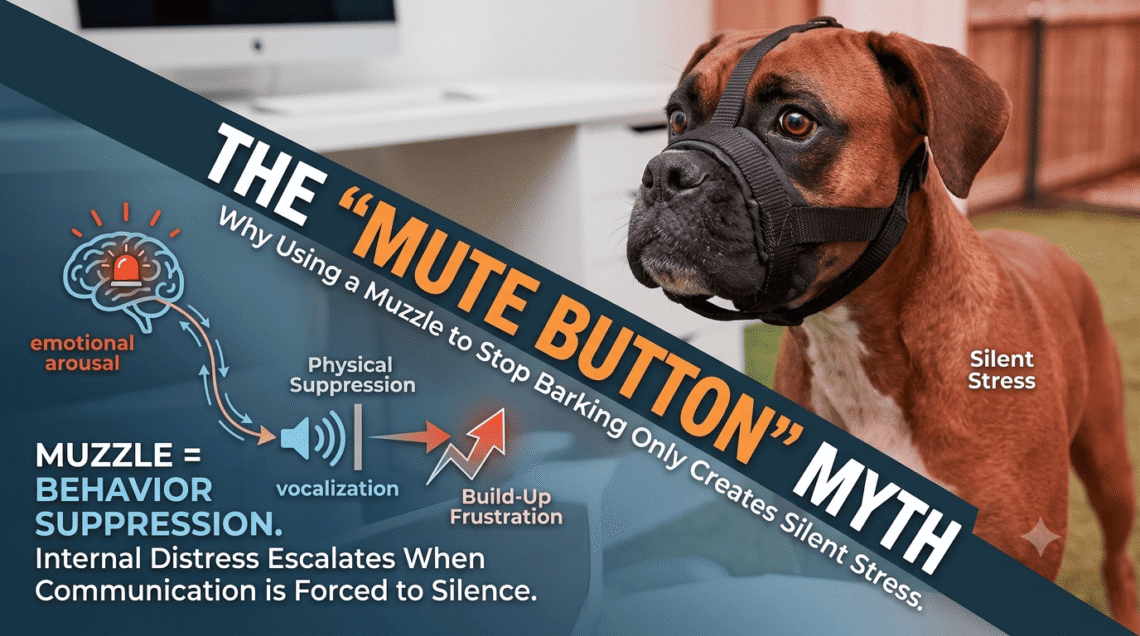
Introduction: The Logic That Feels Obvious — But Breaks in Reality
At first glance, the syllogism seems flawless. A dog barks using its mouth; a muzzle securely covers the mouth; therefore, a muzzle must stop barking. This intuitive, linear chain of logic is exactly why thousands of frustrated pet parents search for the “best muzzle to stop barking” every year. It feels like a quick, mechanical fix for a loud, stressful problem.
However, veterinary behaviorists and certified canine experts consistently point out that this assumption represents a fundamental misunderstanding of both canine physiology and humane dog training.
The True Purpose of a Canine Muzzle
In veterinary medicine, a muzzle is strictly categorized as a temporary safety tool designed to prevent biting, not as a behavioral suppression device. Authoritative bodies—including the Cornell University College of Veterinary Medicine and the American Kennel Club (AKC)—maintain strict protocols on muzzle utility. They are engineered for short-term, supervised management during high-stress, acute scenarios, such as:
- Emergency veterinary triage
- Necessary grooming sessions for reactive dogs
- Gradual, supervised socialization under the guidance of a behaviorist
Using a muzzle as a tool for permanent noise control violates the core principles of animal welfare. In fact, keeping a dog muzzled for extended periods to stop barking can lead to severe health crises, including heatstroke. Because dogs rely on panting to regulate their body temperature, restricting their jaws with an ill-fitted or restrictive sleeve muzzle can be fatal.
Barking is a Symptom, Not the Root Cause
The critical flaw in the “muzzle equals silence” theory is the failure to recognize that barking is a behavioral output driven by internal emotional states. It is a complex form of canine communication triggered by:
- Separation anxiety and distress
- Territorial frustration or fear-based reactivity
- Boredom and lack of mental stimulation
Even when a specialized basket muzzle allows a dog to safely pant, sip water, and take treats, it does absolutely nothing to alter the external stimulus or internal anxiety driving the behavior.
In practice, forcing a dog into a physical restriction while they are over the threshold does not solve the issue—it exacerbates it. A highly stressed dog will simply redirect their panic, resulting in muffled frantic barking, whining, self-harm, or an escalation into deeper aggression once the tool is removed.
This vast chasm between mere physical restriction and genuine behavioral resolution is where the “quick-fix” misconception utterly breaks down—and it is precisely where the dangerous misuse of muzzles begins.
What Veterinary Sources Actually Say About Muzzles
To evaluate whether a muzzle can truly “stop barking,” we must look at how the world’s leading veterinary authorities define the tool. Across veterinary medicine, clinical behavioral science, and certified dog training organizations, there is an absolute consensus: a muzzle is a temporary safety device, never a behavior modification tool.
Major regulatory and educational bodies, such as the American Kennel Club (AKC) and the American Veterinary Society of Animal Behavior (AVSAB), emphasize that a muzzle’s primary objective is risk mitigation—specifically, preventing bites during acute, high-stress events.
The Core Purpose: Short-Term Management vs. Long-Term Training
According to official AKC veterinary guidance, muzzles are indicated for short-term management in highly specific, supervised scenarios:
- Emergency Medical Triage: When an injured or painful dog may bite out of self-defense.
- Stressful Handling: During necessary veterinary examinations or grooming sessions for reactive dogs.
- Public Safety Compliance: As a proactive measure in jurisdictions with breed-specific legislation (BSL) or during controlled behavioral modification sessions.
Using a muzzle to suppress an ongoing, daily behavioral issue like nuisance barking or separation anxiety completely misinterprets its engineering and purpose.
The Anatomy of a Humane Muzzle: Why Physical Restriction is Dangerous
The most critical distinction in canine welfare is the difference between a basket muzzle and a fabric/sleeve muzzle.
| Muzzle Type | Allowed Mechanics | Intended Use | Safety Level for Barking |
|---|---|---|---|
| Basket Muzzle (Wire, Plastic, or Biothane) |
Panting, drinking water, taking treats, yawning. | Veterinary visits, grooming, reactivity training. | Safe for breathing, but ineffective at stopping vocalization. |
| Fabric / Sleeve Muzzle (Nylon or Mesh) |
Holds the jaw completely shut; prevents all mouth movement. | Ultra-short veterinary procedures (under 5 minutes). | Highly Dangerous. Induces severe stress and risks heatstroke. |
Expert resources from the Cornell University College of Veterinary Medicine highlight that a properly fitted basket muzzle must allow a dog to pant fully. Panting is not just a casual action; it is a dog’s primary mechanism for thermoregulation (cooling down) and stress dissipation.
Because a humane basket muzzle leaves the jaw free to move, it reveals the fundamental flaw in the “mute button” theory. If a properly fitted, safe muzzle still allows a dog to pant heavily, whine, drink water, and emit muffled vocal sounds, then the belief that a muzzle creates absolute silence is anatomically and technically false.
The Consequence of Silencing: Shifting the Stress Response
When owners turn to restrictive nylon mesh muzzles to force silence, they inadvertently trigger severe physiological and psychological distress.
Veterinary Consensus: Preventing a dog from opening its mouth to bark or pant does not extinguish the underlying emotional trigger—such as fear, territorial aggression, or severe isolation distress. Instead, it creates a pressure-cooker effect.
By taking away a dog’s primary method of communication (vocalizing) and their coping mechanism (panting), the animal’s arousal levels skyrocket. Veterinary professionals warn that this lack of a behavioral outlet often causes the dog to escalate down the “canine ladder of aggression,” shifting from barking to more dangerous, silent behaviors like lunging, biting, or self-mutilation once the physical restraint is removed.
Ultimately, using a muzzle as a noise-control device is the behavioral equivalent of putting a piece of tape over a car’s blinking “Check Engine” light. It hides the immediate symptom from view while the engine underneath continues to overheat.
Can Dogs Actually Bark With a Muzzle On?
The definitive, evidence-based answer is yes: dogs can absolutely bark while wearing a muzzle. The widespread belief that applying a muzzle instantly induces total silence is a myth that fails real-world application.
How effectively a dog can vocalize—and how much damage is done to their emotional well-being—depends entirely on the engineering of the device and the mechanical limitations placed on the canine jaw.
Basket Muzzles: Why Vocalization Safely Persists
Basket muzzles (constructed from hard plastic, wire, or flexible Biothane) are universally recommended by veterinary behaviorists because they prioritize canine welfare. Because a basket muzzle must be spacious enough to allow a dog to pant normally, it leaves the jaw free to move vertically.
Consequently, a basket muzzle does not eliminate sound; it merely modifies it. When a dog attempts to bark inside a basket muzzle, you can expect the following outcomes:
- Muffled Volume: The physical frame breaks up the sound waves, reducing the sharpness and volume of the bark, but the noise persists.
- Mechanical Adjustments: Dogs quickly learn to adjust their jaw mechanics within the basket frame, allowing them to open their mouths wide enough to emit alert or demand barks.
- Uninhibited Vocalization: Because the vocal cords and airway are entirely unobstructed, triggers like a passing delivery truck or a stranger will still result in immediate, audible vocalization.
Soft/Fabric Muzzles: The Dangerous Illusion of Silence
Nylon, mesh, or fabric sleeve muzzles operate on a fundamentally different—and far more restrictive—design. They are engineered to wrap tightly around the dog’s snout, clamping the maxilla (upper jaw) and mandible (lower jaw) together to prevent any mouth movement.
While these fabric sleeves can severely limit a dog’s physical ability to emit a full-throated bark, they introduce catastrophic welfare risks and still fail to guarantee absolute silence:
- The High Risk of Asphyxiation and Heatstroke: Because dogs lack sweat glands across their bodies, they rely almost exclusively on panting for thermoregulation. Clamping a dog’s mouth shut for extended periods—especially when the dog is highly aroused, anxious, or hot—prevents them from cooling down. This can trigger a rapid, life-threatening medical emergency.
- Alternative Vocal Strains: Even when a dog’s jaws are pinned together, the internal emotional drive to communicate remains unextinguished. Dogs under this high level of restraint will continuously emit high-pitched whining, stressed whimpering, nasal growling, and guttural vocal strains.
The Neurobiology of the Bark: Why the Urge Persists
To understand why a muzzle cannot function as a “mute button,” one must look at the neurobiology of canine communication. Barking is not a localized, mechanical glitch of the mouth; it is a full-body behavioral output driven by the central nervous system.
When a dog encounters an environmental trigger (such as an intruder, a separation trigger, or a frightening stimulus), the brain’s amygdala fires, flooding the dog’s system with adrenaline and cortisol. This emotional state demands a behavioral release.
| What Changes With a Muzzle | What Remains EXACTLY the Same |
|---|---|
| Acoustic volume and sound clarity | The internal emotional arousal and panic |
| The physical range of motion of the jaw | The neurological urge to vocalize |
| The efficiency of the canine warning system | The environmental trigger causing the stress |
If a dog is highly motivated by fear or territorial instinct, physical restriction will not stop the attempt to bark. The dog will continue to thrust their body forward, strain their vocal cords, and experience escalating internal panic, because the root cause of the behavior remains entirely unaddressed.
Key Takeaway: A muzzle is an acoustic baffle, not a behavioral cure. Depending on the design, it may muffle the frequency or slightly restrict the jaw, but it cannot override a dog’s neurological imperative to communicate.
Why the “Muzzle = Silence” Idea Is Scientifically Wrong
The deeply flawed belief that a muzzle should automatically guarantee silence stems from an oversimplified, purely mechanical assumption: block the mouth, block the bark. However, modern veterinary behavior science completely refutes this. Barking is not an isolated mechanical reflex; it is a motivated emotional behavior initiated and regulated by the central nervous system, not just the jaw.
In peer-reviewed veterinary literature, barking is classified as a complex canine communication system. The mouth is merely the final, physiological output channel for a profound, widespread neurological event happening inside the dog’s brain.
Barking Starts in the Brain, Not the Mouth
When a dog encounters an environmental stimulus—such as a delivery driver approaching the porch, a passing dog, or the closing of a front door—the brain’s sensory systems immediately shunt this data to the amygdala and the limbic system.
Depending on the context and the individual dog’s genetics and past experiences, the brain instantly evaluates the trigger through an emotional lens, rapidly generating states of fear, threat perception, overstimulation, territorial protection drives, or isolation distress.
Once these internal states are activated, the brain triggers the hypothalamic-pituitary-adrenal (HPA) axis, flooding the dog’s bloodstream with cortisol and adrenaline. This chemical cascade demands a behavioral release. Barking is simply the primary vocal pathway the canine body uses to express and attempt to alleviate this intense internal pressure.
Applying a muzzle does absolutely nothing to stop this internal chemical and neurological storm. It does not reduce fear, it does not soothe excitement, and it does not remove the instinctual drive to protect territory. It merely attempts to build a wall at the final inch of the behavioral pipeline.
The Central Flaw: Emotional Arousal Remains Untouched
Because a muzzle only interferes with the final physical expression of a vocalization, it leaves the dog’s internal processing completely altered for the worse. Even if a highly restrictive muzzle limits how wide a dog can open its jaws, the animal continues to experience tachycardia (elevated heart rate), acute hypervigilance, and intense frustration escalation.
Because the behavior is still fully “active” and burning inside the nervous system, forcing physical restriction without addressing the emotion creates a psychological pressure-cooker. The dog does not look at the trigger and think, “I am wearing a muzzle, so I will be calm.” Instead, they think, “The threat is still here, I am terrified, and now I cannot defend myself or communicate.”
Why the Learning Cycle Persists Despite Physical Barriers
In the framework of operant conditioning, behaviors are repeated because they serve a functional purpose or yield a specific consequence. For a reactive or anxious dog, barking is a highly functional tool:
Trigger (Stranger Arrives) → Behavior (Barking) → Consequence (Stranger Leaves/Mailman Walks Away)
In the dog’s mind, their bark successfully drove the “intruder” away, deeply reinforcing the behavior. A muzzle entirely fails to interrupt this learning cycle. Even while wearing a basket muzzle, the dog can still see the trigger, experience the surge of fear, and attempt the vocal response. When the source of stress moves away, the dog’s brain registers a successful defense. The internal motivation to bark remains entirely intact and unchanged for the next encounter.
Scientific Takeaway: From a clinical behavioral standpoint, a muzzle is an acoustic and physical baffle, not a neurological off-switch. It alters the acoustic output and compromises jaw efficiency, but it leaves 90% of the behavioral loop fully operational. Trying to fix a complex, anxiety-driven vocalization issue with a muzzle is the behavioral equivalent of treating a fever by breaking the thermometer.
What Happens When You Use a Muzzle to Stop Barking
Using a muzzle with the expectation that it will “fix” or cure barking invariably leads to results that clash sharply with an owner’s intent. Instead of resolving the underlying issue, it simply forces a highly active, emotional behavior into a state of physical suppression.
Veterinary behaviorists consistently warn that using a safety device to forcibly suppress communication induces severe, unintended behavioral side effects. When you try to use a muzzle as a mute button, the following four clinical outcomes typically occur:
Behavior is Suppressed, Not Solved
In animal behavior, there is a vast difference between a dog that is calm and a dog that is suppressed. When a muzzle prevents a dog from fully vocalizing, the internal behavioral loop remains fully operational. The dog still detects the environmental trigger, processes the intense emotional arousal, and attempts to execute a behavioral survival response.
Because the final mechanical step (the bark) is blocked, the behavioral loop cannot reach completion. Over time, this creates a profound buildup of unresolved frustration. Denying an animal the ability to complete a natural response to a perceived threat or stressor leaves the nervous system trapped in a perpetual state of fight-or-flight.
Escalation of Stress and Internal Displacement
When a natural behavioral outlet is physically blocked, the underlying emotional energy does not just disappear—it displaces. If a dog is highly fearful or territorial but cannot utilize its natural warning signals (like barking or growling), its internal stress levels skyrocket.
This trapped emotional arousal routinely manifests as silent stress indicators or displaced frantic behaviors: intense body tension, trembling, chronic pacing, or frantic whining. Worse, this intense, bottled-up frustration frequently creates a rebound effect. The moment the muzzle is removed, the dog’s reactivity to the same triggers is often significantly intensified and far more explosive.
Masking the Real Behavioral Pathology
One of the most dangerous risks highlighted by the American Veterinary Society of Animal Behavior (AVSAB) is the illusion of improvement. When an owner applies a tight muzzle, the immediate acoustic volume decreases. To the untrained eye, it looks like the problem is solved. However, this is merely a cosmetic fix. Because the underlying separation anxiety, systemic fear, or lack of socialization is left completely untreated, the psychological pathology continues to rot beneath the surface. Masking the symptom allows the true behavioral disease to worsen entirely unnoticed.
Sensitization and Worsening of Long-Term Reactivity
When a dog is repeatedly exposed to things that terrify or anger them while trapped in a physical restraint, a neurological process called sensitization occurs. Instead of getting used to the trigger (desensitization), the dog becomes more sensitive and reactive to it over time. Because the dog associates the appearance of the trigger with the distressing physical restriction and frustration of the muzzle, the trigger becomes even more threatening. This often leads to severe behavioral regression, making the dog highly volatile when they are unmuzzled.
| Expected Outcome | Actual Scientific Reality |
|---|---|
| A calm, quiet, and relaxed dog. | A terrified or frustrated dog in a state of silent stress. |
| A long-term resolution to nuisance barking. | A temporary mechanical block that masks worsening psychological trauma. |
| A well-behaved pet around triggers. | An increasingly sensitized animal at a higher risk for explosive reactivity. |
Ultimately, a muzzle does not produce peace; it produces a physical blockade. Instead of cultivating a behaviorally healthy, quiet dog, it creates an animal suffering from silent, unexpressed panic.
What a Muzzle Is Actually Designed For
To fully dismantle the “muzzle equals silence” myth, we must return to the foundational principles of veterinary equipment design. Veterinary professionals and certified applied animal behaviorists are universally aligned on this definition: a muzzle is a temporary safety management tool, not a behavior modification device. Its entire engineering is optimized for risk mitigation and injury prevention during acute, high-stress events—not for emotional regulation, noise reduction, or the suppression of canine communication.
Primary Purpose: Acute Bite Prevention, Not Behavior Control
The sole biological and mechanical purpose of a muzzle is to eliminate the risk of a bite when a dog is forced past their emotional threshold. It is an engineering barrier designed to protect human handlers and the dog themselves during short-term, high-stakes handling.
According to standard veterinary safety protocols, proper indications for a muzzle include emergency medical triage, intrusive grooming procedures, or as a proactive safety net for certified trainers working directly with dog-reactive or people-aggressive animals. In all these scenarios, the objective is immediate safety. The tool is applied with the explicit understanding that it will not alter the dog’s long-term behavior or underlying emotional state.
Why Safety Matters More Than Silence
A common error among pet owners is viewing canine warning signals—such as barking, low growling, or lip-curling—as “bad behaviors” that need to be silenced. In reality, these are vital, adaptive communication signals. A muzzle is specifically designed not to erase these warning signs. Instead, it acts as a passive safety layer. When a dog wears an anatomically correct basket muzzle, they are intentionally left with the physical freedom to pant freely, hydrate, and take high-value treats to safely build positive conditioned associations.
A Temporary Tool, Not a Lifestyle Solution
A foundational rule across all major veterinary and animal welfare organizations—including the American Veterinary Medical Association (AVMA)—is that muzzles are engineered exclusively for short-term, fully supervised periods. They are fundamentally contraindicated for daily barking control, unsupervised restraint, or convenience-based management. Using a muzzle as a prolonged lifestyle solution completely subverts its intended engineering and crosses the line into a severe animal welfare violation.
What a Muzzle Does NOT Do
To clear up any remaining confusion for search engines and pet owners alike, it is vital to explicitly state what a muzzle cannot do: it does NOT calm anxiety, it does NOT reduce fear, it does NOT teach alternative behaviors, and it does NOT fix underlying reactivity.
Key Takeaway: A muzzle is best understood as the canine equivalent of a car’s airbag. It is a highly specialized safety device designed to prevent catastrophe during a crisis. Expecting a muzzle to cure a dog’s nuisance barking is like expecting an airbag to teach a person how to be a better driver.
Why Dogs Still Communicate Even With a Muzzle
The ultimate flaw of the “muzzle equals silence” myth lies in the reductionist assumption that vocalization is a dog’s primary method of expression. In canine behavioral science, barking is recognized as just one acoustic component of an incredibly sophisticated, multi-channel communication system. When a muzzle is applied, it acts as a filter on a single output channel—it does not hit pause on the dog’s desire or ability to communicate.
Barking is Only One Variable in a Complex System
Canids are primarily visual and olfactory communicators; they speak far more with their bodies than with their vocal cords. When an owner focuses solely on suppressing a bark, they miss an entire symphony of canine body language signals (such as wide “whale eyes”, pinned or forward ears, rigid flag tails, or a rock-hard frozen posture) that indicate a dog is reaching its breaking point.
A Muzzle Cannot Mask Emotional Expression
Because a muzzle cannot alter the central nervous system, a dog’s true emotional state remains completely legible to anyone trained in canine behavioral reading. The tool cannot sanitize or hide panic. Forcing a muzzle onto an anxious dog does not create a calm dog; it creates a dog that is trembling, hyperventilating, and throwing off intense displacement behaviors like frantic lip-licking or yawning within the basket frame.
The Communication Shift: Escalating Alternative Signals
In behavioral psychology, when an animal’s primary method of communication is physically blocked, they don’t stop trying to communicate. Instead, they shift to a different channel, often increasing the intensity of their alternative signals. If the bark is muffled, you will often observe intensified body fixation, profound postural lunging against the leash, or alternative acoustic strains like high-pitched nasal whining or low, closed-mouth guttural growling.
The Danger of Misreading “Silent Stress”
The greatest safety hazard of using a muzzle for noise control is that it induces a false sense of security in the owner. When the barking stops, humans naturally assume the danger or distress has passed. Veterinary behaviorists refer to this as a dangerous misreading of silent stress.
| What an Untrained Owner Sees | What a Veterinary Behaviorist Sees |
|---|---|
| A quiet, still dog wearing a muzzle. | A dog in a state of high behavioral suppression and acute stress. |
| A behavioral issue that is “fixed.” | Early warning signs being ignored, increasing the risk of an explosive reaction later. |
| A dog that is “calming down.” | A dog whose communication has been artificially bottlenecked. |
Key Takeaway: A muzzle is an acoustic baffle, not a communication blackout. It suppresses a single vocal channel while leaving the dog’s emotional, neurological, and physical signaling completely intact. To look at a quiet, muzzled, terrified dog and declare them “cured” is a failure to understand the baseline language of the domestic dog.
Proper Training and Responsible Muzzle Use
Once the foundational myth is shattered—confirming that a muzzle is a temporary safety barrier rather than an acoustic volume knob—we can pivot to clinical best practices. In modern veterinary medicine and force-free behavior modification, a muzzle is a collaborative safety tool. It must never be used as a punishment, forced onto an over-threshold animal, or deployed as a shortcut for genuine behavioral training.
Responsible, ethical muzzle utilization is built entirely upon systemic training, anatomical precision, and precise contextual application.
The Clinical Foundation: Desensitization and Counter-Conditioning
Forcing a highly aroused or anxious dog into a physical restraint without preparation triggers a massive spike in cortisol and can cause permanent conditioned aversion to the tool. Ethical usage requires a structured protocol of desensitization and counter-conditioning (DS/CC). The goal is to change the dog’s emotional response so they view the muzzle as a high-value treat delivery system rather than a trap.
Anatomical Precision: Choosing and Sizing the Tool
Using the wrong muzzle design or an incorrect size is one of the leading causes of physical injury and acute distress in domestic dogs. For any application lasting longer than a few minutes, a well-ventilated basket muzzle (constructed from injection-molded plastic, wire, or flexible Biothane) is mandatory. Fabric, nylon, or mesh sleeve muzzles should be reserved exclusively for ultra-short veterinary emergencies where the dog’s life is in immediate danger.
Critical Checkpoints for a Humane Muzzle Fit include ensuring full pant room clearance for respiratory cooling, maintaining roughly 0.5 inches of length clearance from the tip of the nose to avoid ulcerations, and checking that the top frame does not press into the delicate eye orbits.
Baskerville Ultra Basket Muzzle
Designed by veterinarians, this lightweight rubber basket muzzle provides optimal panting room, allowing your dog to breathe, drink, and accept rewards comfortably during desensitization training.
Check Price on AmazonDean & Tyler Wire Basket Muzzle
Engineered from chrome-plated wire for maximum structural integrity and continuous ventilation. Ideal for large, high-arousal or dog-reactive breeds requiring a reliable safety layer.
View Options on AmazonStrict Operational Boundaries: Short-Term and Supervised
Even a dog perfectly conditioned to a basket muzzle must never be left in the device indefinitely. Leading welfare organizations maintain rigid operational guardrails: a muzzle must only be worn for short, defined intervals during active supervision. It is strictly contraindicated for unsupervised use, crate management, or daily household noise control. Leaving a muzzled dog unattended introduces immediate risks of asphyxiation, fatal choking, or severe facial injury from pawing at the basket.
Better Alternatives to Stop Excessive Barking
If a muzzle is not a solution for barking, the real question becomes: what actually works? Veterinary behavior science is very clear on this point—excessive barking is a symptom, not the root problem. So effective solutions focus on identifying and changing the cause, not blocking the sound.
Identify the Real Trigger Behind Barking
Before any training begins, the first step is understanding why the dog is barking. Common triggers include:
- Fear or anxiety (strangers, loud noises, separation)
- Territorial behavior (people or dogs near home)
- Boredom or lack of stimulation
- Excitement or overstimulation
- Attention-seeking behavior
Without identifying the trigger, any solution becomes temporary at best.
Desensitization (Reducing Emotional Reaction)
Desensitization works by gradually exposing the dog to the trigger at a low intensity until it no longer causes a strong emotional response. For example, if a dog reacts to strangers, you start with distance exposure. Slowly reduce that distance over time, and reward calm behavior throughout the process. This helps reduce the emotional “charge” that drives the barking cascade.
Counter-Conditioning (Changing Emotional Association)
Instead of only reducing the physical reaction, counter-conditioning completely changes how the dog structurally feels about the trigger. For example, the moment a stranger appears, the dog receives a high-value treat. Over time, the dog constructs a completely new connection pathway: stranger = positive association instead of a threat. This directly targets the emotional root of barking behavior.
Enrichment and Mental Stimulation
Many chronic barking problems come from under-stimulated dogs looking to burn off mental energy. Helpful solutions include:
- Puzzle feeders and interactive food games
- Scent-based activities and nosework games
- Structured play sessions
- Regular walks with variation in the environment
A mentally engaged dog is significantly less likely to bark from sheer boredom or daily frustration.
Physical Exercise and Routine Stability
Dogs with excess energy often express it through structural vocalization. Improving daily exercise consistency, ensuring predictable routines, and establishing structured rest periods can significantly reduce stress-based barking over time.
Reinforcing Quiet Behavior (Not Punishing Barking)
Modern force-free training focuses on rewarding the exact behavior you want, not punishing the behavior you dislike. For example, when your dog stays quiet in the presence of a mild stimulus, reward them immediately. When the dog chooses a calm state, give them focused attention and praise. This builds deep clarity in communication without increasing environmental stress.
When Professional Help Is Necessary
Some barking cases are linked to deeper, systemic behavioral pathologies such as severe separation anxiety, intense reactivity, or trauma-based fear responses. In these cases, working alongside a qualified, force-free trainer or a board-certified veterinary behaviorist is often the safest, most effective path to sustainable improvement.
Key Takeaway: Excessive barking is not a “mouth problem.” It is a behavioral and emotional problem. Real solutions focus on understanding triggers, changing emotional responses, improving the environment, and teaching alternative behaviors—not physically blocking the sound waves.
Conclusion: Breaking the “Muzzle Equals Silence” Myth
The idea that “a dog barks with their mouth, a muzzle closes the mouth, therefore a muzzle creates silence” feels logical at first glance—but it falls apart once you look at how dog behavior actually works.
Barking is not simply a mechanical action of the mouth. It is the end result of a deeper chain that starts in the brain: emotion, arousal, instinct, and environmental triggers all come together before a dog ever vocalizes. A muzzle only interacts with the final step of that chain. It does not change what the dog feels, what the dog is reacting to, or why the behavior is happening in the first place.
That is why dogs may still try to bark, whine, or communicate even when wearing a muzzle. And it is also why relying on a muzzle as a “silencing tool” misunderstands both the purpose of the device and the nature of the behavior.
A muzzle, when used correctly, is a temporary safety tool. Its role is to reduce risk in specific situations like veterinary care, grooming, or handling moments where safety is a priority. It is not designed to train behavior, suppress communication, or solve underlying emotional triggers.
When people expect silence from a muzzle, the real risk is not just disappointment—it is misdiagnosis of the problem. A dog that is still fearful, anxious, overstimulated, or reactive needs guidance, training, structure, and sometimes professional support. Simply blocking the sound does not address any of these root causes.
In the end, the truth is simple:
- A muzzle does not equal silence.
- It equals management—not resolution.
Understanding this difference is what leads to better training decisions, safer handling, and ultimately a healthier relationship between dogs and their owners.
Frequently Asked Questions
Absolutely not. Leaving a dog muzzled and unsupervised is a critical animal welfare hazard. If the dog attempts to vomit or overheats while you are away, it can result in immediate asphyxiation or fatal heatstroke. It is never a lifestyle solution for apartment barking.
No. Whining and whimpering require very little vertical jaw movement. Because a basket muzzle keeps airways fully unrestricted for safety, a distressed, fearful, or anxious dog will still be able to whine or emit vocal strains continuously.
Your dog must be able to open their mouth wide inside the basket to pant fully and lap water. There should be a half-inch gap between the end of the nose and the muzzle tip, and the top straps should never press directly into the delicate eye sockets.